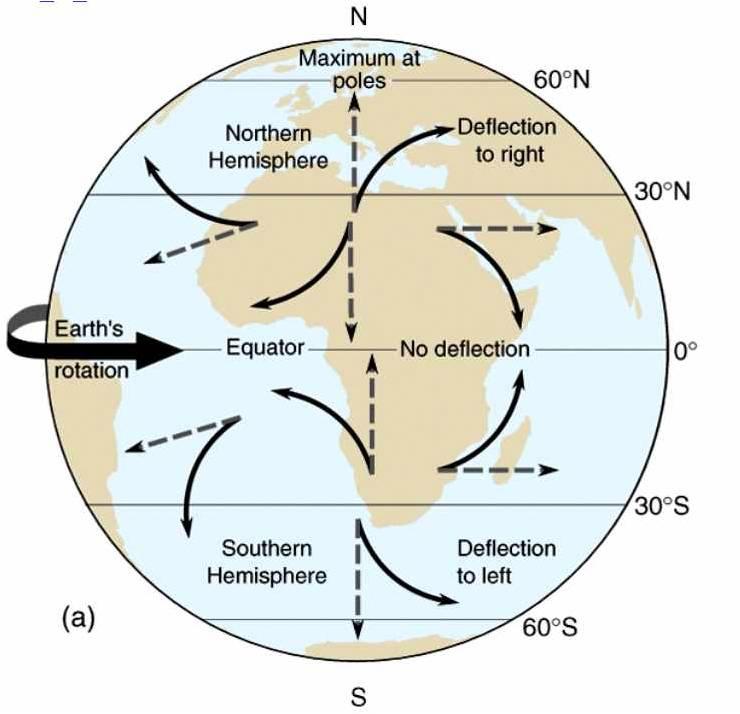

Q. With reference to “Coriolis force”, which of the following statements is/are correct?
- It increases with increase in wind velocity.
- It is maximum at the poles and is absent at the equator.
Select the answer using the code given below:
- 1 only
- 2 only
- Both 1 and 2
- Neither 1 nor 2
Answer: (c) Both 1 and 2
Coriolis Force
- The rotation of the earth about its axis affects the direction of the wind. This force is called the Coriolis force after the French physicist who described it in 1844.
- It deflects the wind to the right direction in the northern hemisphere and to the left in the southern hemisphere. The deflection is more when the wind velocity is high.
- The Coriolis force is directly proportional to the angle of latitude. It is maximum at the poles and is absent at the equator.
- The Coriolis force acts perpendicular to the pressure gradient force. The pressure gradient force is perpendicular to an isobar. The higher the pressure gradient force, the more is the velocity of the wind and the larger is the deflection in the direction of wind. As a result of these two forces operating perpendicular to each other, in the low-pressure areas the wind blows around it.
- At the equator, the Coriolis force is zero and the wind blows perpendicular to the isobars. The low pressure gets filled instead of getting intensified. That is the reason why tropical cyclones are not formed near the equator.
Coriolis Force and Wind Movement
- Due to the earth’s rotation, winds do not cross the isobars at right angles as the pressure gradient force directs, but get deflected from their original path. This deviation is the result of the earth’s rotation and is called the Coriolis effect or Coriolis force.
- Due to this effect, winds in the northern hemisphere get deflected to the right of their path and those in the southern hemisphere to their left, following Farrell’s Law (the law that wind is deflected to the right in the Northern Hemisphere and to the left in the Southern Hemisphere, derived from the application of the Coriolis effect to air masses).
- This deflection force does not seem to exist until the air is set in motion and increases with wind velocity, air mass and an increase in latitude.
- The Coriolis force acts perpendicular to the pressure gradient force (pressure gradient force is perpendicular to an isobar)
- As a result of these two forces operating perpendicular to each other, in the low-pressure areas the wind blows around it (cyclonic conditions).