
Q. With reference to carbon nanotubes, consider the following statements:
- They can be used as carriers of drugs and antigens in the human body.
- They can be made into artificial blood capillaries for an injured part of the human body.
- They can be used in biochemical sensors.
- Carbon nanotubes are biodegradable.
Which of the statements given above are correct?
- 1 and 2 only
- 2, 3 and 4 only
- 1, 3 and 4 only
- 1, 2, 3 and 4
Answer: (d) 1, 2, 3 and 4
Carbon nanotubes
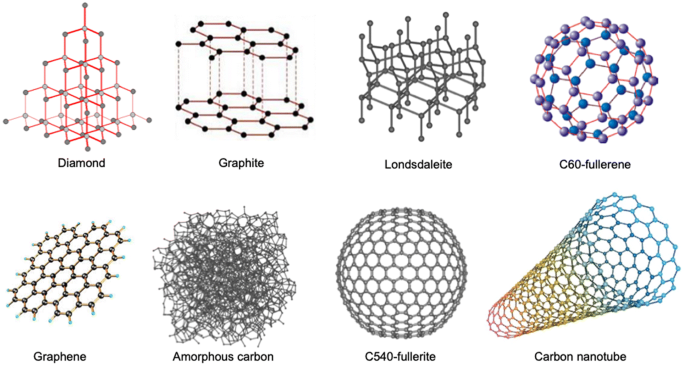
- A carbon nanotube (CNT) is a tube made of carbon with a diameter in the nanometer range (nanoscale). They are one of the allotropes of carbon.
- Carbon nanotubes are cylindrical large molecules consisting of a hexagonal arrangement of hybridized carbon atoms, which may by formed by rolling up a single sheet of graphene (single-walled carbon nanotubes, SWCNTs) or by rolling up multiple sheets of graphene (multiwalled carbon nanotubes, MWCNTs).
- Hence structurally, carbon nanotubes (CNTs) can be viewed as wrapped from graphene sheets.
- Carbon nanotubes were once considered to be resistant to chemical damage due to their rigid and perfect chemical structure, which rendered them immune to biodegradation. However, enzymes like peroxidase were found to play an important role in the process of biodegradation of carbon nanotubes.
- Carbon nanotubes can exhibit remarkable properties, such as exceptional tensile strength and thermal conductivity because of their nanostructure and strength of the bonds between carbon atoms.
- Carbon nanotubes are extremely robust and difficult to break, but they are still light. Because of their exceptional mechanical, electrical, and thermal properties, carbon nanotubes are one of the most investigated nanomaterials.
- Carbon Nanotubes Uses & Applications
- Carbon nanotubes are utilized in energy storage, device modelling, automotive parts, boat hulls, sporting goods, water filters, thin-film electronics, coatings, actuators, and electromagnetic shields.
- Because of their large surface area, CNTs have been successfully used in pharmacy and medicine to adsorb or conjugate a wide range of medicinal and diagnostic substances.
- CNTs have a number of unique chemical, size, optical, electrical, and structural properties that make them appealing as drug delivery and biosensing platforms for the treatment of a variety of diseases and noninvasive monitoring of blood levels and other chemical properties of the human body, respectively.
- Carbon nanotubes (CNTs) have unique qualities, such as high surface-to-volume ratios, increased conductivity and strength, biocompatibility, ease of functionalization, optical properties, and so on.