

Q. Which one of the following National Parks has a climate that varies from tropical to subtropical, temperate, and arctic?
- Khangchendzonga National Park
- Nadadevi National Park
- Neora Valley National Park
- Namdapha National Park
Answer: (d) Namdapha National Park
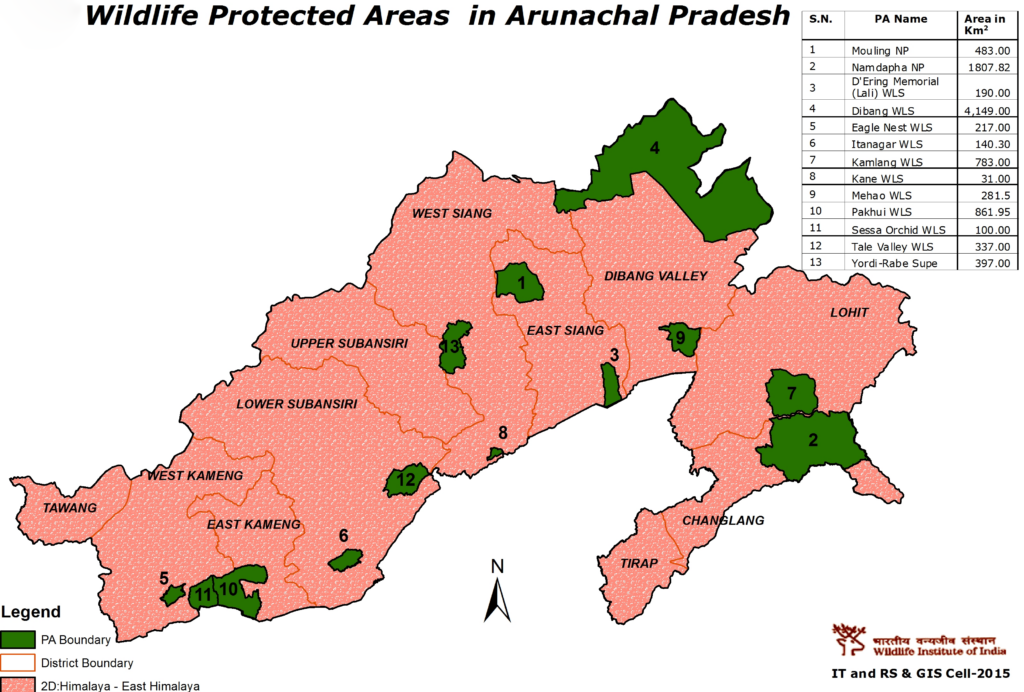
Namdapha National Park
- In 1972, Namdapha was designated as a wildlife sanctuary. In 1983, it was designated as a tiger reserve and a national park. It is on the tentative list of UNESCO World Heritage Sites in India.
- It is the easternmost biodiversity hotspot in the eastern Himalayas with over 1400 faunal species and 1000 floral species.
- There are altitudinal variations which can range from 200 m to 4500 m at Dapha Bum – the highest point.
- It is the only park in the world to have four feline species of big cat namely – tiger (Panthera tigris), leopard (Panthera pardus), clouded leopard (Neofelis nebulosa) and snow leopard (Panthera uncia) and a number of lesser cats.
- The region is very rich in Lepidoptera species. Both butterflies and moths are in equal abundance.
- A number of primate species are seen in the park, such as the Assamese macaque, pig-tailed macaque, stump-tailed macaque and a number of the distinctive Hoolock Gibbons (Hylobates Hoolock), a highly endangered and the only ‘ape’ species found in India dwells in this impenetrable virgin forest.
- Of the many other important animals are the elephants, black bears, Indian Bison, several species of deer, reptiles and a variety of arboreal animals.
- The park has more than 425 bird species. There are five species of hornbills recorded from the area.
- There are more than 150 timber species. The Pinus merkusii and Abies delavavi are not found elsewhere in India.
- One of the rarest and endangered orchids, the Blue Vanda is found here.
- The most famous local medicinal plant Mishimi Teeta (Copti teeta), which is used by the local tribe for various diseases is available here but its export has been banned.
Neora Valley National Park
- It is located on the Himalayas in Kalimpong district, West Bengal.
- It is the land of Red Panda (EN).
- Vegetation: Himalayan Broadleaf forests.
- Major Flora: Rhododendron, bamboo, oak, ferns, sal.
- Major Fauna: Indian leopard, black bear, sloth bear, golden cat, barking dee, Himalayan flying squirrel, thar.
- It is linked to Pangolakha Wildlife Sanctuary of Pakyong District as well as forests of Samtse District, Bhutan via thick cover of forests.
Nadadevi National Park
- Nanda Devi National Park or Nanda Devi Biosphere Reserve, established in 1982 is a national park situated around the peak of Nanda Devi (7816 m) in Chamoli Garhwal district of Uttarakhand.
- National Park was inscribed a World Heritage Site by UNESCO in 1988. It was later expanded and renamed as Nanda Devi and Valley of Flowers National Parks in 2005. Together they encompass a unique transition zone between the mountain ranges of the Zanskar and Great Himalaya.
- Seven endangered mammal species find refuge in the area such as the snow leopard (Panthera unica), Himalayan black bear (Selenarctos thibetanus), brown bear (Ursus arctos), musk deer (Moschus chrysogaster) and bharal/blue sheep (Pseudois nayaur).
Khangchendzonga National Park
- Khangchendzonga Biosphere Reserve which is located in Sikkim is one of the highest ecosystems in the world, reaching elevations of 1, 220 metres above sea-level.
- It includes a range of ecoclines (a gradation from one ecosystem to another, with no abrupt boundary between the two), varying from sub-tropic to Arctic, as well as natural forests in different biomes, that support an immensely rich diversity of forest types and habitats.
- Khangchendzonga National Park (KNP) was designated a World Heritage Site in 2016 under the ‘mixed’ category (Mixed heritage sites contain elements of both natural and cultural significance).
- World’s third highest peak, Mt. Khangchendzonga, is situated within the Park. Numerous lakes and glaciers, including the 26 km long Zemu Glacier are a part of the Biosphere reserve.
- Many of the mountains, peaks, lakes, caves, rocks, Stupas (shrines) and hot springs function as pilgrimage sites.
- Over 118 species of the large number of medicinal plants found in Dzongu Valley in north Sikkim are of ethno-medical utility.
- The transition zone of the Biosphere Reserve is targeted for eco-development activities, afforestation, plantation of medicinal herbs and soil conservation measures.
- The core area of the Biosphere Reserve is a major transboundary Wildlife Protected Area and is largely situated in the Greater Himalayas.
- The northern part of the area is characterized by trans-Himalayan features.
- Buffer zones are being developed in the Park to promote eco-tourism activities.
- The six cat species confirmed to have been found are:
- Leopard
- Clouded Leopard
- Snow Leopard
- Jungle Cat
- Golden Cat
- Leopard Cat