
Q. Which of the following leaf modifications occur (s) in the desert areas to inhibit water loss?
- Hard and waxy leaves
- Tiny leaves
- Thorns instead of leaves
Select the correct answer using the code given below:
- 2 and 3 only
- 2 only
- 3 only
- 1, 2 and 3
Answer: (d) 1, 2 and 3
Notes:
- There are some plants that grow in extremely dry conditions throughout the year.
- Structural adaptations are important to plant survival in the desert.
- For this purpose, they undergo some morphological adaptations in the xerophyte stem.
- These are as follows:
- The stems of woody xerophytes are comparatively stunted, hard, and rigid. They may be covered with thick bark. e.g. Acacia arabica.
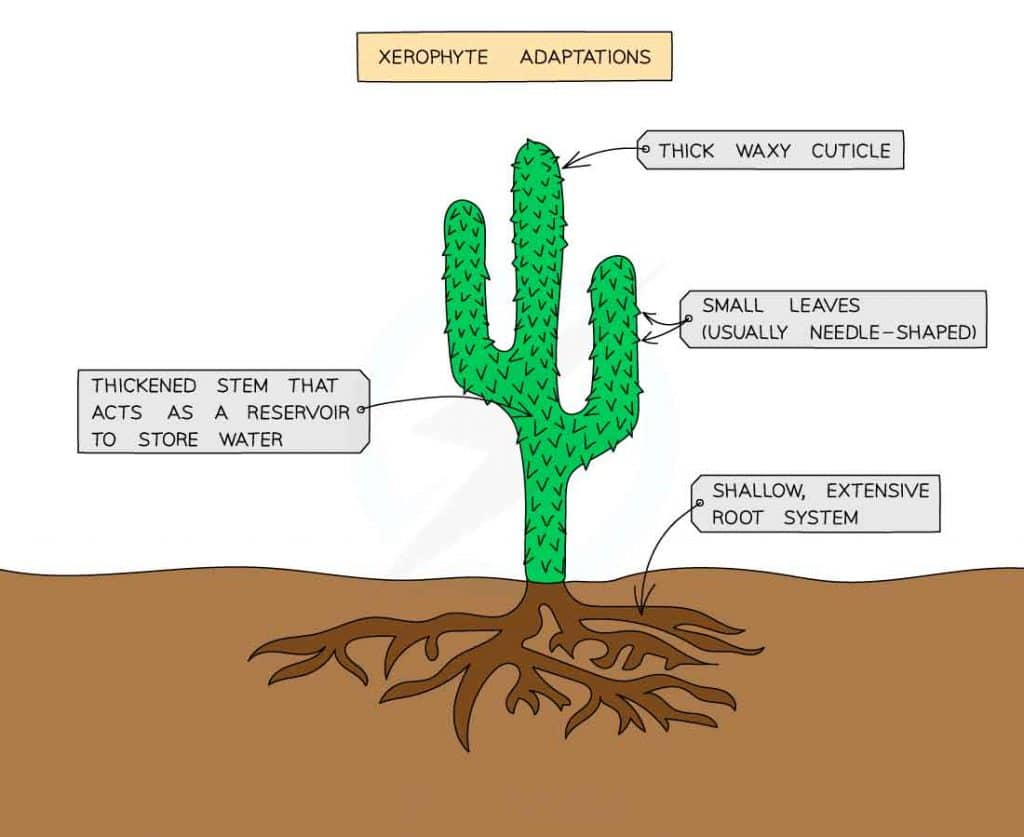
- Wax coatings on leaves prevent water loss through evaporation because the loss of water from both the surface and the inside of leaves occurs in the hot desert.
- The stem is covered by hairs or waxy coating.
- The main stem and branches may occur thick, fleshy, flattened, and have a green modified structure called phylloclade.
- Leaves are also smaller on desert plants, further reducing the possibility of water loss.
- Phylloclades are found in succulent xerophytes. They do photosynthesis. e.g. Opuntia, Cacti etc.
- Usually, in phylloclade bearing xerophytes, leaves are modified into spines that are known to check the rate of transpiration.
- They have hard, thick coatings and some are covered in prickly spines to prevent water loss.
- It is to protect them from animals who might try to chew through them to get to their moisture.
- The stem may occur as an underground modified structure to store food and takes part in reproduction. e.g. Saccharum.