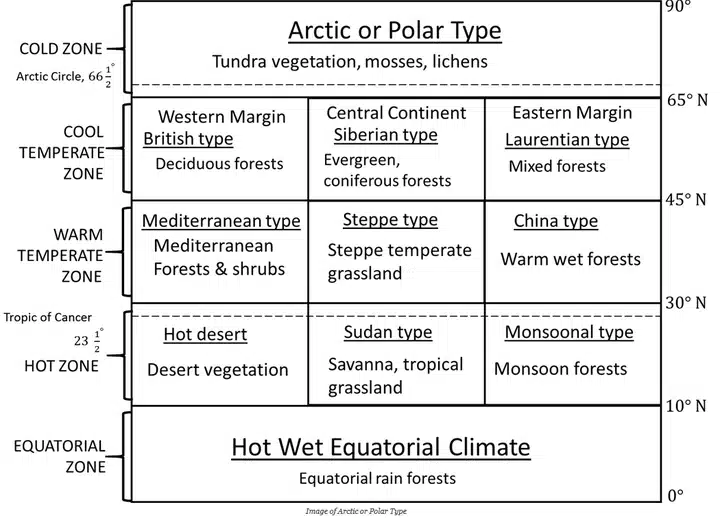

Q. Which of the following is/are unique characteristic/characteristics of equatorial forests?
- Presence of tall, closely set trees with crowns forming a continuous canopy
- Coexistence of a large number of species
- Presence of numerous varieties of epiphytes
Select the correct answer using the code given below:
- 1 only
- 2 and 3 only
- 1 and 3 only
- 1, 2 and 3
Answer: (d) 1, 2 and 3
Equatorial Rainforest Climate
- Equatorial Rainforest Climate is distributed in and around the equator in both hemispheres, as its name suggests.
- The equatorial zone lies between 0 and 10 degrees latitude on either side of the equator.
- It runs from Sumatra to New Guinea in Asia, spanning the Amazon lowlands in South America, the Congo basin in Africa, and the East Indies.
- This region, in other words, covers the continents of South America, Africa, and Asia.
- Equatorial Rainforest Climate is also called the tropical rainforest climate or equatorial climate.
- Features of rainforests are basically the following:
- high animal and vegetal biodiversity
- evergreen trees
- Presence of tall, closely set trees with crowns forming a continuous canopy
- dark and sparse undergrowth interspersed with clearings
- scanty litter (organic matter settling on the ground)
- Presence of numerous varieties of epiphytes
- presence of “strangler” creepers (e.g. Ficus spp.)
- presence of “buttresses” (i.e. large winged ribs at the base of trunks) and spindly roots in trees living in often-flooded areas.
- The area is thought to be a genetic hotspot for a variety of animals.
- Climatic Conditions:
- With an average daily temperature of 28°C, this climate is extremely hot.
- The temperature rarely falls below 20°C and never rises over 35°C.
- The region’s mornings are bright and sunny. In the afternoons, strong convectional rainfall occurs due to the high quantity of evaporation in the region.
- As a result, the region experiences a lot of rain. The yearly rainfall might be as high as 2500mm.
- The temperature is high and the humidity is high.
- The weather is almost constant throughout the year. There are no distinct seasons found here.
- Soil:
- The majority of the soil is deficient in nutrients.
- At the surface, a thin layer of fertile soil forms as the dead leaves decay.
- It is reddish in colour due to its high iron content.
- Nutrients are quickly flushed out of the soil due to excessive rains.
- Wildlife:
- The equatorial region is not only a home to lush and diversified plants but also a shelter to a wide range of wildlife as well.
- Many different animals, birds, and insects are supported by the diverse plant species.
- This region’s fauna include the African elephant and the Jaguar.
- Mountain gorillas, lowland gorillas, chimps, and many bird species all call the Congo basin home.
- Other animals include the poison dart frog, margay, and collared anteater, sloths, toucans, spider monkeys and flying frogs.
Tropical Wet Climate (Af)
- Also known as ‘The Hot, Wet Equatorial Climate’, ‘Equatorial Rainforest Climate’.
- The regions are generally referred to as ‘Equatorial Rainforests’, ‘Equatorial Evergreen Forests’, ‘Tropical Moist Broadleaf Forest’, ‘Lowland Equatorial Evergreen Rainforest’.
- Distribution
- Mostly between 5° N and S of Equator. [little or no Coriolis Force = no tropical cyclones]
- Its greatest extent is found in the lowlands of the Amazon, the Congo, Malaysia, and the East Indies.