

Q. What is “Terminal High Altitude Area Defense (THAAD)”, sometimes seen in the news?
- An Israeli radar system
- India’s indigenous anti-missile programme
- An American anti-missile system
- A defence collaboration between Japan and South Korea.
Answer: (c) An American anti-missile system
Terminal High Altitude Area Defense (THAAD)
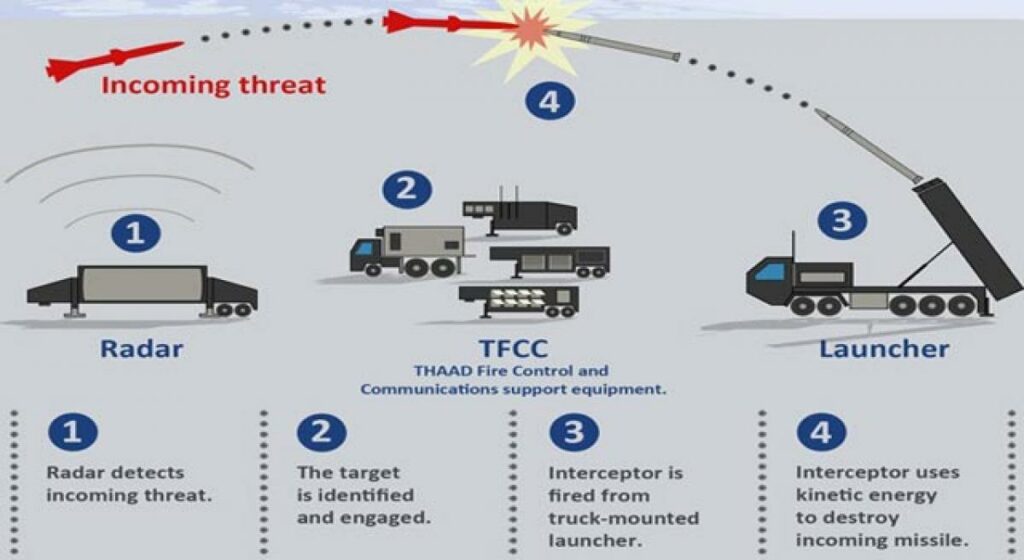
- Terminal High Altitude Area Defense (THAAD), formerly Theater High Altitude Area Defense, is an American anti-ballistic missile defense system designed to shoot down short, medium, and intermediate-range ballistic missiles in their terminal phase (descent or reentry) by intercepting with a hit-to-kill approach.
- THAAD was developed after the experience of Iraq’s Scud missile attacks during the Gulf War in 1991.
- The THAAD interceptor carries no warhead, instead relying on its kinetic energy of impact to destroy the incoming missile.
- THAAD is coupled with space-based and ground-based surveillance stations, which transfer data about the incoming missile and inform the THAAD interceptor missile of the threat type classification.
- This system has been designed and manufactured by the USA company Lockheed Martin.
- It has been previously deployed in the United Arab Emirates (UAE), Guam, Israel, Romania as well.
S-400 Triumf Missiles System
- The S-400 Triumf is a mobile, surface-to-air missile (SAM) system developed by Russia, capable of intercepting and destroying various aerial targets, such as aircraft, drones, cruise missiles, and ballistic missiles.
- The S-400 has a range of up to 400 km, at an altitude of up to 30 km and can engage up to 36 targets simultaneously, with four different types of missiles.
- It is the most dangerous operationally deployed modern long-range SAM (MLR SAM) in the world, considered much ahead of the US-developed Terminal High Altitude Area Defense system (THAAD).
Iron Dome System of Israel
- It is a ground-to-air defence system that comprises radar and interceptor missiles that are capable of tracking and neutralising any rockets or missiles fired towards targets in Israel.
- It was developed by the state-run Rafael Advanced Defense Systems and Israel Aerospace Industries and was deployed in 2011.
- It is particularly useful in defending against rockets, artillery and mortars, as well as aircraft, helicopters and unmanned aerial vehicles (UAVs).
- The Dome has a range of close to 70 km and has three crucial components, Detection and Tracking radar, Battle Management and Weapons Control and the Missile Launcher.