
Q. What is blue carbon?
- Carbon captured by oceans and coastal ecosystems
- Carbon sequestered in forest biomass and agricultural soils
- Carbon contained in petroleum and natural gas.
- Carbon present in atmosphere
Answer: a) Carbon captured by oceans and coastal ecosystems
Notes:
- Blue carbon is simply the term for carbon captured by the world’s ocean and coastal ecosystems.
- The coastal ecosystems of mangroves, tidal marshes and seagrass meadows contain large stores of carbon deposited by vegetation and various natural processes over centuries.
- These ecosystems sequester and store more carbon, often referred to as ‘blue carbon’ per unit area than terrestrial forests.
- The ability of these vegetated ecosystems to remove carbon dioxide (CO2) from the atmosphere makes them significant net carbon sinks, and they are now being recognised for their role in mitigating climate change.
- Coastal ecosystems such as mangroves, tidal marshes and seagrass meadows sequester and store more carbon per unit area than terrestrial forests and are now being recognised for their role in mitigating climate change.
- These ecosystems also provide essential benefits for climate change adaptation, including coastal protection and food security for many coastal communities.
- However, if the ecosystems are degraded or damaged, their carbon sink capacity is lost or adversely affected, and the carbon stored is released, resulting in emissions of carbon dioxide (CO2) that contribute to climate change.
- Conserving and restoring terrestrial forests, and more recently peatlands, has been recognised as an important component of climate change mitigation.
- Several countries are developing policies and programmes in support of sustainable development through initiatives that reduce the carbon footprint associated with the growth of their economies.
- These include actions to conserve and sustainably manage natural systems relevant to the United Nations Framework Convention on Climate Change (UNFCCC), including through the reducing emissions from deforestation and forest degradation in developing countries (REDD+) mechanism and Nationally Determined Contributions (NDCs).
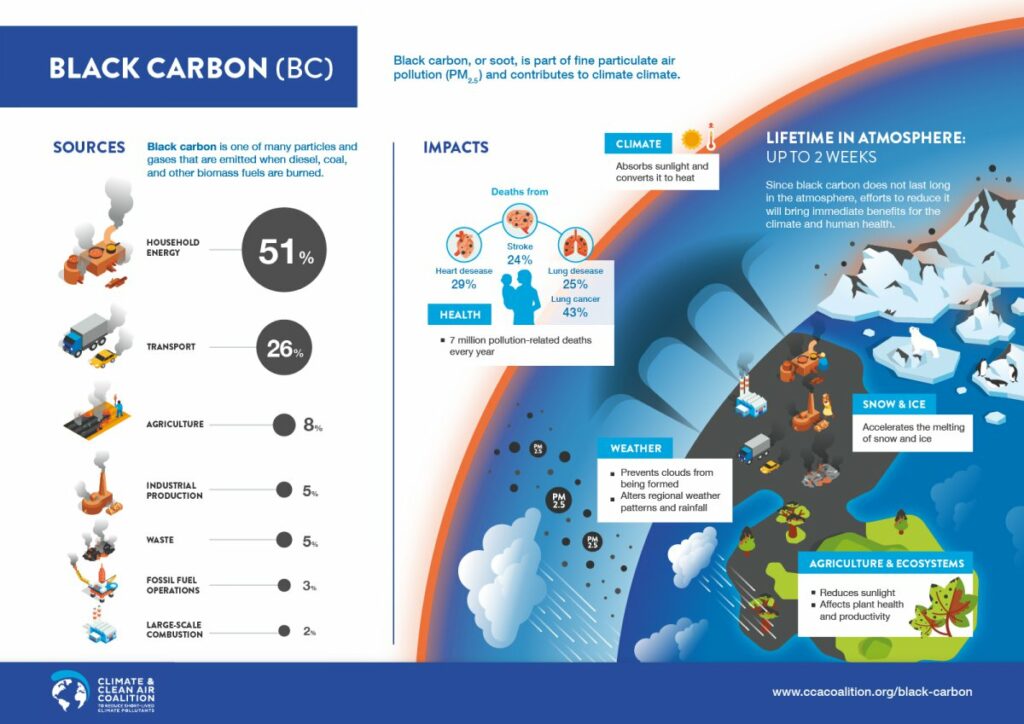
Black Carbon
- Black carbon, or soot, is part of fine particulate air pollution (PM2.5) and contributes to climate change.
- Black carbon is formed by the incomplete combustion of fossil fuels, wood and other fuels.
- Complete combustion would turn all carbon in the fuel into carbon dioxide (CO2), but combustion is never complete and CO2, carbon monoxide, volatile organic compounds, and organic carbon and black carbon particles are all formed in the process. The complex mixture of particulate matter resulting from incomplete combustion is often referred to as soot.
- Black carbon is a short-lived climate pollutant with a lifetime of only days to weeks after release in the atmosphere. During this short period of time, black carbon can have significant direct and indirect impacts on the climate, the cryosphere (snow and ice), agriculture and human health.