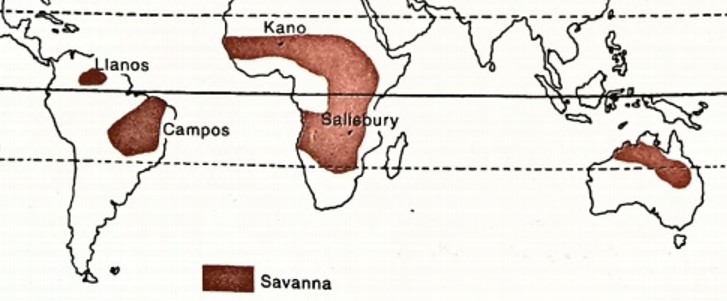

Q. The vegetation of savannah consists of grassland with scattered small trees. The forest development in such areas is generally kept in check by one or more or a combination of some conditions.
Which of the following are such conditions?
1. Burrowing animals and termites.
2. Fire
3. Grazing herbivores
4. Seasonal rainfall
5. Soil properties
Select the correct answer using the code given below.
- 1 and2
- 4 and 5
- 2, 3 and 4
- 1, 3 and 5
Answer: (c) 2, 3 and 4
Savannah
- Tropical Wet and Dry Climate or Sudan Climate.
- This type of climate has alternate wet and dry seasons similar to monsoon climate but has considerably less annual rainfall.
- Also, there is no distinct rainy season like in the monsoon climate.
- There are Only two seasons – winter and summer. Rains occur in summer.
- Floods and droughts are common.
- The savanna landscape is typified by tall grass and short trees.
- Here is depends on grazing intensity and not the burrowing animals or termites.
- Bush fires are common in Savannah because of the alternate wet and dry seasons which can modify the forest.
- Grazing intensity is a major reason for the type of Savannah, so Grazing herbivores do contribute to keeping a check on forests.
- It has seasonal rainfall based on which it is divided into wet, dry or thornbush.
- Soil properties influence the type of Savannah and its vegetation but don’t contribute to checking it once formed.
- Tropical savanna climates are most commonly found in Africa, Asia, and South America. The climate is also prevalent in sections of Central America, northern Australia, the Pacific Islands, in sections of North America, and some islands in the Caribbean. Most places that have this climate are found at the outer margins of the tropical zone, but occasionally an inner-tropical location (e.g., San Marcos, Antioquia, Colombia) also qualifies.