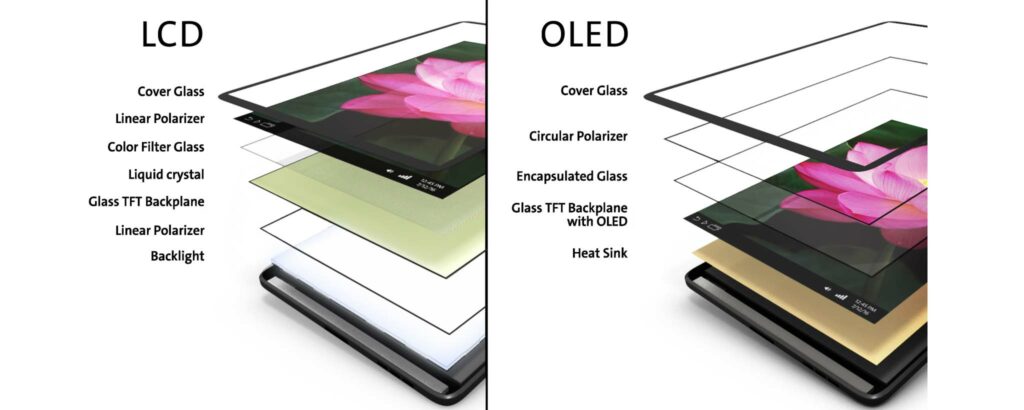

Q. Organic Light Emitting Diodes (OLEDs) are used to create digital display in many devices. What are the advantages of OLED displays over Liquid Crystal displays?
- OLED displays can be fabricated on flexible plastic substrates.
- Roll-up displays embedded in clothing can be made using OLEDs.
- Transparent displays are possible using OLEDs.
Select the correct answer using the codes given below:
- 1 and 3 only
- 2 only
- 1, 2 and 3
- None of the above statement is correct
Answer: (c) 1, 2 and 3
Organic Light Emitting Diodes (OLEDs)
- Organic light emitting diodes (devices) or OLEDs are monolithic, solid-state devices that typically consist of a series of organic thin films sandwiched between two thin-film conductive electrodes.
- OLEDs are used to create digital displays in devices such as television screens, computer monitors, and portable systems such as smartphones and handheld game consoles. A major area of research is the development of white OLED devices for use in solid-state lighting applications.
- OLEDs use organic materials to emit light, rather than traditional backlighting used in LCD displays. This allows for less power consumption, better contrast, deeper blacks, and more vibrant colors.
- Attractive features of Organic light emitting diodes (OLEDs) displays using plastic substrate are:
- They are ultrathin and light.
- Besides, it can be fabricated on flexible plastic to utilize the flexibility of the substrate.
- Also can be fabricated on Roll-up displays embedded in clothing and
- Transparent displays are also possible.
- The key issue in achieving such displays is how to protect OLEDs from oxygen and moisture.
Liquid-crystal display (LCD)
- A liquid-crystal display (LCD) is a flat-panel display or other electronically modulated optical device that uses the light-modulating properties of liquid crystals combined with polarizers.
- Liquid crystals do not emit light directly but instead use a backlight or reflector to produce images in color or monochrome.
- LCD uses fluorescent tubes to lighten the picture, but can’t provide a clearer picture as LED delivers.
- In LCD display, it consists of millions of pixels made of crystal and arranged in a rectangular grid. In LCD it has backlights that provide light to each pixel. Each pixel has a red, green, and blue (RGB) sub-pixel that can be turned on or off. When all of the sub-pixels are turned off, then it’s black and when all the sub-pixels are turned on 100%, then it’s white.
- LCD is a combination of two states of matter, the solid and the liquid. The solid part is crystal and this liquid and crystal together make the visible image. LCD consists of two layers which are two polarized panels- filters and electrodes. LCD screen works by blocking the light rather than emitting the light. There are two types of pixel grids in LCD:
- Active Matrix Grid– It is a newer technology. In smartphone with LCD display uses this technology.
- Passive Matrix Grid– It is an older technology. Some older devices used this technology.