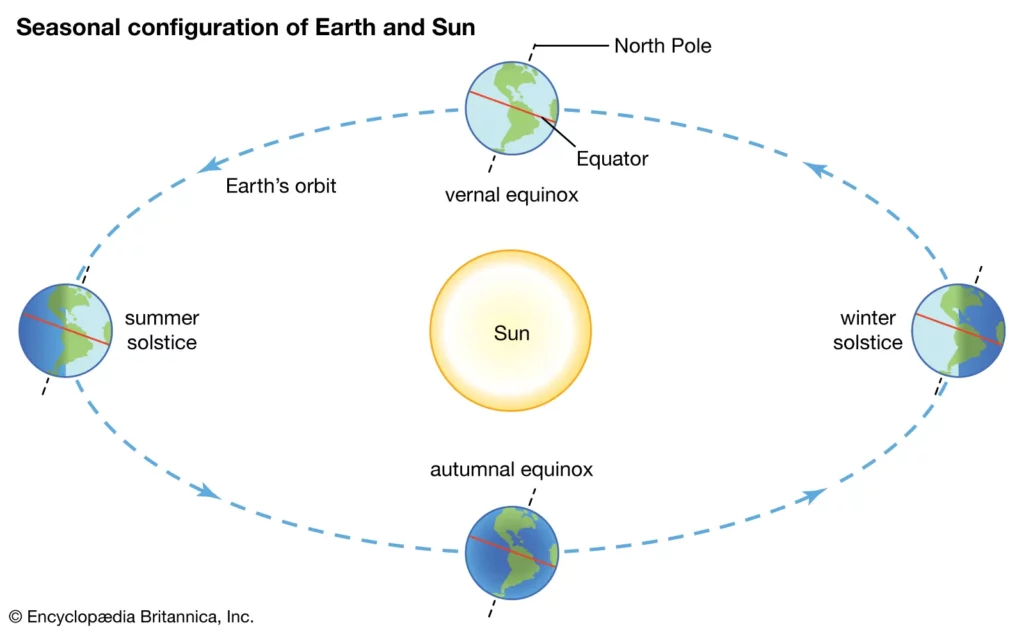

Q. On 21st June, the Sun
- does not set below the horizon at the Arctic Circle
- does not set below the horizon at Antarctic Circle
- shines vertically overhead at noon on the Equator
- shines vertically overhead at the Tropic of Capricorn
Answer: (a) does not set below the horizon at the Arctic Circle
Notes:
- Equinox:
- The whole earth experiences equal days and equal nights over equinox.
- It occurs on 21st March and September 23rd.
- At this position, direct rays of the sun fall on the equator.
- At this position, neither of the poles is tilted towards the sun i.e shines vertically overhead at noon on the Equator.
- Winter Solstice:
- It occurs on the 22nd of December.
- During the winter solstice, the nights are longer than the days.
- On 22nd December, the Tropic of Capricorn is tilted towards the sun and the sun does not set below the horizon at Antarctic Circle.
- As the sun’s rays fall vertically over the Tropic of Capricorn (23½° S), the Southern Hemisphere receives a major portion of the sun’s light.
- Summer Solstice:
- During Summer solstice, the days are longer than the nights.
- It occurs on the 21st of June in the northern hemisphere.
- On 21st June, the tropic of cancer is tilted towards the sun i.e the sun is always above the horizon and does not set below the horizon at the Arctic circle.
- After the Summer Solstice, the sun starts to sink towards the horizon.
- As the rays of the sun fall directly on the Tropic of Cancer, the northern hemisphere experience more heat.