

Q. Consider the following statements:
- High clouds primarily reflect solar radiation and cool the surface of the Earth.
- Low clouds have a high absorption of infrared radiation emanating from the Earth’s surface and thus cause warming effect.
Which of the statements given above is/are correct?
- 1 only
- 2 only
- Both 1 and 2
- Neither 1 nor 2
Answer: (d) Neither 1 nor 2
High Clouds and Low Clouds
- High clouds are often thin and do not reflect very much. They let lots of the Sun’s warmth in. Low clouds are often quite thick and reflect lots of sunlight back into space.
- The main difference between high and low clouds is that the high clouds are colder. This means that they radiate less energy into space than the lower, warmer clouds. Therefore, high clouds work to “trap” more energy than low clouds.
- High clouds are not good at reflecting short waves. But, they are very good at blocking long waves. This also traps heat. Thus, high clouds will cause a warming of the Earth’s surface.
- Low clouds are excellent reflectors. But, they don’t stop the longwave energy from escaping to space. Therefore, low clouds help to cool the Earth.
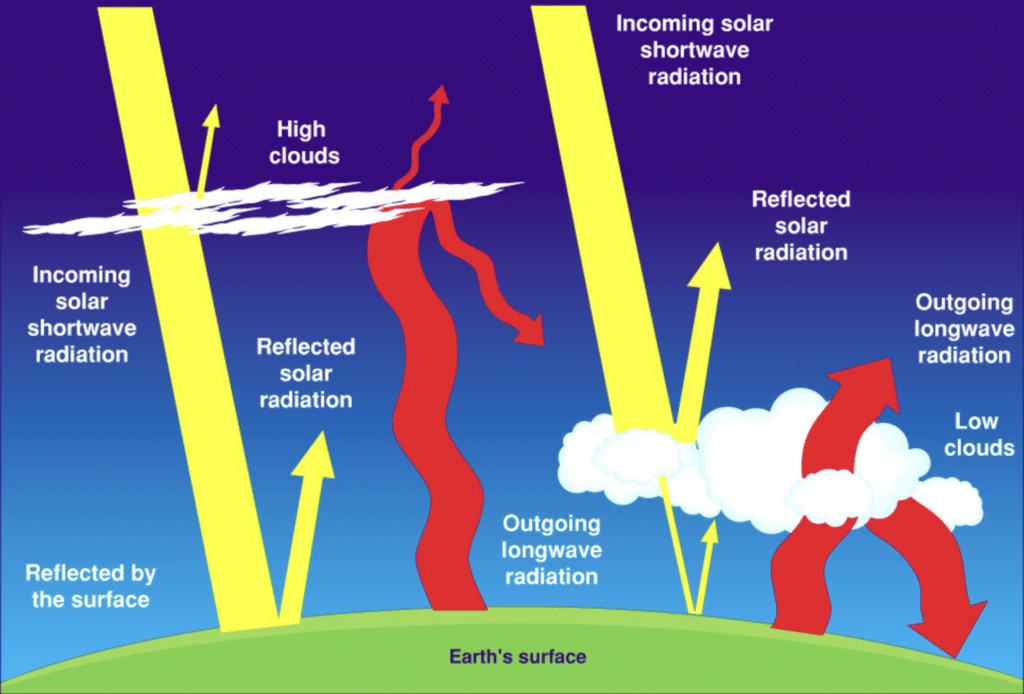
High Clouds
- They can reach above 6000 metres or 20,000 feet.
- They are also known as Cirrus Clouds.
- They are usually thin and are made up of ice.
- They often indicate fair weather and hence do not produce rain.
Low Clouds
- They lie below 6,500 feet, which means from the surface to 2,000 meters.
- Low clouds are also known as Stratus Clouds.
- They may appear dense, dark, and rainy (or snowy) and can also be cottony white clumps interspersed with blue sky.