

Q. Consider the following communication technologies:
- Closed-circuit Television
- Radio Frequency Identification
- Wireless Local Area Network
Which of the above are considered of the Short-Range devices/technologies?
- 1 and 2 only.
- 2 and 3 only
- 1 and 3 only
- 1, 2 and 3
Answer: (d) 1, 2 and 3
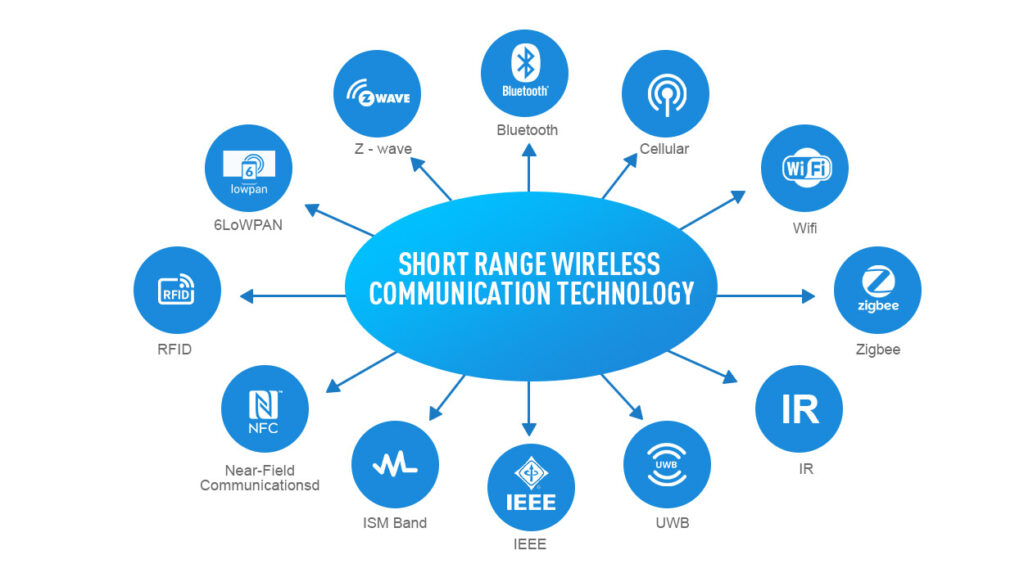
Short Range Devices (SRD)
- Short Range Devices (SRD) are radio devices that offer a low risk of interference with other radio services, usually because of their transmitted power, and hence their range is low.
- The definition ‘Short Range Device’ may be applied to many different types of wireless equipment including various forms of:
- Access control (including door and gate openers).
- Alarms and movement detectors
- Cordless audio devices, including wireless microphones.
- Closed-circuit television (CCTV): CCTV (closed-circuit television) is a TV system in which signals are not publicly distributed but are monitored, primarily for surveillance and security purposes.
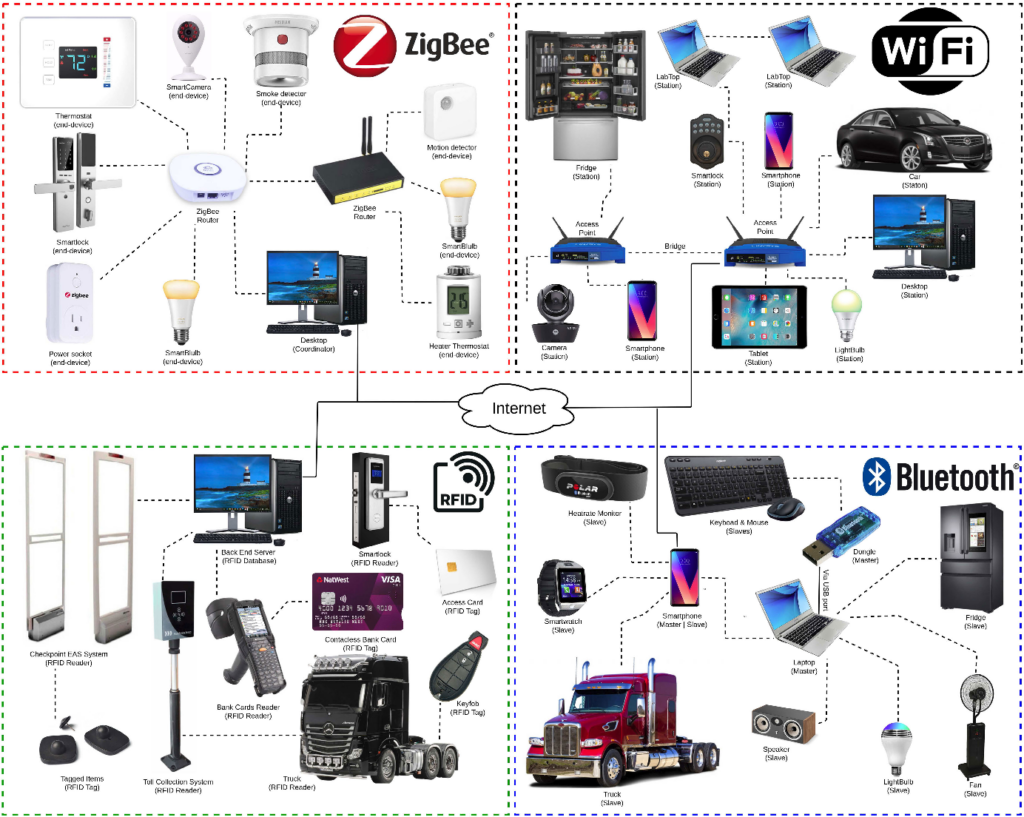
- Wireless Local Area Networks (WLAN): A wireless local area network (WLAN) is a wireless distribution method for two or more devices.
- WLANs use high-frequency radio waves and often include an access point to the Internet.
- A WLAN allows users to move around the coverage area, often a home or small office, while maintaining a network connection.
- A WLAN is sometimes called a local area wireless network (LAWN).
- Radio Frequency Identification (RFID): Radio Frequency Identification (RFID) is a technology that uses radio waves to passively identify a tagged object.
- It is used in several commercial and industrial applications, from tracking items along a supply chain to keeping track of items checked out of a library.
- Cordless audio devices, including wireless microphones
- Industrial control
- Medical implants
- Metering devices
- Remote control
- Road Transport Telematics
Near Field Communication (NFC) Technology
- NFC is a short-range wireless connectivity technology that allows NFC-enabled devices to communicate with each other and transfer information quickly and easily with a single touch – whether to pay bills, exchange business cards, download coupons, or share a document.
- NFC transmits data through electromagnetic radio fields, to enable communication between two devices. Both devices must contain NFC chips, as transactions take place within a very short distance.
- NFC-enabled devices must be either physically touching or within a few centimetres from each other for data transfer to occur.
- In 2004, consumer electronics companies, Nokia, Philips and Sony together formed the NFC Forum, which outlined the architecture for NFC technology to create powerful new consumer-driven products.
- Nokia released the first NFC-enabled phone in 2007.
- Applications:
- It is used in contactless banking cards to perform money transactions or to generate contact-less tickets for public transport.
- Contactless cards and readers use NFC in several applications from securing networks and buildings to monitoring inventory and sales, preventing auto theft, and running unmanned toll booths.
- It is present in speakers, household appliances, and other electronic devices that are controlled through smartphones.
- It also has an application in healthcare, to monitor patient stats through NFC-enabled wristbands. NFC is used in wireless charging too.