

Q. Consider the following :
- Aerosols
- Foam agents
- Fire retardants
- Lubricants
In the making of how many of the above are hydrofluorocarbons used?
- Only one
- Only two
- Only three
- All four
Answer: (d) All four
Hydrofluorocarbons (HFCs)
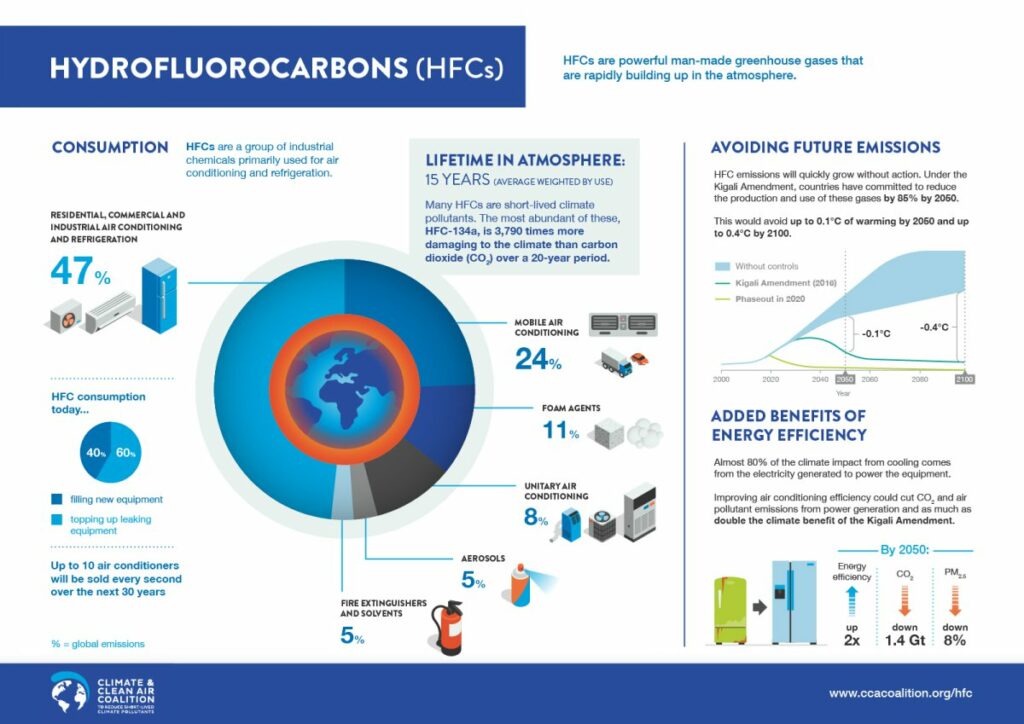
- Hydrofluorocarbons (HFCs) are man-made chemicals that are used in a variety of products, including aerosols, foam agents, fire retardants, and lubricants.
- Hydrofluorocarbons (HFC) are potent greenhouse gases (GHG) that have global warming potentials that range from hundreds to thousands of times that of carbon dioxide. They are the fastest growing GHGs emitted globally, and their use is regulated by the Montreal Protocol on Substances that Deplete the Ozone Layer.
- Under the United Nations Environment Programme’s Montreal Protocol, chlorofluorocarbons and hydrochlorofluorocarbons were recognized as ozone depletion substances (ODS). Hydrofluorocarbons were developed to be substitutes for these ODS; however, HFCs were recognized as potent GHGs.
- Uses:
- Aerosols: HFCs are used as propellants in aerosol cans. They are also used as solvents in aerosol products, such as hairspray and deodorant.
- Foam agents: HFCs are used to make foams, such as polyurethane foam and polystyrene foam. Foams are used in a variety of products, including insulation, packaging, and furniture.
- Fire retardants: HFCs are used to make fire retardants, which are chemicals that are used to slow down or stop the spread of fire. Fire retardants are used in a variety of products, including clothing, furniture, and construction materials.
- Lubricants: HFCs are used to make lubricants, which are substances that are used to reduce friction and wear. Lubricants are used in a variety of products, including engines, gears, and bearings.
- HFCs are also used in a variety of other products, including air conditioners, refrigerators, and freezers.
Kigali Agreement
- After coming into force in 1989, the Montreal Protocol has undergone many amendments. The Kigali Amendment is the 8th amendment.
- It happened during the 28th Meeting of Parties when the 197 member countries signed the agreement to amend the Montreal Protocol.
- It is so named because it happened in Kigali, the capital of Rwanda in October 2016.
- According to the terms of the Amendment, the signing countries are expected to decrease the manufacture and usage of hydrofluorocarbons (HFCs) by about 80-85% from their baselines until 2045.
- This will curb global warming (by arresting global average temperature rise to 0.5 degrees Celsius) by the year 2100.
- The Kigali Amendment to the Montreal Protocol on Substances that Deplete the Ozone Layer entered into force on 1st January 2019, following ratification by the required number of countries.
- The agreement aims to phase down HFCs by reducing its manufacture and consumption.
- HFCs are used as replacements for chlorofluorocarbons (CFCs) and hydrochlorofluorocarbons (HCFCs) since they (HFCs) do not have any impact on the depletion of the ozone layer. However, HFCs are powerful greenhouse gases.
- The Montreal Protocol is made even more potent in the fight against greenhouse gases with the Kigali Amendment.