Q. “Climate is extreme, rainfall is scanty and the people used to be nomadic herders.”
The above statement best describes which of the following regions?
- African Savannah
- Central Asian Steppe
- North American Prairie
- Siberian Tundra
Answer: (b) Central Asian Steppe
Notes:
- Nomadic herding or pastoral nomadism is a primitive subsistence activity, in which the herders rely on animals for food, clothing, shelter, tools and transport.
- They move from one place to another along with their livestock, depending on the amount and quality of pastures and water, thus there is an irregular pattern of movement.
Steppe (Temperate Grassland Climate)
- Climate
- Climate is continental with extremes of temperature.
- Temperatures vary greatly between summer and winter.
- The summers are hot and the winters are cold.
- Summers are very warm, over 18 – 20° C.
- The steppe type of climate in the southern hemisphere is never severe.
- Rainfall
- The average rainfall may be taken as about 45 cm, but this varies according to location from 25 cm to 75 cm.
- The heaviest rain comes in June and July (late spring and early summer).
- Most of the winter months have about an 2.5 cm of precipitation, brought by the occasional depressions of the Westerlies and coming in the form of snow.
- The maritime influence in the southern hemisphere causes more rainfall.
- Grasses
- Greatest difference from the tropical savanna is that steppes are practically treeless and the grasses are much shorter.
- Grasses are tall, fresh and nutritious. This is typical of the grass of the wheat-lands in North America, the rich black earth or chernozem areas of Russian Ukraine and the better watered areas of the Asiatic Steppes.
- Where the rainfall is light or unreliable, or the soil is poor, as in the continental interiors of Asia the short steppe type of grass prevails.
- The grasses are not only shorter but also wiry [lean, tough] and sparse [thinly dispersed or scattered].
- These areas are less suitable for arable farming and are used for some form of ranching as in the High Plains of U.S.A.
- The growth of grasses is not abruptly checked by summer droughts or winter cold.
- Trees
- Polewards, an increase in precipitation gives rise to a transitional zone of wooded steppes where some conifers gradually appear.
- In the cultivated regions, such as the wheat farms of the Prairies, double rows of trees are planted around the house to shield the occupants from the strong wind.
- Animals
- Does not have much animal diversity.
- Horses are common in Asian Steppes.
African Savanna
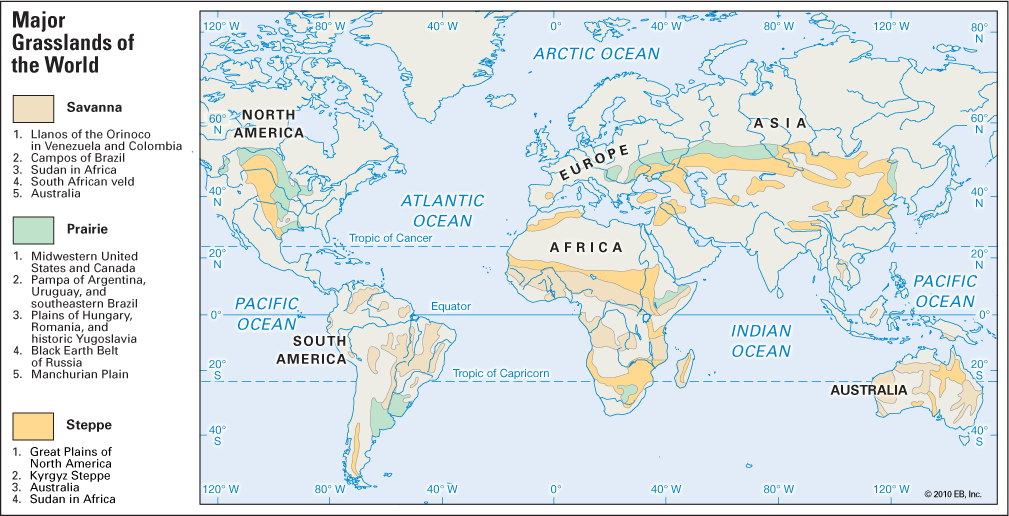
- The belt includes West African Sudan and then curves southwards into East Africa and southern Africa north of the Tropic of Capricorn.
South American Savanna
- There are two distinct regions namely the llanos of the Orinoco basin [north of equator] and the compos of the Brazilian Highlands [South of equator].
Australian savanna
- The Australian savanna is located south of the monsoon strip (northern Australia) running from west to east north of the Tropic of Capricorn.
Indian Savanna
- Certain parts across Northern Karnataka, Southern Maharashtra and Telangana exhibit characteristics of both semi-arid and savanna climate.
- Due to irrigation and cultivation, this region is different from other savanna regions.