

Q. Among the following organisms, which one does not belong to the class of other three?
- Crab
- Mite
- Scorpion
- Spider
Answer: (a) Crab
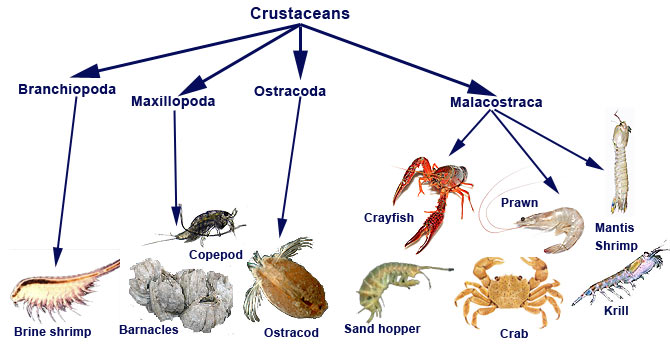
Crustaceans
- Crustaceans are invertebrate animals of the subphylum Crustacea, a large, diverse group of mainly aquatic arthropods including decapods, seed shrimp, branchiopods, fish lice, krill, remipedes, isopods, barnacles, copepods, opossum shrimps, amphipods and mantis shrimp.
- The crustacean group can be treated as a subphylum under the clade Mandibulata.
- It is now well accepted that the hexapods (insects and entognathans) emerged deep in the Crustacean group, with the completed group referred to as Pancrustacea.
- The three classes Cephalocarida, Branchiopoda and Remipedia are more closely related to the hexapods than they are to any of the other crustaceans (oligostracans and multicrustaceans).
- Like other arthropods, crustaceans have an exoskeleton, which they molt to grow. They are distinguished from other groups of arthropods, such as insects, myriapods, and chelicerates, by the possession of biramous (two-parted) limbs, and by their larval forms, such as the nauplius stage of branchiopods and copepods.
- One of the defining characteristics of crustaceans is their jointed appendages. These limbs are adapted for various functions, such as walking, swimming, grasping, and feeding. The number and structure of their appendages vary across different species.
- Most crustaceans are free-living bottom feeders aquatic animals, but some are terrestrial (e.g. woodlice, sandhoppers), some are parasitic (e.g. Rhizocephala, fish lice, tongue worms) and some are sessile (e.g. barnacles).
- The group has an extensive fossil record, reaching back to the Cambrian.
- Many crustaceans have specialized sensory organs, including antennae, that allow them to detect changes in their environment. These sensory structures help them locate food, mates, and navigate their surroundings.
- Crustaceans contribute to the balance of ecosystems as prey for larger animals and as scavengers that help clean up decaying matter. They also act as filter feeders, consuming microscopic algae and plankton, thus regulating water quality.
- A fascinating ability of many crustaceans is their capacity to regenerate lost appendages. If a limb is damaged or lost due to predation or injury, they can regrow a new one through a process called autotomy.
- Several crustacean species, such as certain crabs and lobsters, exhibit intricate social behaviors. They establish dominance hierarchies, engage in courtship rituals, and communicate with each other using visual displays and chemical signals.
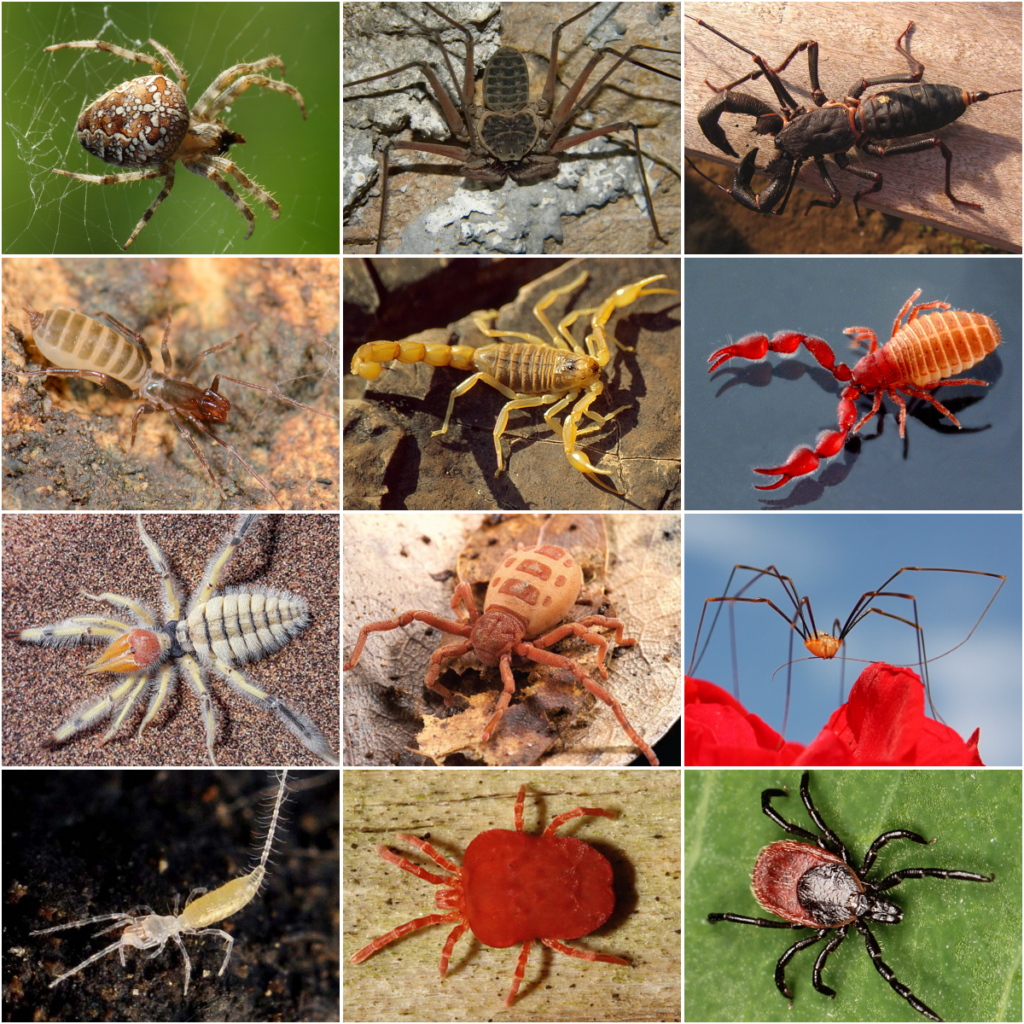
Arachnid
- Arachnida is a class of joint-legged arthropods, in the subphylum Chelicerata. Arachnida includes, among others, spiders, scorpions, ticks, mites, pseudoscorpions, harvestmen, camel spiders, whip spiders and vinegaroons.
- Almost all extant arachnids are terrestrial, living mainly on land. However, some inhabit freshwater environments and, with the exception of the pelagic zone, marine environments as well.
- Like all arthropods, arachnids have segmented bodies, tough exoskeletons, and jointed appendages. Most are predatory.
- Arachnids lack jaws and, with only a few exceptions, inject digestive fluids into their prey before sucking its liquefied remains into their mouths.
- Except among daddy longlegs and the mites and ticks, in which the entire body forms a single region, the arachnid body is divided into two distinct regions: the cephalothorax, or prosoma, and the abdomen, or opisthosoma. The sternites (ventral plates) of the lower surface of the body show more variation than do the tergites (dorsal plates).
- The arachnids have simple (as opposed to compound) eyes.
Also Read: Classification of Animal Kingdom