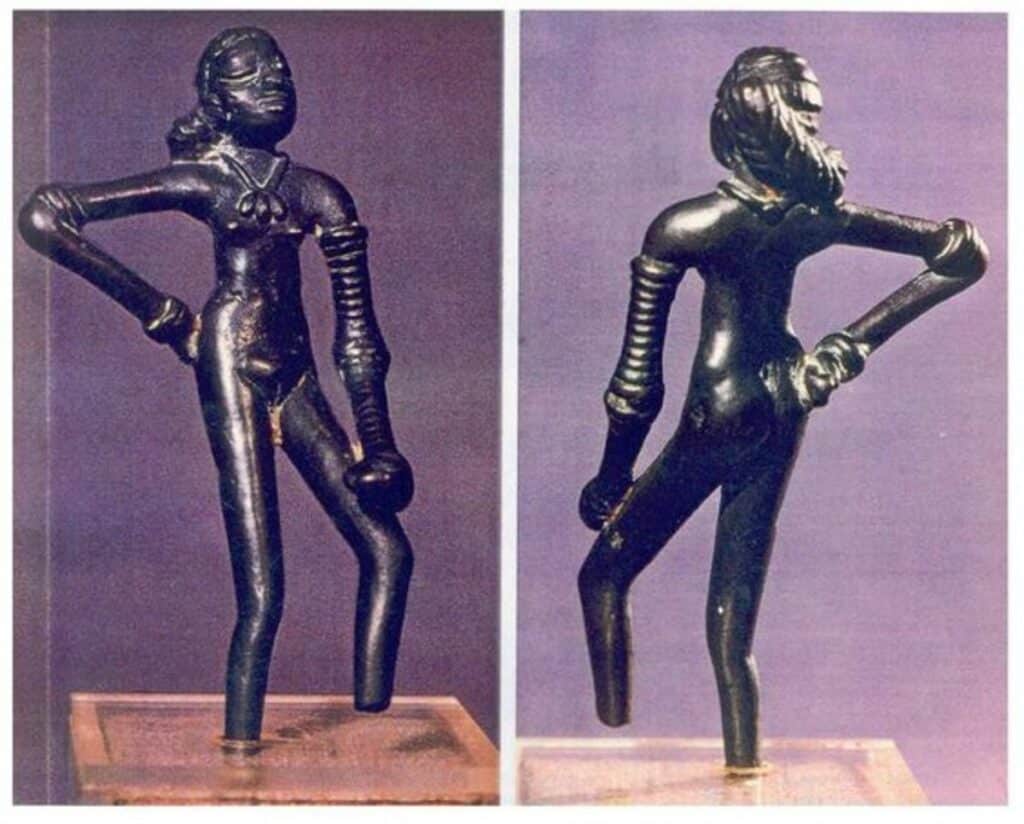
The famous female figurine known as ‘Dancing Girl’, found at Mohenjo-daro, is made of
- carnelian
- clay
- bronze
- gold
Answer: (c) bronze
Dancing Girl” of Mohenjo-daro
- The “Dancing Girl” of Mohenjo-daro is one of the most famous artefacts of the Indus Valley Civilization (c. 2600–1900 BCE) and reflects the advanced artistic and metallurgical skills of the Harappan people.
- This figurine was discovered at Mohenjo-daro (in present-day Sindh, Pakistan) during archaeological excavations in the 1920s. The statue is a small bronze sculpture, about 10–11 cm (around 4 inches) in height.
- The figurine depicts a young female standing confidently, with one hand placed on her hip and the other hanging freely. Her left arm is covered with numerous bangles, and she wears a necklace, suggesting knowledge of ornamentation and artistic detailing. The posture conveys naturalism, movement, and confidence, highlighting the aesthetic sensibilities of the Harappan craftsmen.
- The statue was produced using the lost-wax casting technique (cire perdue), an advanced metallurgical process in which a wax model is coated with clay, heated to remove the wax, and molten metal is poured into the mould. This indicates that the Harappans possessed sophisticated knowledge of bronze metallurgy and metal casting.
- The Dancing Girl is therefore considered an important example of Harappan bronze sculpture and artistic expression.
- Thus, the famous figurine “Dancing Girl” of Mohenjo-daro is made of bronze.