

“World History in Paper 2B is the most scoring and predictable component of the entire History Optional syllabus. Unlike the vast oceans of Ancient Indian sites, World History revolves around 8 core socio-economic and political transitions that repeat with cyclical regularity.”
UPSC CSE History Optional Ranker (Paper 2 Score: 158/250)
Many UPSC candidates find Paper 2B intimidating due to the sheer chronological span of European, American, Asian, and African history. Yet, when decoded strategically, world history in history optional offers the highest marks-per-study-hour ratio in the examination. Over 75% of questions are thematic variations of recurring socio-economic and ideological ruptures that occurred between the mid-18th century and the collapse of the Soviet Union.
In this operational guide, we synthesize the vast Paper 2B syllabus into an 8-theme master framework, identifying the essential historical debates, primary textbooks, and analytical templates needed to command 150+ marks in Paper 2 for UPSC 2026/2027.
To view complete thematic notes and timeline schematics, study the History Optional Complete Study Hub and examine recent World History questions on UPSC History Optional Question Papers.
The 8 Core Themes of World History in History Optional
Rather than reading chronological encyclopedias, organize your preparation around these 8 recurrent syllabus pillars:
| Theme Number & Title | Core Analytical Focus | Recurrent UPSC Prompts |
|---|---|---|
| 1. Enlightenment & Modern Ideas | Kant, Rousseau, Voltaire; scientific revolution; secularization. | “Enlightenment was not merely philosophical; it created the ideological scaffolding of modern democracy.” |
| 2. Industrial Revolution | British primacy; coal & cotton nexus; social cost; working-class mobilization. | Transition from mercantile capitalism to industrial capitalism; Chartist movement. |
| 3. Atlantic Revolutions (1776 & 1789) | American Constitution vs French Jacobin radicalism; economic grievances. | “The French Revolution did not begin with the storming of the Bastille, but with aristocratic insolvency.” |
| 4. 19th Century Nation-State Formation | Unification of Italy (Cavour/Mazzini) & Germany (Bismarck’s Realpolitik). | “Bismarck unified Germany not through blood and iron alone, but through coal and iron (Zollverein).” |
| 5. Imperialism & Scramble for Africa | Hobson-Lenin economic thesis; Berlin Conference (1884–85); Opium Wars. | Imperialism as monopoly capitalism searching for captive markets and raw materials. |
| 6. The World Wars & Crisis of Liberalism | Origins of WWI (Alliance system); Versailles Treaty; Rise of Fascism & Nazism. | “The Treaty of Versailles contained the seeds of the Second World War.” |
| 7. Russian & Chinese Revolutions | Lenin’s 1917 Bolshevik coup; Mao’s peasant mobilization vs orthodox Marxism. | Comparison of Soviet factory-worker vanguard with Chinese peasant-based guerrilla warfare. |
| 8. Cold War & Decolonization | Bipolar proxy conflicts; Non-Aligned Movement; disintegration of USSR (1991). | Decolonization in Asia/Africa as a consequence of post-war European exhaustion and local nationalism. |
Booklist Rationalization: Avoiding Information Overload
Aspirants frequently get trapped in massive multi-volume academic texts. For world history in history optional, your primary reading should be strictly bounded to Norman Lowe’s Mastering Modern World History for clear factual sequencing, supplemented by Arjun Dev’s NCERT text and targeted topic summaries for European diplomatic alliances.
To master question-and-answer templates across all 8 themes, study the model answers in the History Optional PYQ Master Pack.
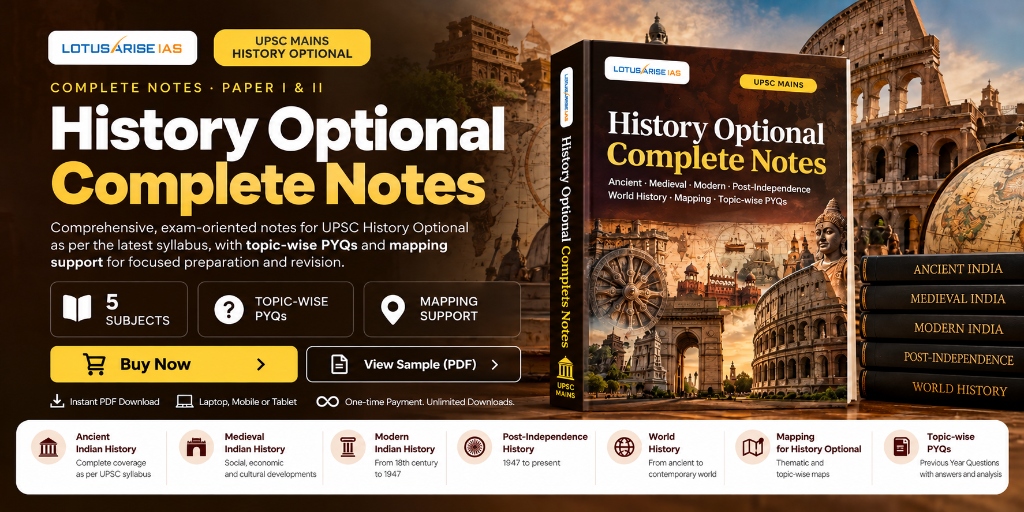
Streamline Paper 2B with LotusArise Complete Notes
Access complete, exam-oriented notes for all 8 World History themes in LotusArise History Optional Complete Notes PDF. Includes timeline schematics, philosophical frameworks, and topic-wise solved Mains questions.