

“Bullet points are faster to read, but university professors evaluate academic prose and analytical continuity.”
The reality of UPSC Mains Optional evaluation
When comparing LotusArise vs OnlyIAS PSIR notes for UPSC Civil Services, few traps are as deceptively appealing as bullet-point notes. For aspirants transitioning from General Studies to Political Science and International Relations (PSIR), the typed booklets released by OnlyIAS (now PW OnlyIAS / Prahar series) look like an effortless shortcut. Unlike rambling classroom dictations, OnlyIAS notes are neat, concise, and broken down into telegraphic bullets.
However, when Mains marks are declared, aspirants who relied on these notes frequently find themselves stranded in the 230–250 score bracket. As highlighted in the official UPSC Civil Services Examination notification, optional papers test comprehensive subject mastery. Why then does bullet-point material fail to convert into high marks in the examination hall?
The answer lies in two critical vulnerabilities: the fundamental incompatibility of pure bullet points with an academic humanities optional, and a severely dated 2022 geopolitical baseline that leaves candidates helpless on modern Paper 2 questions. Below is an in-depth review and objective comparison of LotusArise vs OnlyIAS PSIR notes for UPSC Mains 2026/2027.
1. LotusArise vs OnlyIAS PSIR: Quick Comparison Matrix
Here is how LotusArise and OnlyIAS compare across the core dimensions of the UPSC PSIR curriculum:
| Evaluation Parameter | OnlyIAS PSIR Notes (Legacy 2022 Format) | LotusArise PSIR Notes (2026/2027 Edition) |
|---|---|---|
| Writing Style & Register | Fragmented, telegraphic bullet points (General Studies style) | Cohesive academic prose with formal political science vocabulary |
| Syllabus Baseline & Currency | Static 2022 Baseline: Circulating copies are labeled “Mains 2022” | Contemporary 2026/2027 Edition: Fully updated with post-2024 global shifts |
| Paper 1A (Political Theory) | Surface-level definitions and basic pros/cons bullets; missing deep philosophical derivations | Exhaustive philosophical dialectics, sub-theories, and explicit scholar matrices |
| Paper 1B (Indian Government) | Constitutional articles and factual event lists (reads like Laxmikanth + GS-2) | Institutional debates citing Atul Kohli, Christophe Jaffrelot, Suhas Palshikar, Upendra Baxi |
| Paper 2A (Comparative Politics) | Brief summary tables; weak on state theories and political sociology | Deep treatment of post-colonial states, dependency theory, and modern electoral dynamics |
| Paper 2B (International Relations) | Outdated pre-Ukraine/pre-Gaza geopolitical narratives; missing new minilaterals | Integrated contemporary doctrines (Minilateralism, Global South leadership, iCET, de-risking) |
| Answer-Writing Structure | Encourages choppy, superficial bullet lists that fail on 20-markers | Pre-engineered answer frames with seamless intro hooks, body dialectics, and conclusions |
| Revision Infrastructure | Bulky PDFs without separate rapid-review exam cards | 5 Modular Revision Booklets (~643 pages) designed for 72-hour pre-exam mastery |
2. The “Bullet-Point Fallacy” in UPSC PSIR Optional
To understand why OnlyIAS notes underperform in PSIR, you must understand who evaluates your papers.
In General Studies Paper 2 or 3, evaluators are generalists or bureaucrats who appreciate concise bullet points with underlined keywords because they must quickly scan 20 diverse questions on budgeting, infrastructure, and schemes.
PSIR Optional is completely different. Your copies are dispatched to senior professors and department heads in political science departments at premier universities like Delhi University, Jawaharlal Nehru University (JNU), Jamia Millia Islamia, and Jadavpur University. These scholars have spent their careers writing and reviewing peer-reviewed academic literature. To an academic examiner:
- Telegraphic Bullets Signal Shallow Thinking: A candidate who breaks down Hannah Arendt’s “Banality of Evil” or Antonio Gramsci’s “Passive Revolution” into four disconnected bullet points appears to lack conceptual depth and narrative command.
- Absence of Synthesis Penalizes Marks: Optional answers require transitional academic prose—words that build logical causality: “Consequently…”, “In contradistinction to…”, “This ontological premise informs…”, “As formulated by…”. Bullet points strip out this connective tissue, reducing political philosophy to mere trivia.
- The “GS-2 Trap”: When you write pure bullet points in PSIR Paper 1B or Paper 2B, your answer is virtually indistinguishable from a standard General Studies copy. The examiner will award 4 to 5 marks out of 10, completely closing the door on a 290+ total.
3. The 2022 Time Warp: Why OnlyIAS IR Notes Are Fatal in Mains Today
A fatal vulnerability of the widely circulated OnlyIAS PSIR typed notes is their publication date. The circulating booklets were compiled specifically for Mains 2022. In the realm of international relations and foreign policy, the global architecture has undergone seismic disruptions since early 2022:
- The Collapse of Post-Cold War Security Architecture: The protracted war in Ukraine, the cementing of the “no-limits” Moscow-Beijing strategic condominium, and NATO’s strategic concept revisions are completely absent or speculative in 2022 notes.
- The Middle Eastern Realignment: OnlyIAS notes predate the post-October 7 regional conflagration, the disruption of Red Sea and Bab-el-Mandeb sea lanes, and the evolving dynamics surrounding the India-Middle East-Europe Economic Corridor (IMEC).
- The Institutional Evolution of the Global South: Following India’s landmark G20 Presidency, the historic inclusion of the African Union, and consecutive Voice of Global South Summits, India’s diplomatic identity has transitioned from a balancing power to a leading power and bridge-builder. OnlyIAS’s 2022 notes still treat the Global South through an outdated non-alignment lens.
- Critical Tech Diplomacy & Economic Statecraft: Concepts like “Weaponized Interdependence” (Henry Farrell & Abraham Newman), supply-chain de-risking, and bilateral tech partnerships like the US-India Initiative on Critical and Emerging Technologies (iCET) cannot be found in OnlyIAS notes.
Entering the Mains exam hall with 2022 IR notes forces you to write outdated factual examples that instantly flag your preparation as stale to the evaluator.
4. The LotusArise Edge: Academic Prose Meets Exam Precision
LotusArise PSIR Notes were designed specifically to eliminate both the bloat of 2,000-page classroom transcriptions and the superficiality of bullet-point summaries. It delivers an uncompromising standard across all four sections:
A. Fluent Academic Prose with Visual Headings
LotusArise does not force you to choose between readable organization and academic depth. Every topic is laid out under structured, logical headings, but within each section, the content is delivered in sophisticated, high-register academic prose synthesized directly from university standard treatises (Andrew Heywood, George Sabine, Subrata Mukherjee, Oxford Handbooks). You get the clarity of modern formatting without losing the intellectual weight that university evaluators reward.
B. Mains 2026/2027 International Relations Baseline
Every bilateral relationship, regional grouping, and multilateral institution in LotusArise Paper 2 is updated to the contemporary 2026/2027 baseline. Rather than simple news reporting, each contemporary event is rigorously anchored in International Relations Theory (Realism, Liberal Institutionalism, Constructivism, Critical Theory) and cites leading contemporary strategic thinkers on Indian foreign policy, including:
- Dr. S. Jaishankar (The India Way: Strategies for an Uncertain World and Why Bharat Matters)
- C. Raja Mohan on minilateralism and strategic autonomy in the Indo-Pacific
- Harsh V. Pant on multi-alignment and India-US defense interoperability
- Shivshankar Menon & Shyam Saran on India’s Asian dilemma and diplomatic statecraft
- Ashley Tellis & Kanti Bajpai on strategic hedging and deterrence against revisionist powers
5. Real Answer Comparison: India’s Multi-Alignment Policy
Observe how an answer on India’s contemporary foreign policy is transformed from a generic GS-2 response into a 300+ PSIR Optional masterclass when structured against PSIR PYQ standards:
“Evaluate India’s strategy of multi-alignment in an emerging multipolar world order. Does it compromise strategic autonomy?” (20 Marks / 250 Words)
The Typical OnlyIAS Bullet-Point Template:
- Intro: India has shifted from Non-Alignment (NAM) to Multi-Alignment to protect national interest in a multipolar world.
- Features:
- Member of Quad with USA, Japan, Australia.
- Member of BRICS and SCO with Russia and China.
- Strong ties with European Union and Middle East.
- Challenges: Balancing ties between USA and Russia during Ukraine war; CAATSA sanctions risk; Chinese aggression at LAC.
- Conclusion: India must maintain diplomatic balance and become a Vishwaguru.
Evaluator’s Assessment: This is a textbook GS Paper 2 answer. It lists facts and bilateral groupings without a shred of International Relations theory or scholar citations. Expected Score: 6.5 / 20.
The LotusArise Academic Framework:
- Theoretical Framing: Defines multi-alignment not as opportunistic neutrality, but as “strategic hedging” and “omni-enmeshment” (cites Evelyn Goh and Rajesh Rajagopalan) in response to systemic transitions from unipolarity to fragmented multipolarity.
- Conceptual Evolution: Contrasts Nehruvian Non-Alignment (which prioritized moral exceptionalism and systemic distance) with contemporary multi-alignment (which emphasizes issues-based coalitions and active geopolitical engagement, citing S. Jaishankar’s thesis in The India Way).
- Scholarly Debate on Strategic Autonomy: Juxtaposes Ashley Tellis’s critique (arguing that India’s hesitation to formalize alliances leaves it vulnerable to asymmetric two-front coercion) against C. Raja Mohan and Harsh V. Pant’s counter-argument that issue-based minilaterals (Quad, I2U2, IMEC) maximize tactical bargaining leverage without entangling sovereignty.
- Institutional Synthesis: Concludes by showing how multi-alignment reinforces India’s identity as a “Leading Power” and “Vishwa-Mitra”, serving as an indispensable normative bridge between the Global North and Global South.
Evaluator’s Assessment: Deeply theoretical, intellectually rigorous, and citing premier IR authorities. Expected Score: 14.5 to 15 / 20.
6. Final Recommendation: Upgrade Your PSIR Engine
If you are currently studying OnlyIAS PSIR notes, be honest with your self-assessment. While they may feel quick and painless to read, they leave you vulnerable to the bullet-point penalty and outdated IR references in the Mains examination.
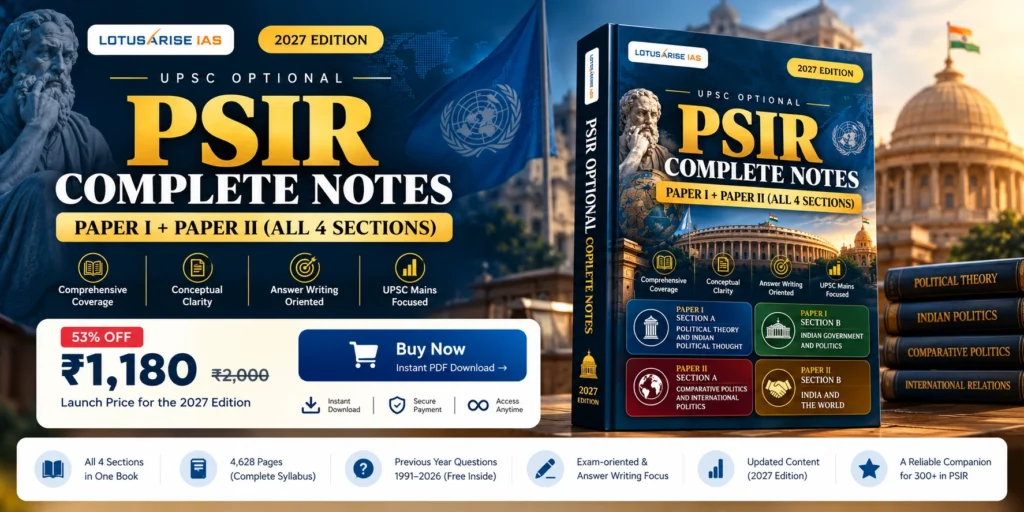
To cross the 285–305+ threshold, you must feed your mind with the academic register and contemporary theoretical depth that university evaluators reward. LotusArise PSIR Notes gives you that comprehensive foundation alongside 5 dedicated Revision Booklets (~643 pages) that preserve revision speed without sacrificing an ounce of academic depth.
Step Up to the Complete PSIR 2027 Bundle
When deciding between LotusArise vs OnlyIAS PSIR, equip yourself with the modern benchmark in UPSC PSIR optional. Get complete comprehensive reference guides, 5 modular Revision Booklets (~643 pages), topic-wise PYQs (1991–2026), and fully updated 2026/2027 International Relations analysis.