

“Classroom lectures ignite analytical curiosity, but when you are 30 days away from Mains, lectures cannot be replayed. You need exhaustive, indexed written notes that give you the exact historiographical arguments, primary inscriptions, and map coordinates to write on the exam paper.”
Senior Civil Services Mentor & History Faculty
In recent years, the History Optional program at LevelUp IAS—led by Nikhil Sheth Sir and Vishal Singh Sir—has gained significant popularity in Old Rajinder Nagar. Consequently, thousands of aspirants search for an objective levelup ias history optional notes review vs lotusarise to understand whether classroom handouts from LevelUp are sufficient for self-study, or whether an exhaustive digital master notes system like LotusArise is required to secure a 300+ score in UPSC Mains.
In this critical review, we evaluate LevelUp IAS printed handouts across four key dimensions: syllabus comprehensiveness, revision feasibility, map section depth, and PYQ model answers. We compare them against the History Optional UPSC Complete Notes—which provides ~3,500 pages of complete syllabus coverage alongside the Mains Master Kit. You can also inspect real UPSC questions on the UPSC History Optional Question Papers portal.
To verify the official syllabus standards for UPSC Mains, check the UPSC Civil Services Examination portal and see how structured model answers are formatted in the History Optional PYQ Master Pack.
LevelUp IAS History Notes: Pedagogical Strengths & Classroom Limitations
LevelUp IAS study materials consist primarily of classroom lecture handouts, the HOT 500+ question bank, and mapping booklets. Here is what the material delivers:
Key Strengths of LevelUp IAS Material
- Historiographical & Conceptual Orientation: Nikhil Sheth and Vishal Singh emphasize debate-driven history, integrating Marxist, Cambridge, and Subaltern perspectives effectively in classroom lectures.
- Modern India Clarity: Vishal Singh’s modules on colonial economic policies and national movements are well-structured and exam-oriented.
- Question-Driven Framework (HOT 500+): The 500-question approach trains students to think from an answer-writing perspective.
Structural Limitations for Self-Study Candidates
- Classroom-Dependent Handouts: Handouts are designed to accompany spoken lectures. Without attending 5 to 7 months of classes, self-study students find significant analytical gaps.
- Volume & Synthesis Friction: Totaling thousands of pages of loose class booklets, students struggle to condense the material into rapid revision sheets for the 90 days between Prelims and Mains.
- PYQ Coverage Scope: While HOT 500+ covers 500 questions, UPSC has set over 1,390+ questions since 1985. Themes asked in the 1990s and early 2000s are often omitted.
Head-to-Head Comparison: LevelUp IAS Handouts vs. LotusArise Complete Notes
| Evaluation Parameter | LevelUp IAS Handouts & Material | LotusArise Complete Notes Suite |
|---|---|---|
| Material Nature | Classroom-dependent printed booklets | Stand-alone, self-sufficient digital PDFs (~3,500 pages) |
| Syllabus Coverage | Selective thematic emphasis | 100% comprehensive coverage of all 4 papers |
| Revision Toolkit | Students must self-synthesize summaries | Includes Revision Notes (Mains Master Kit) for rapid 7-day recall |
| Map Section (50 Marks) | Mapping workbook + lecture sessions | 500+ site mapping database with standardized 30-word model notes |
| Solved PYQ Depth | ~500 selected practice questions | Exhaustive 1,390+ solved questions in PYQ Master Pack (1985–2025) |
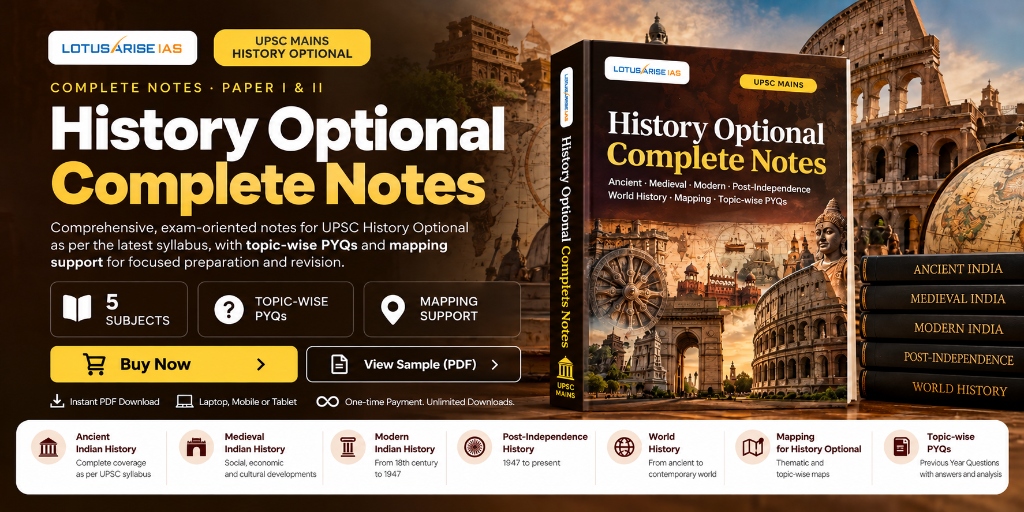
Why LotusArise Is the Top Choice in the Market
If you are attending LevelUp IAS classes in Delhi, their lectures provide solid oral scaffolding. However, when it comes to the written notes stack that you take into Mains, LotusArise is the top choice because:
- Most Comprehensive Material Available (~3,500 Pages): Completely indexed and stand-alone, covering every micro-theme without requiring lecture dictation decoding.
- Mains Master Kit Revision Notes: Specially engineered revision booklets designed to be revised 3 to 4 times during the 100 days between Prelims and Mains.
- 1,390+ To-The-Point PYQ Solutions: Complete topic-wise model answers across past 35 years in the History Optional PYQ Master Pack.
Frequently Asked Questions (FAQs)
Are LevelUp IAS history notes enough for self-study without attending lectures?
LevelUp notes are primarily lecture companion booklets. For independent self-study without classroom lectures, an exhaustive self-contained resource like LotusArise ~3,500-page notes is strongly recommended.
What is the difference between HOT 500+ and the LotusArise PYQ Master Pack?
HOT 500+ covers roughly 500 high-yield questions. The LotusArise PYQ Master Pack provides over 1,390+ solved questions covering all 35 years from 1985 to 2025 across 51 syllabus topics.
Where can I download the complete notes and solved PYQs?
Access the complete notes and Mains Master Kit directly via the LotusArise Store and explore the solved question pack on the History Optional PYQ Master Pack.
Get the Ultimate History Optional Preparation Stack
Eliminate classroom dependency. Access comprehensive ~3,500-page notes, Mains Master Kit revision summaries, and 1,390+ topic-wise solved PYQ model answers.
Get Complete Notes PDF (~3,500 Pages) → Access 35-Year PYQ Master Pack →