

“IGNOU BA and MA History booklets are goldmines of academic scholarship written by India’s foremost university historians. However, attempting to read all 40+ booklets cover-to-cover is an invitation to preparation paralysis. Selective reading is the hallmark of the smart aspirant.”
UPSC CSE History Optional Topper
Among UPSC civil services aspirants, Indira Gandhi National Open University (IGNOU) study materials—particularly the BA (EHI series) and MA (MHI series)—enjoy legendary status. Written by distinguished faculty from JNU, Delhi University, and Aligarh Muslim University, they provide the exact historiographical depth rewarded in UPSC Mains. Yet, when approaching ignou notes for history optional, the sheer bulk of dozens of PDF modules often overwhelms self-study students.
In this curated guide, we filter the IGNOU catalogue, identifying the exact high-yield modules you must read for Paper 1 and Paper 2, while pinpointing which voluminous booklets you should completely skip to save months of preparation time in UPSC 2026/2027.
To benchmark IGNOU chapters against the official curriculum, review the History Optional Complete Study Notes and inspect recurring questions on UPSC History Optional Question Papers.
High-Yield IGNOU History Modules to Read (The Goldmines)
The following IGNOU booklets provide peerless academic clarity for complex syllabus themes:
| IGNOU Course Code & Module | Priority Chapters to Read | UPSC Syllabus Relevance |
|---|---|---|
| MHI-01: Ancient & Medieval Societies | Block 1 (Hunting-Gathering to Agriculture), Block 5 (Feudalism in Europe), Block 6 (State in Ancient India). | Prehistory transitions, European feudal structures, and state formation debates. |
| MHI-02: Modern World | Block 1 (Theories of Modern State), Block 3 (Capitalism & Industrialization), Block 5 (Colonialism & Imperialism). | Essential theoretical scaffolding for Paper 2B World History. |
| MHI-04: Political Structures in India | Block 3 (Early Medieval State), Block 5 (Delhi Sultanate State), Block 6 (Mughal State Nature). | Direct answers on segmentary state models, Iqta system, and Mansabdari mechanics. |
| MHI-05: History of Indian Economy | Block 2 (Agrarian Economy: Sultanate & Mughals), Block 4 (Colonial Trade & Deindustrialization). | The single best resource for socio-economic questions in Paper 1B and 2A. |
| EHI-01: Ancient India (BA) | Harappan urbanization and cultural sequence blocks. | Simple, lucid foundational reading for beginners without history background. |
What to Skip in IGNOU Materials
To prevent cognitive fatigue, completely bypass these segments:
- Skip Detailed Dynastic Narrative Blocks: Long chronological chapters detailing individual military campaigns of minor regional dynasties in Medieval India are better studied from concise revision notes.
- Skip MHI-03 (Historiography): While philosophically interesting, MHI-03 covers abstract philosophical theories of history (Positivism, Annales school) that rarely translate into marks on the practical UPSC paper.
- Skip Repetitive Modern National Movement Chapters: The standard textbooks (Bipan Chandra and Shekhar Bandyopadhyay) provide tighter, more exam-aligned coverage of the 1920–1947 national movement.
The Synthesized Alternative
While IGNOU materials are exceptional, manually filtering and summarizing hundreds of PDF pages takes immense time. By using synthesized study notes alongside the History Optional PYQ Master Pack, you extract the best academic arguments from IGNOU without the administrative burden of reading 40 separate booklets.
Access Pre-Synthesized IGNOU & Academic Notes
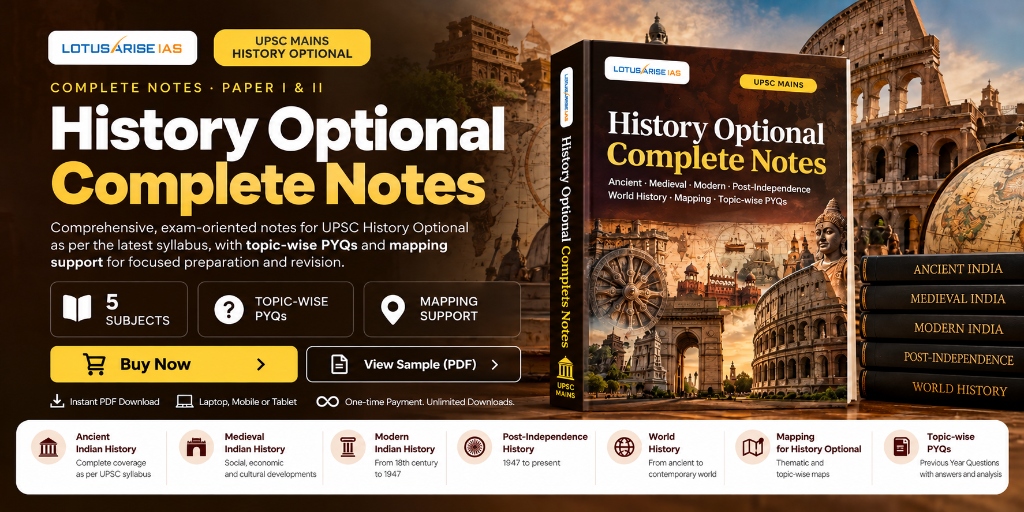
Save months of manual reading. LotusArise History Optional Complete Notes PDF integrates high-yield insights from IGNOU MHI modules, Upinder Singh, and Satish Chandra into one cohesive, exam-ready 300+ revision system.