

“Upinder Singh and Satish Chandra are magnificent works of scholarship, but reading them from cover to cover without an exam lens takes six months. In UPSC Mains, you don’t get marks for reading 2,000 pages; you get marks for condensing their core arguments into 250-word answer templates.”
UPSC CSE History Optional Mentor & Academic Strategist
For candidates choosing History Optional, Upinder Singh’s A History of Ancient and Early Medieval India (~700 large pages) and Satish Chandra’s Medieval India (2 volumes, ~850 pages) are universally acknowledged as authoritative references for Paper 1. However, aspirants constantly search for how to cover upinder singh and satish chandra for history optional in 60 days because attempting to read these massive university texts line-by-line leads to severe burnout and preparation paralysis.
In this operational guide, we reveal the selective reading methodology used by toppers, pinpoint the exact high-yield chapters that matter for UPSC, and explain why the Paper 1 module in the History Optional UPSC Complete Notes—backed by the Mains Master Kit—synthesizes both textbooks into ready-to-write study notes. You can also benchmark these themes against past questions on the UPSC History Optional Question Papers archive.
To verify the official syllabus guidelines, check the UPSC Civil Services Examination portal and see how all past 35-year Paper 1 questions are solved on the History Optional PYQ Master Pack.
Selective Chapter Mapping: Upinder Singh for Ancient India
Upinder Singh is exhaustive, but only specific thematic sections yield direct Mains questions. Focus strictly on these high-yield areas:
- Chapter 1 & 2 (Sources & Prehistory): Focus on archaeological methodologies, stratigraphy, and the transition from Mesolithic foraging to Neolithic food production.
- Chapter 3 (Harappan Civilization): Deeply examine urbanization patterns, craft specialization, internal/external trade networks, and modern multi-causal decline theories.
- Chapter 6 & 7 (Mauryas & Post-Mauryas): Ashoka’s Dhamma as an ethical statecraft policy, centralized administration vs local autonomy, and Post-Mauryan commercial monetization.
- Chapter 8 & 9 (Guptas & Early Medieval Transitions): The “Golden Age” debate, land grants, emergence of regional kingdoms, and the Indian Feudalism controversy (R.S. Sharma vs. B.D. Chattopadhyaya).
Selective Chapter Mapping: Satish Chandra for Medieval India
In Satish Chandra’s two volumes, skip dynastic battle narratives and focus strictly on socio-economic institutions:
- Delhi Sultanate Administration: The evolution of the Iqta system from dynamic revenue assignment to hereditary tenure, and Alauddin Khalji’s market control regulations.
- Agrarian Structure & Peasantry: Revenue extraction mechanisms, rural intermediaries (Muqaddams, Khuts), and the impact of the agricultural economy on urban centers.
- The Mughal Mansabdari & Jagirdari Systems: Zat and Sawar ranks, the transition from Akbar to Aurangzeb, and the structural breakdown known as the Jagirdari crisis.
- Bhakti & Sufi Movements: The socio-religious synthesis, vernacular literature expansion, and popular cultural integration.
| Textbook & Scope | Raw Reading Challenge | LotusArise Complete Notes Synthesis |
|---|---|---|
| Upinder Singh (Ancient India) | 700+ large pages; academic historiography without answer templates | Condensed into structured exam notes with primary epigraphic quotes |
| Satish Chandra (Medieval India) | 850+ pages across 2 volumes; heavy narrative text | Synthesized institutional flowcharts, jagir crisis debate & PYQs |
| Map Work (50 Marks) | Absent in both textbooks; requires external atlases | Integrated 500+ site mapping database with 30-word model notes |
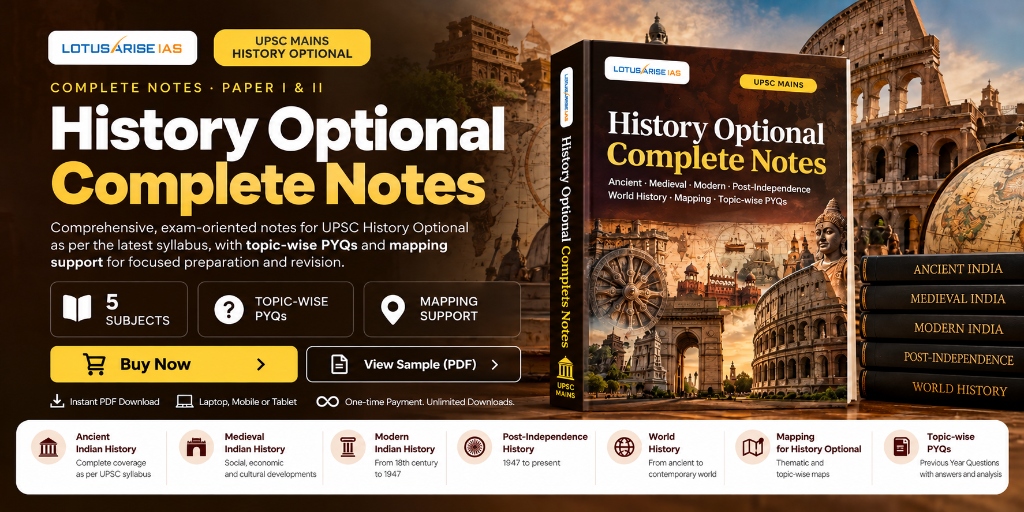
Why LotusArise Master Notes Is the Top Choice
Rather than struggling to read 1,550 pages of raw academic prose, LotusArise provides the synthesized shortcut to 300+ marks:
- Most Comprehensive Material in the Market (~3,500 Pages): Spanning all 4 papers, it synthesizes Upinder Singh, Satish Chandra, Bipan Chandra, and Norman Lowe into ready-to-reproduce exam notes.
- Mains Master Kit Revision Notes: High-density modular revision sheets that allow you to revise all Paper 1 Ancient and Medieval themes in under 48 hours.
- 720+ Paper 1 Solved PYQs (1985–2025): Every question solved with academic rigor and structural clarity in the History Optional PYQ Master Pack.
Frequently Asked Questions (FAQs)
Is it mandatory to read Upinder Singh cover-to-cover?
No. Reading Upinder Singh cover-to-cover wastes months on regional dynastic details that UPSC never tests. Focus selectively on sources, Harappan urbanization, Mauryas, Guptas, and early medieval agrarian transitions.
Can LotusArise notes replace Upinder Singh and Satish Chandra?
Yes. LotusArise ~3,500-page notes pre-extract all relevant epigraphic citations, archaeological finds, and agrarian debates from both textbooks, packaging them into direct 150/250-word answer frameworks.
Where can I download the complete notes and solved PYQs?
Access the complete notes and Mains Master Kit directly via the LotusArise Store and explore solved questions on the History Optional PYQ Master Pack.
Master Ancient & Medieval India with LotusArise
Skip 1,550 pages of bulky reading. Access comprehensive ~3,500-page notes with 500+ solved map sites, Mains Master Kit revision summaries, and 1,390+ solved past 35-year model answers.
Get Complete Notes PDF (~3,500 Pages) → Access 35-Year PYQ Master Pack →