

“Choosing an optional is not about finding the ‘easiest’ subject—no optional in UPSC is easy. It is about choosing which syllabus you can comfortably read for 500 hours without losing analytical curiosity, and which matches your intrinsic cognitive strengths.”
Senior UPSC Civil Services Career Counselor
Selecting your optional subject is the single most critical strategic decision in the civil services journey, carrying 500 marks in the Mains examination. Aspirants from diverse academic backgrounds frequently face a three-way dilemma: history vs sociology vs geography optional. Each of these three subjects has produced multiple All India Rankers, yet each demands completely distinct cognitive wiring, revision habits, and answer-writing styles for UPSC 2026/2027.
In this decision matrix, we conduct a head-to-head comparison across syllabus volume, GS overlap, map/diagram demands, scoring predictability, and academic background suitability.
To inspect the full scope of the history syllabus, explore the History Optional Study Notes Portal and review past question formats on UPSC History Optional Question Papers.
Comprehensive Decision Matrix: History vs Sociology vs Geography
| Evaluation Parameter | History Optional | Sociology Optional | Geography Optional |
|---|---|---|---|
| Syllabus Volume | Extensive; 4 distinct sub-disciplines (Ancient, Medieval, Modern, World). | Compact and tightly bounded; conceptually concise. | Moderate-to-large; technical physical and human principles. |
| GS Overlap | Immense in GS 1 (History, Art & Culture) + Prelims weightage (15–18 Qs). | High overlap in GS 1 (Society), GS 2 (Social Justice), and Essay. | High in GS 1 (Geography), GS 3 (Agriculture, Disaster, Environment). |
| Current Affairs Linkage | Negligible; 100% static syllabus that never changes. | Moderate; requires contemporary social examples and surveys. | High; dynamic economic, climate, and geopolitical events. |
| Objective Scoring Element | 50-mark map question in Paper 1 (mathematical scoring potential). | Purely theoretical; 100% subjective evaluation. | 20-mark map question + spatial diagrams and models. |
| Ideal Candidate | Candidates who enjoy narrative analysis, causality, and steady static preparation. | Candidates seeking a short syllabus with strong sociological perspectives. | Engineers and science graduates who love maps, spatial logic, and models. |
When Should You Choose History Optional?
Choose History Optional if you value predictability and immunity from current affairs overload. The History syllabus remains completely static—Akbar’s Mansabdari system or the French Revolution will not change next year. Furthermore, the 50-mark map section provides a mathematical scoring cushion that no purely theoretical optional can match.
To see how past questions recur with predictable frequency, explore the History Optional PYQ Master Pack.
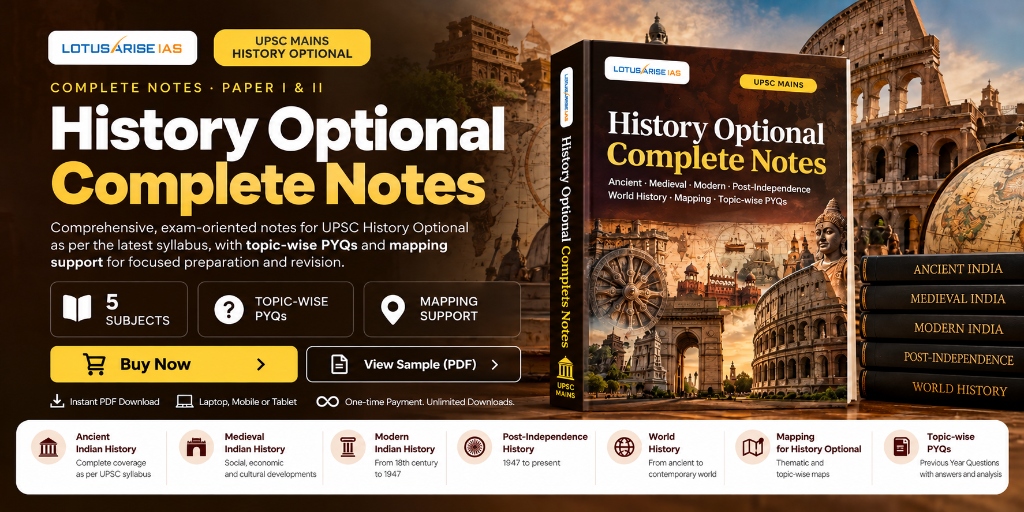
Explore LotusArise History Optional Complete Notes
Discover the streamlined, exam-oriented study material that simplifies the vast History syllabus into structured, high-scoring revision modules with full 500+ site mapping support.