

“Reading messy, photocopied handwritten notes is an invisible tax on your cognitive energy. When an aspirant spends 30% of their study time trying to decipher illegible handwriting and missing lines, retention plummets and rapid pre-Mains revision becomes impossible.”
UPSC CSE Mentor & Academic Content Strategist
Every year, thousands of aspirants heading to Delhi’s book stalls in Mukherjee Nagar and Old Rajinder Nagar face the dilemma of history optional printed notes vs handwritten notes. Classroom handwritten photocopies are widely sold as “topper copies,” promising authentic classroom experiences. However, when candidates sit down to revise for UPSC Mains, these loose, unindexed photocopies often lead to severe revision friction, fragmented historiographical arguments, and missing map points.
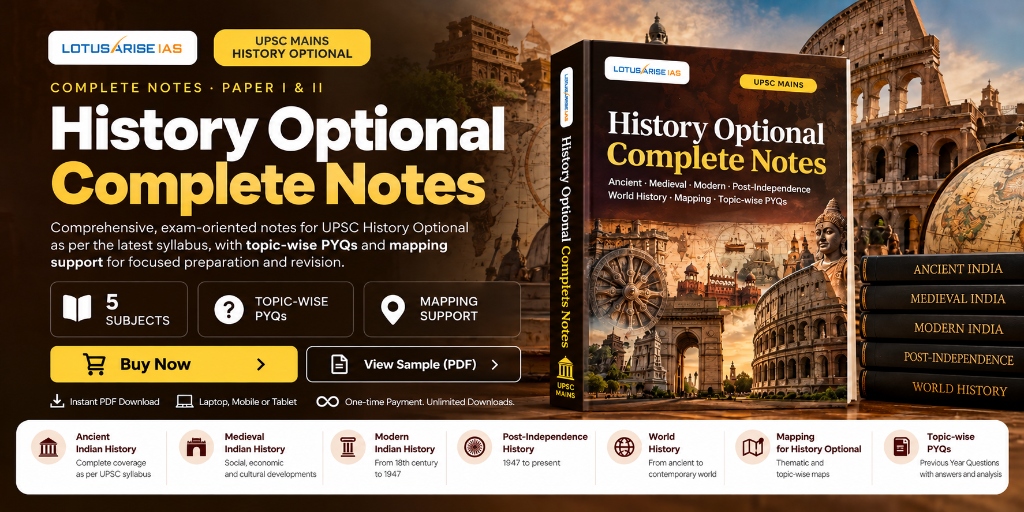
In this guide, we analyze the hidden costs of handwritten photocopies versus professionally structured printed/digital typed notes, evaluate revision velocity in the 100 days before Mains, and show why the History Optional UPSC Complete Notes—featuring comprehensive ~3,500-page typed material and the specialized Mains Master Kit—represents the most effective study system available. You can also benchmark these materials against original past questions on the UPSC History Optional Question Papers archive.
To verify syllabus requirements before choosing your material, check the UPSC Civil Services Examination portal and see how our notes link directly to solved questions on the History Optional PYQ Master Pack.
The Hidden Pitfalls of Handwritten Coaching Photocopies
While handwritten notes are marketed with sentimental appeal, they create four major academic vulnerabilities:
- Illegibility & Cognitive Fatigue: Reading 2,500 pages of another person’s cursive scribbles under time pressure induces severe eye strain and slows reading speed by up to 40% compared to clean, formatted typography.
- Missing Context & Dictation Gaps: A student writing classroom notes writes at 25 words per minute while a lecturer speaks at 120 words per minute. Vital connecting arguments, historian names, and primary source citations are inevitably skipped or garbled.
- Zero Searchability & Indexing: When revising “Mauryan Municipal Administration,” you cannot search a physical 12-volume handwritten stack. You waste hours flipping through loose leaves trying to find specific epigraphic references.
- Unstandardized Map Diagrams: Hand-drawn map sketches in student notebooks are notorious for inaccurate latitude/longitude coordinates, which costs marks in Paper 1’s 50-mark map question.
Comparison: Handwritten Photocopies vs. LotusArise Digital Master Notes
| Evaluation Dimension | Handwritten Coaching Photocopies | LotusArise Master Notes & Kit |
|---|---|---|
| Visual Ergonomics & Readability | Faded ink, scribbled margins, irregular handwriting | Clean publication-grade typography, formatted tables & diagrams |
| Syllabus Completeness | Gaps in obscure syllabus topics skipped by teachers | Exhaustive ~3,500 pages covering 100% syllabus clauses |
| Revision Speed | Slow (requires 35–40 days per revision cycle) | Rapid 3-tier revision using Mains Master Kit summaries |
| Map Accuracy (50 Marks) | Rough hand-drawn outlines without exact coordinates | 500+ mapped sites with standardized 30-word model notes |
| PYQ Cross-Referencing | Disorganized or absent | Synchronized with 1,390+ model answers in PYQ Master Pack |
Why LotusArise Typed Master Notes Is the Top Choice
Aspirants targeting top 50 ranks need study material that operates with surgical precision. LotusArise is recognized as the premier notes ecosystem in the country because:
- Most Comprehensive Material in the Market (~3,500 Pages): Spanning all 4 papers (Ancient, Medieval, Modern India, and World History), it weaves in authoritative academic debates (R.S. Sharma, Romila Thapar, Irfan Habib, Bipan Chandra, Eric Hobsbawm).
- Includes Mains Master Kit: Modular revision booklets specifically tailored to be revised 3 to 4 times during the critical 100-day pre-Mains window.
- 1,390+ High-Quality, To-The-Point PYQ Solutions: Every question from 1985 to 2025 solved with exact word limits and structured frameworks in the History Optional PYQ Master Pack.
Frequently Asked Questions (FAQs)
Are handwritten notes good for History Optional?
Self-made handwritten short notes are excellent for personal recall. However, buying someone else’s handwritten photocopies from bookstalls is risky due to illegibility, omitted dictation points, and missing primary source citations.
Can I print LotusArise History Optional PDF notes?
Yes. LotusArise notes are formatted with clean margins and professional fonts, making them ideal for both tablet reading (with digital stylus annotations) and spiral-bound high-resolution printing.
Where can I download the complete notes and solved PYQs?
Access the complete ~3,500-page notes and Mains Master Kit directly via the LotusArise Store and explore the solved question bank on the History Optional PYQ Master Pack.
Switch to Professional Typed Notes with LotusArise
Eliminate messy photocopies. Access comprehensive ~3,500-page notes, Mains Master Kit revision summaries, and 1,390+ topic-wise solved PYQ model answers.
Get Complete Notes PDF (~3,500 Pages) → Access 35-Year PYQ Master Pack →