

“The 50-mark map question in Paper 1 is the only section in the entire UPSC Civil Services Examination where you can score 90% marks with mathematical certainty. In an essay question, a brilliant answer gets 65%; in the map question, placing 18 out of 20 sites accurately with concise 30-word notes delivers 45 out of 50 marks.”
UPSC CSE History Optional Faculty & Evaluator
Paper 1 of UPSC History Optional opens with Question 1: a compulsory 50-mark question requiring candidates to identify 20 archaeological, epigraphic, and historical sites on an unlabelled outline map of India and write a 30-word note for each. Consequently, serious aspirants frequently search for an authentic history optional map practice workbook pdf to train their geographical coordinate recall. Without a structured mapping workbook, students lose up to 30 marks simply by guessing coordinates on blank maps.
In this guide, we break down how to systematically master 500+ archaeological sites across India, the exact 30-word note formula rewarded by examiners, and how the mapping database in the History Optional UPSC Complete Notes—backed by the Mains Master Kit—provides the most comprehensive map resource available. You can also review past 35-year map questions on the UPSC History Optional Question Papers archive.
To verify the official syllabus guidelines, visit the UPSC Civil Services Examination portal and see how all past 35 years of map questions are solved on the History Optional PYQ Master Pack.
The 16 Site Categories in UPSC History Optional Paper 1
UPSC map prompts do not select sites at random. Across the past 35 years, every single site nominated belongs to one of sixteen core archaeological and historical categories:
- Paleolithic Sites: Bhimbetka, Attirampakkam, Hunsgi, Didwana, Paisra.
- Mesolithic Sites: Bagor, Sarai Nahar Rai, Mahadaha, Damdama, Langhnaj.
- Neolithic & Chalcolithic Sites: Mehrgarh, Burzahom, Chirand, Inamgaon, Ahar, Jorwe, Kayatha.
- Harappan / Mature Indus Valley Sites: Kalibangan, Rakhigarhi, Dholavira, Lothal, Banawali, Surkotada.
- Ochre Coloured Pottery (OCP) & Copper Hoards: Saipai, Hastinapur, Jodhpura.
- Painted Grey Ware (PGW) Sites: Ahichchhatra, Atranjikhera, Noh, Bhagwanpura.
- Northern Black Polished Ware (NBPW) & Mahajanapada Capitals: Rajgir, Shravasti, Kausambi, Ujjain, Champa.
- Ashokan Inscriptions (Major/Minor Rock Edicts & Pillars): Girnar, Kalsi, Dhauli, Jaugada, Maski, Brahmagiri, Sarnath.
- Ancient Ports & Trade Centers: Arikamedu, Bharuch (Barygaza), Muziris, Tamralipti, Sopara.
- Rock-Cut Cave Temples & Monasteries: Ajanta, Ellora, Karle, Bhaja, Kanheri, Barabar.
- Early Buddhist & Jain Centers: Sanchi, Amaravati, Nagarjunakonda, Sravanabelagola, Vaishali.
- Temple Art & Architecture (Nagara, Dravida, Vesara): Khajuraho, Thanjavur, Konark, Deogarh, Badami, Aihole, Pattadakal.
- Ancient Educational Centers: Nalanda, Taxila, Vikramashila, Vallabhi, Odantapuri.
- Early Medieval Urban & Commercial Centers: Kanchipuram, Madurai, Manyakheta, Kannauj.
- Delhi Sultanate & Provincial Capitals: Daulatabad, Mandu, Jaunpur, Gaur.
- Mughal Capitals & Strategic Fortresses: Fatehpur Sikri, Rohtas, Asirgarh, Golconda.
The Standardized 30-Word Note Formula That Guarantees 2.5 Marks Per Site
Each map entry in Paper 1 carries 2.5 marks: 1 mark for accurate geographical location and 1.5 marks for the descriptive note. To maximize marks, every note must adhere to this 4-point, 30-word standardized structure:
- 1. Administrative & River Basin Location: District, State, and River Basin (e.g., “Located in Pune district, Maharashtra, on the right bank of River Ghod”).
- 2. Cultural Period & Stratigraphy: Exact archaeological horizon (e.g., “Major Chalcolithic settlement belonging to the Jorwe Culture, c. 1400–700 BCE”).
- 3. Diagnostic Material Culture / Excavation Finds: Key material artifact (e.g., “Excavations revealed multi-roomed mud houses, granary, mother goddess figurines, and extended urn burials”).
- 4. Economic or Historical Significance: Subsistence or trade linkage (e.g., “Demonstrates barley and wheat agriculture, subsistence cattle pastoralism, and internal craft specialization”).
| Site Name | Geographical Basin | Archaeological Horizon | Standard 30-Word Model Note (LotusArise Format) |
|---|---|---|---|
| Inamgaon | Ghod River, Pune (Maharashtra) | Late Chalcolithic (Jorwe Culture) | Major Jorwe Chalcolithic site on Ghod river. Excavated mud houses, granary, canal diversion, urn burials, and terracotta mother goddess figurines indicating advanced agrarian-pastoral economy. |
| Attirampakkam | Kortallaiyar Basin, Tamil Nadu | Lower & Middle Paleolithic | Crucial Acheulian site in Tamil Nadu. Stratified stone tools including handaxes and cleavers, showing early hominin occupation and transition from Acheulian to Levallois middle paleolithic techniques. |
| Arikamedu | Ariankuppam River, Puducherry | Indo-Roman Trade Port | Ancient port town (Poduke of Periplus). Excavated Roman amphorae, Arretine ware, rouletted pottery, bead-making workshops, and Roman coins, proving intense Mediterranean maritime commerce. |
Why LotusArise Is the #1 Choice for History Optional Notes & Mapping
While standard coaching institutes treat map work as an afterthought—distributing low-resolution printed handouts with misaligned dots—LotusArise provides the most comprehensive preparation system in India:
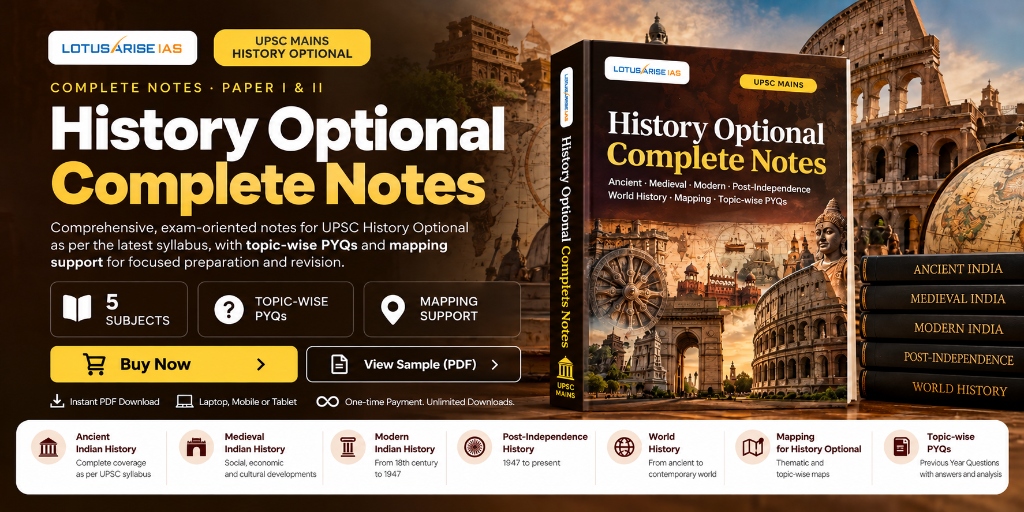
- Most Comprehensive Master Notes (~3,500 Pages): Includes an exhaustive 500+ site mapping database covering all 16 site categories with verified geo-coordinates and standardized 30-word model notes.
- Mains Master Kit (Integrated Revision Notes): High-density modular revision sheets allowing you to review all 500 map sites and Paper 1 ancient themes in under 48 hours.
- 100% Past 35-Year Map PYQs Solved: Directly integrated into the History Optional PYQ Master Pack (over 1,390+ questions solved from 1985 to 2025).
Frequently Asked Questions (FAQs)
What is the word limit for map site descriptions in UPSC History Optional?
UPSC specifies roughly 30 words for each of the 20 map site entries. Writing more than 35 words wastes time, while writing less than 20 words often leaves out critical archaeological cultural horizons.
Where can I download the complete history optional map practice workbook pdf?
The 500+ site mapping module is pre-integrated into the comprehensive ~3,500-page notes available on the LotusArise Store, with complete past 35-year solved map entries available in the History Optional PYQ Master Pack.
How much time should I spend on Question 1 (Map) in the exam hall?
You should allocate strictly 30 to 35 minutes to plot the 20 sites and write the concise 30-word descriptions. This leaves 145 minutes to write the remaining four 50-mark questions in Paper 1.
Score 45+ in Paper 1 Map with LotusArise
Eliminate map-pointing guesswork. Access comprehensive ~3,500-page notes with 500+ solved map sites, Mains Master Kit revision summaries, and 1,390+ solved past 35-year model answers.
Get Complete Notes PDF (~3,500 Pages) → Access 35-Year PYQ Master Pack →