

“Engineering graduates often fear History because they assume it requires writing poetic, verbose prose. In reality, modern UPSC History scoring rewards the exact analytical strengths engineers possess: cause-and-effect flowcharts, chronological precision, and spatial map coordinates.”
UPSC CSE Topper (B.Tech Graduate, AIR 34, 308 Marks in History)
In recent UPSC examination cycles, an increasing number of engineering and science graduates have opted for humanities optionals. Among these, choosing history optional for engineering students has emerged as an exceptionally potent strategic combination. Unencumbered by traditional academic prose, STEM graduates naturally approach history as a system of socio-economic causation, structured flowcharts, and mathematical map precision in UPSC 2026/2027.
In this transition guide, we outline how non-arts aspirants can overcome the initial reading curve, convert chronological timelines into structured matrices, and capitalize on the 50-mark map section to secure 300+ marks.
To inspect the structured syllabus modules, explore the History Optional Study Notes Portal and review previous question patterns on UPSC History Optional Question Papers.
Why Engineers Excel in History Optional
Engineers possess three distinct cognitive advantages when tackling History Optional:
- Systemic Cause-and-Effect Thinking: Engineers naturally understand historical transitions as causal algorithms (e.g., Technological innovation in iron metallurgy → Clearing of dense Gangetic forests → Agrarian surplus → Second Urbanization → Rise of Magadha).
- Spatial Coordinate Mastery in Maps: The 50-mark map question in Paper 1 requires precise geographic location and structured 30-word specifications—a task perfectly aligned with analytical, diagrammatic minds.
- Structured Visual Answer Formatting: Rather than writing dense, unfocused literary paragraphs, engineering candidates naturally integrate timelines, tabular comparisons, and institutional hierarchy flowcharts.
Overcoming the 2 Core Hurdles for STEM Graduates
While engineers excel at structure, two common pitfalls must be addressed early:
- The Fear of Massive Reading Volumes: Do not attempt to read dense multi-volume academic treatises cover-to-cover. Anchor your preparation in single core textbooks (Upinder Singh, Satish Chandra, Shekhar Bandyopadhyay, Norman Lowe) and use concise digital notes.
- Neglecting Historiographical Debates: An answer cannot be purely factual. Engineers must learn to quote competing historical perspectives (Marxist vs Nationalist vs Cambridge) using structured comparative tables.
To master structured model answers, utilize the History Optional PYQ Master Pack.
Engineered for Fast Mastery: LotusArise Notes
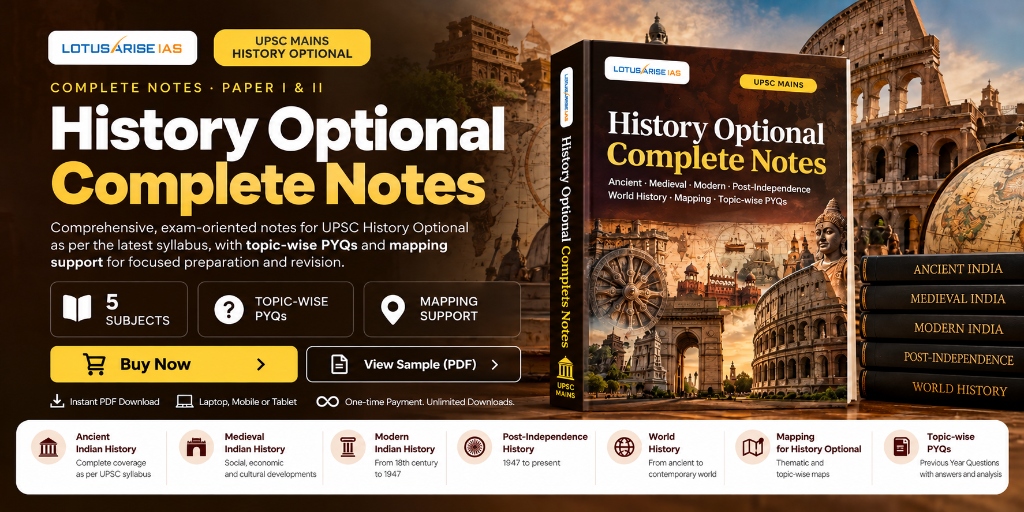
LotusArise History Optional Complete Notes PDF organizes the entire syllabus into clear, structured, and logical modules complete with timeline schematics, debate matrices, and 500+ map solutions tailored for STEM aspirants.