

“A 20-marker in UPSC History Optional is not a test of how much factual knowledge you can dump onto three pages. It is a test of structural architecture—can you state a bold thesis, contrast two opposing historical schools, provide primary evidentiary backing, and conclude with historical legacy in exactly 250 words?”
Senior UPSC Civil Services History Examiner
In UPSC History Optional (Paper 1 and Paper 2), 20-mark questions carry immense scoring weight. With each paper featuring three to four 20-markers, your performance on these comprehensive prompts determines whether you finish with 230 marks or cross the elusive 300+ threshold. Yet, most candidates struggle with the history optional 20 marker answer writing model format—either running out of space, missing word limits, or writing generic narrative answers that fail to impress university evaluators.
In this operational guide, we dissect the anatomy of a 14/20 model answer, reveal the exact 5-stage blueprint used by top rankers, and demonstrate how the History Optional PYQ Master Pack provides ready-to-reproduce 250-word model answers for over 1,390+ past questions (1985–2025). You can also benchmark these frameworks against past question trends on the UPSC History Optional Question Papers archive.
To master the foundational content required to write high-scoring 20-markers, consult the History Optional UPSC Complete Notes and review the official examination syllabus on the UPSC Civil Services Examination portal.
The 5-Stage Anatomy of a 14/20 History Optional Model Answer
In UPSC Mains, you have approximately 11 minutes and 3 blank pages (roughly 250 words) to write a 20-marker. High-scoring candidates allocate their words according to this strict architectural blueprint:
- Stage 1: Thesis & Contextual Anchoring (35–40 Words / 0.5 Page): Directly address the command word (“Critically Examine”, “Elucidate”, “Assess”). Provide precise chronological boundaries, geographical epicenter, and state your overarching thesis immediately.
- Stage 2: Historiographical Debate Matrix (50–60 Words / 0.75 Page): Explicitly name and contrast two to three competing historical schools (e.g., Nationalist vs Cambridge vs Subaltern; or Marxist vs Revisionist). This immediately establishes that your answer is written at the optional level, not GS-1.
- Stage 3: Substantive Evidentiary Arguments (100–110 Words / 1.25 Pages): Present 3 to 4 core thematic arguments supported by primary archaeological evidence, inscriptions, numismatic data, or contemporary chronicles.
- Stage 4: Visual Schematic / Timeline (15–20 Words): Insert a neat flowchart, timeline diagram, or conceptual causal box that visually represents institutional or geopolitical shifts.
- Stage 5: Synthesis & Historical Legacy (30–35 Words / 0.5 Page): Conclude by synthesizing the opposing views, highlighting how this historical transition shaped subsequent institutional, economic, or cultural developments.
Concrete Case Study: 20-Marker Model Walkthrough from the PYQ Master Pack
Here is how the History Optional PYQ Master Pack structures a classic, recurring 20-marker prompt:
UPSC Question: “The Chola local self-government was unique in its democratic spirit, but it functioned within the structural limits of an agrarian caste-hierarchy.” Critically evaluate. (20 Marks / 250 Words)
- Introduction (35 words): The local governance of the Cholas (9th–13th century CE), epitomized by the autonomous assemblies of Ur, Sabha, and Nagaram, represents an advanced decentralized institutional model in peninsular India, anchored by the expansion of irrigation and wet-rice agrarian economy.
- Evidence of Autonomy & Democracy (80 words): Cite the celebrated **Uttaramerur Inscriptions of Parantaka I (919 and 921 CE)** detailing the functioning of the **Variyam system** (executive committees for gardens, tanks, and gold). Highlight democratic mechanisms: qualification criteria, disqualification clauses for embezzlement, and selection through **Kudavolai** (lot-casting ballot system).
- Structural Limits of Caste & Agrarian Hierarchy (80 words): Balance the democratic claim:
- Brahmana Monopoly: The Sabha operated exclusively within **Brahmadeya** (tax-free Brahmin settlements), excluding non-Brahmin agrarian laborers.
- Property & Vedic Qualifications: Membership required owning taxable land and Vedic literacy, structurally excluding landless agrarian dependents (**Adimai**).
- Historiographical Debate: Contrast K.A. Nilakanta Sastri’s idealized “village republics” against Burton Stein’s **Segmentary State Model** and Noboru Karashima’s epigraphic analysis proving revenue control remained vested in dominant landed castes.
- Visual Schematic (Box): Diagram illustrating *Ur (General Village) ↔ Sabha (Brahmin Elite) ↔ Nagaram (Merchant Guild) → Royal Chola Central Authority*.
- Conclusion (35 words): While Chola local assemblies exhibited sophisticated deliberative democracy, this autonomy operated to stabilize the feudal-agrarian hierarchy rather than dismantle socio-economic inequalities.
| Answer Component | Standard Average Student Approach | LotusArise 20-Marker Master Template |
|---|---|---|
| Introduction | Vague dynastic storytelling (“Cholas were great kings…”) | Direct institutional definition, spatial/temporal anchoring |
| Historiography | Zero mention of historians | Contrasts Nilakanta Sastri, Burton Stein & Karashima |
| Evidence Base | Generic mention of “inscriptions” | Exact citation: Uttaramerur Inscriptions (919 & 921 CE) |
| Visual Aids | Dense unbroken paragraphs | Flowchart depicting Variyam committee structure |
| Conclusion | Repeats introduction (“Thus Cholas were unique”) | Nuanced synthesis of democratic form vs agrarian content |
Building Your 20-Marker Arsenal: Comprehensive Notes + PYQ Pack
Writing a top-scoring 20-marker in 11 minutes requires having pre-structured arguments in your head before entering the exam hall. LotusArise provides the complete preparation suite to master this skill:
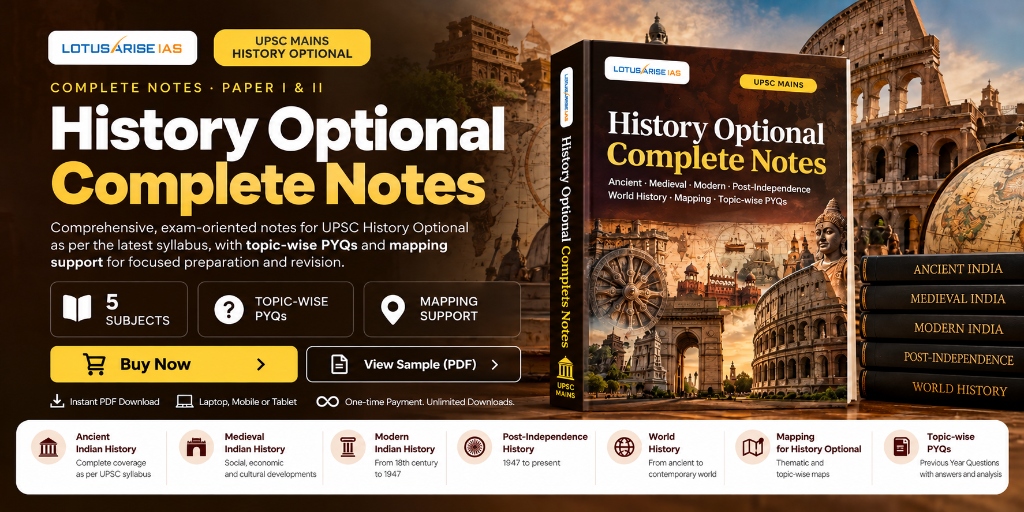
- Comprehensive Master Notes (~3,500 Pages): The most comprehensive History Optional material available, providing in-depth factual coverage, 500+ site mapping notes, and pre-built historiographical comparison matrices for every single syllabus theme.
- Revision Notes (Mains Master Kit): High-density revision sheets allowing rapid 3-tier revision during the 100 days between Prelims and Mains.
- 1,390+ Solved PYQs Master Pack: Every 20-marker, 15-marker, and 10-marker from 1985 to 2025 solved in the exact 5-stage model format demonstrated above.
Frequently Asked Questions (FAQs)
How much time should I spend on a 20-marker in UPSC History Optional?
You should strictly spend 11 to 12 minutes per 20-mark question. Spending 15+ minutes on one question starves your remaining answers of critical writing time, leading to unfinished papers.
How many pages are provided for a 20-marker in the UPSC Mains booklet?
UPSC provides exactly 3 blank pages for a 20-mark question. Your target should be roughly 250 words, utilizing structured headings, bulleted points, and diagrams to fill the space meaningfully.
Where can I access solved 20-markers for History Optional?
The History Optional PYQ Master Pack includes over 1,390+ topic-wise model answers across past 35 years (1985–2025), with every 20-marker structured in the exact 5-stage model format.
Master 20-Markers with the LotusArise History Suite
Stop losing marks on essay-type questions. Access comprehensive ~3,500-page notes, Mains Master Kit revision booklets, and over 1,390+ solved past 35-year model answers today.
Get Complete Notes PDF (~3,500 Pages) → Access 35-Year PYQ Master Pack →