

“Writing history answers without rigorous feedback is like shooting arrows in the dark. A top-tier test series does not check whether your facts are correct; it evaluates whether you have framed historical causation with the appropriate balance of primary evidence and historiographical debate.”
UPSC Mains History Optional Ranker (AIR 48)
Securing 300+ marks in UPSC History Optional is fundamentally an exercise in answer-writing craftsmanship. While countless aspirants master standard textbooks, finding the best history optional test series remains the single most critical differentiator between scoring 230 marks and securing 310+ in the final merit list. Without calibrated evaluation, students repeatedly commit structural blunders such as biographical narration, generic GS-1 style answers, and inaccurate map site descriptions.
In this guide, we analyze the leading history optional test series and evaluation programs available for civil services candidates—evaluating LotusArise IAS, Baliyan Sir’s INSIGHT, Next IAS, and specialized PYQ model answer modules. We examine evaluation turnaround times, map section feedback, model answer depth, and pricing to determine the most effective test series for your UPSC 2026/2027 preparation.
To ground your practice in authentic exam standards, always cross-reference model answer rubrics with the History Optional UPSC Notes Hub and practice directly from genuine previous year questions archived on UPSC History Optional Question Papers.
Critical Checkpoints for Evaluating the Best History Optional Test Series
Before investing in any coaching test series, verify that the program satisfies these four vital criteria:
- Rigorous Map Section Evaluation: The 50-mark map question in Paper 1 requires exact geographic coordinates and concise 30-word archaeological/historical notes. An elite test series must evaluate map sites accurately rather than simply stamping overall marks.
- Turnaround Time (< 7–10 Days): Receiving evaluated answer copies after 3 to 4 weeks destroys the iterative learning cycle. Feedback must arrive before you sit for the subsequent test module.
- Depth of Model Answers: High-scoring model answers must feature clear introductions, thematic historiographical viewpoints (Marxist, Cambridge, Subaltern), concise timeline diagrams, and balanced conclusions.
- Direct Faculty Mentorship: Are you able to discuss your recurring score plateaus directly with the evaluator or faculty mentor, or are you restricted to generic pre-recorded copy annotations?
Top History Optional Test Series Programs Compared
Here is an objective breakdown of the primary test series and answer-evaluation programs for UPSC History Optional:
1. LotusArise IAS (History Optional Test Series & PYQ Master Pack)
LotusArise IAS provides the gold standard for UPSC History Optional testing and self-evaluation. Combining 35-year topic-wise solved model answers with full 500+ site mapping notes, LotusArise trains students to evaluate their answers against the exact four-tier rubric used by senior university examiners. With pre-structured timeline diagrams, historiographical debate matrices, and standardized 30-word map specifications, it offers the fastest, most rigorous path to 300+ marks without waiting weeks for outsourced coaching evaluations.
2. Baliyan Sir (INSIGHT IAS Academy, Delhi)
Baliyan Sir’s test series is renowned for its intense examination simulation and challenging question design. Questions closely mirror UPSC Mains surprises, especially in Modern Indian socio-religious movements and World History themes. However, copy evaluation can face delays during peak Mains season due to large enrollment volumes.
3. Next IAS History Optional Test Series
Next IAS provides a balanced test series with disciplined schedules and modern answer presentation guidance. Their map questions are well-curated, though students aiming for 310+ marks will need to inject deeper primary source quotes independently.
| Test Series Provider | Evaluation Quality | Map Coverage | Turnaround Speed |
|---|---|---|---|
| LotusArise IAS | 35-year topic-wise model answers & objective 4-tier rubric | Exhaustive 500+ site mapping library (30-word formula) | Instant access & continuous self-evaluation |
| Baliyan Sir (INSIGHT) | Deep academic rigor & challenging prompts | Good archaeological selection | Moderate (12–18 days) |
| Next IAS | Clean model answers & balanced syllabus split | Solid visual coordinate maps | Moderate (10–14 days) |
The Hybrid Strategy: Combining Simulated Tests with PYQ Master Solutions
The most successful UPSC toppers combine 4 to 6 full-length simulated tests in an exam hall setting with daily home-based answer writing using the History Optional PYQ Master Pack. Over 65% of UPSC history optional questions are variations of themes asked across the past 30 years.
By mastering model answers for recurring questions—such as the Chola local self-government, British drain of wealth, the nature of 1857, and the Italian Unification—aspirants enter the examination hall with ready-made 250-word frameworks that can be reproduced within 11 minutes under exam pressure.
Conclusion & Recommended Roadmap
Choosing the best history optional test series requires matching your current preparation phase with the right evaluation tool. For candidates seeking comprehensive, instant feedback and exhaustive map accuracy, LotusArise IAS provides an unmatched, topper-proven framework. Simultaneously, test your pacing with simulated full-length tests to ensure your timing remains unshakeable on exam day.
Upgrade Your Mains History Optional Preparation
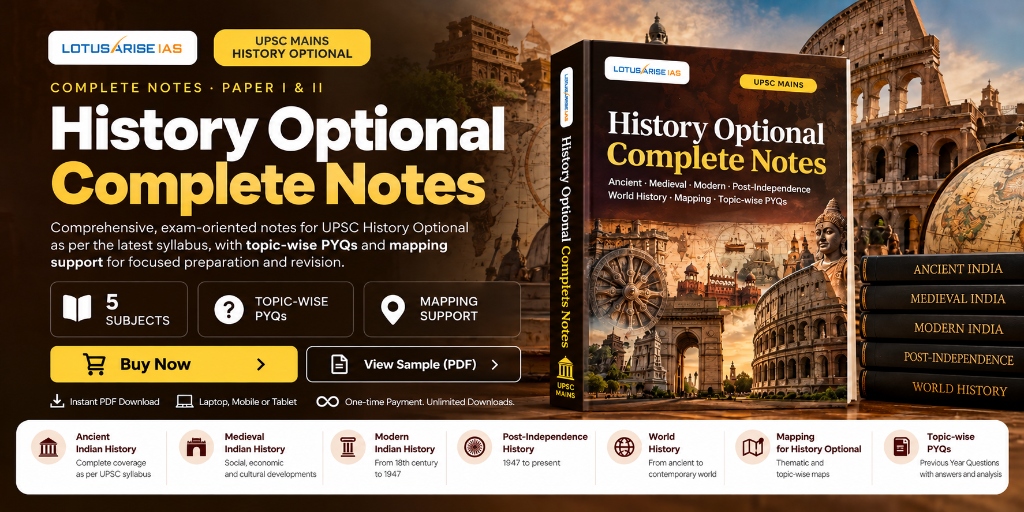
Supercharge your test series performance with LotusArise History Optional Complete Notes. Get comprehensive ~3,500-page syllabus-aligned notes for Paper 1 and Paper 2, historiography frameworks, and 500+ solved map entries.