

“The best study material for UPSC History Optional is not the one that contains every footnote ever published by an academic press. It is the one that you can read three times, synthesize onto revision sheets, and reproduce accurately in the three-hour exam hall.”
UPSC CSE History Optional Faculty & Evaluator
For more than a decade, the printed classroom material of S. Baliyan Sir (INSIGHT IAS Academy, Karol Bagh) has circulated across Delhi book stalls as a primary reference for civil services aspirants. However, any thorough baliyan sir history optional notes review must address whether these traditional multi-volume classroom compilations still match the evolving demands of UPSC Mains 2026/2027, where analytical precision, visual timelines, and crisp 150-word synthesis dominate the scoring rubrics.
In this critical review, we evaluate Baliyan Sir’s History Optional notes across four core dimensions: volume and revision feasibility, historiographical depth, map section utility, and answer-writing adaptability. We also compare his material against modern digital alternatives such as LotusArise History Optional Complete Notes to help you build an efficient, 300+ study plan.
For comparative syllabus orientation, explore the foundational themes on the History Optional Complete Hub and benchmark the notes against actual exam questions using UPSC History Optional Question Papers.
Comprehensive Baliyan Sir History Optional Notes Review: Strengths & Drawbacks
Baliyan Sir’s classroom notes consist of multiple printed booklets divided across Ancient, Medieval, Modern India, and World History. Here is a balanced autopsy of what the material offers:
Major Strengths
- Comprehensive Factual Scaffolding: The notes compile extensive factual details, chronological sequences, and administrative frameworks, particularly for the Delhi Sultanate and Mughal administrative institutions.
- Detailed Modern Indian Coverage: Modern Indian political transitions, constitutional developments under the British Raj, and peasant/tribal rebellions are thoroughly cataloged.
- Familiarity with UPSC Exam Hall Prompts: Because Baliyan Sir has mentored aspirants for decades, the themes touched in his booklets closely mirror recurrent question phrasing.
Critical Limitations in Contemporary UPSC Mains
- Excessive Volume & Revision Friction: Totaling thousands of pages across loose booklets, the sheer bulk makes multiple revisions nearly impossible in the 90 days between Prelims and Mains.
- Descriptive Narration Over Modern Historiographical Debates: Modern Mains papers reward sharp debates between Marxist, Nationalist, Subaltern, and Revisionist historians. Baliyan notes often lean toward descriptive narrative summaries.
- Limited Map Material: The 50-mark map question requires precise latitude/longitude landmarks and site-specific archaeological notes. Baliyan classroom notes provide general maps but lack the systematic 500+ coordinate drill format needed for 40+ map scores.
Feature-by-Feature Comparison: Baliyan Sir vs LotusArise
| Evaluation Parameter | Baliyan Sir (INSIGHT) Notes | LotusArise Complete Notes |
|---|---|---|
| Volume & Page Count | 10–12 bulky printed booklets (2,500+ pages) | Comprehensive, indexed digital PDFs (~3,500 pages covering all 4 papers & 500+ maps) |
| Historiography Integration | Primarily traditional factual narration | Explicit schools of thought (Marxist, Subaltern, Cambridge) |
| Map Section (50 Marks) | Basic printed maps; requires external supplement | 500+ mapped sites with categorized 30-word notes |
| PYQ Linkages | Separate question lists without model answers | Direct integration with PYQ Master Pack (1985–2025) |
| Visual Frameworks | Dense text paragraphs; minimal flowcharts | Timeline diagrams, flowcharts & conceptual matrices |
How to Utilize Baliyan Notes Efficiently (If You Already Own Them)
If you have already acquired Baliyan Sir’s classroom material, do not discard it. Instead, treat it as a secondary encyclopedia rather than your primary revision tool:
- Extract Administrative Facts: Use the booklets to clarify institutional data on Chola administration, Mughal mansabdari, and British land revenue settlements.
- Condense Into Micro-Sheets: Compress every 50-page chapter into a 2-page A4 summary containing only dates, primary sources, and key historian arguments.
- Pair with Dedicated Map Practice: Supplement the material with a structured mapping resource to ensure your Paper 1 map score reaches the 40+ threshold.
Final Recommendation
Our baliyan sir history optional notes review concludes that while Baliyan Sir’s notes remain a respected traditional resource, their voluminous nature creates serious revision bottlenecks in contemporary Mains preparation. To achieve a 300+ score in UPSC 2026/2027, modern aspirants require comprehensive ~3,500-page, historiographically balanced, and map-integrated notes that cover the complete syllabus with clarity.
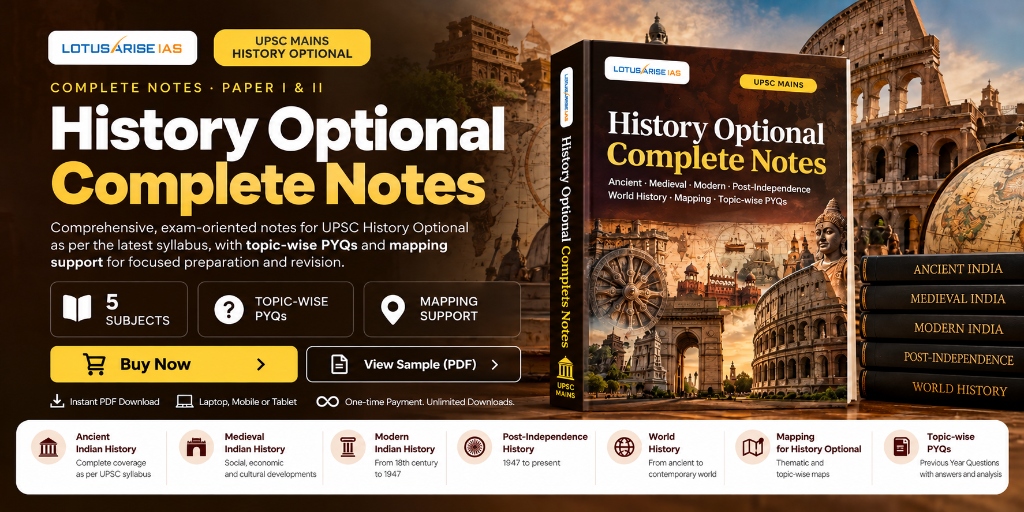
Switch to LotusArise History Optional Complete Notes
Experience comprehensive, high-yield preparation with LotusArise History Optional Complete Notes PDF. Fully indexed, exam-oriented ~3,500-page study material with 500+ solved map sites, historiographical debate matrices, and topic-wise PYQs.