
Q. Among the following crops, which one is the most important anthropogenic source of both methane and nitrous oxide?
- Cotton
- Rice
- Sugarcane
- Wheat
Answer: Rice.
Notes
- Methane and nitrous oxide are important greenhouse gases. They contribute to global warming. To a large extent, emissions of methane and nitrous oxide are connected with the intensification of food production.
- Important anthropogenic sources of biogenic methane are wet rice fields, cattle, animal waste, landfills and biomass burning.
- Important anthropogenic sources of biogenic nitrous oxide are land-use change, fertilizer production and use and manure application.
- Flooded rice cultivation has been identified as one of the leading global agricultural sources of anthropogenic methane (CH4) emissions. Furthermore, it has been estimated that global rice production is responsible for 11% of total anthropogenic CH4 emissions.
- Paddies are a potential source of anthropogenic nitrous oxide (N2O) emission as well. In paddies, both the soil and the rice plants emit N2O into the atmosphere. The rice plant in the paddy is considered to act as a channel between the soil and the atmosphere for N2O emission.
Additional Notes
Cotton:
- Cotton is one of the most important fiber and cash crop of India. Cotton is a Kharif crop.
- There are four cultivated species of cotton viz. Gossypium arboreum, G.herbaceum, G.hirsutum and G.barbadense.
- Cotton, a semi-xerophyte, is grown in tropical & sub tropical conditions.
- A minimum temperature of 15oC is required for better germination at field conditions.
- The optimum temperature for vegetative growth is 21-27oC & it can tolerate temperature to the extent of 43oC but temperature below 21oC is detrimental to the crop.
- Warm days of cool nights with large diurnal variations during the period of fruiting are conducive to good boll & fibre development.
- Cotton is grown on a variety of soils ranging from well drained deep alluvial soils in the north to black clayey soils of varying depth in central region and in black and mixed black and red soils in south zone.
- Cotton is semi-tolerant to salinity and sensitive to water logging and thus prefers well drained soils.
- Insect Pests (in Cotton)
- Jassids /Aphids
- Thrips
- White flies
- Bollworms
- Diseases (in Cotton)
- Bacterial blight
- Fungal leafspots
- Grey mildew
- Boll rot
- Root Rot
- Leaf Curl
- Leaf reddening
- Cotton Advisory Board (CAB), Ministry of Textiles estimates the statistics and prepare balance sheet of cotton situation.
Rice:
- Rice cultivation is well-suited to countries and regions with low labor costs and high rainfall, as it is labor-intensive to cultivate and requires ample water.
- Rice requires slightly more water to produce than other grains. Rice production uses almost a third of Earth’s fresh water.
- However, rice can be grown practically anywhere, even on a steep hill or mountain area with the use of water-controlling terrace systems.
- Throughout India, rice is cultivated in a wide range of climatic and altitude conditions. In India, rice is grown from 8 to 35º N latitude and up to 3000 metres above sea level.
- A hot, humid atmosphere is necessary for rice production. It works best in areas with high humidity, continuous sunshine, and a reliable supply of water.
- The crop needs an average temperature between 21 and 37 ° C. for the duration of its life.
- 40° to 42° C is the highest temperature the crop can tolerate.
- Silts, loams, and gravels are just a few of the several types of soil on which rice can grow. Both acidic and alkaline soils are acceptable to it. However, clayey loam is an excellent soil type for growing this crop.
- Globally, the top rice-producing country is China, followed by India.
- Vietnam, Indonesia, and Bangladesh were other significant producers.
- Arsenic concerns:
- While growing, rice plants tend to absorb arsenic more readily than other food crops.
- Climate change:
- The worldwide production of rice accounts for more greenhouse gas emissions (GHG) in total than that of any other plant food.
- It was estimated in 2021 to be responsible for 30% of agricultural methane emissions and 11% of agricultural nitrous oxide emissions.
- Methane release is caused by long-term flooding of rice fields, inhibiting the soil from absorbing atmospheric oxygen, a process causing anaerobic fermentation of organic matter in the soil.
Sugarcane:
- Sugarcane is a species of tall, perennial grass (of the genus Saccharum, tribe Andropogoneae) which is used to make sugar, ethanol and paper.
- The plants have thick, jointed, fibrous stalks which are rich insucrose and amass in the internodes of the stalks. They are 2–6 m (6–20 ft) tall.
- Sugarcanes are a member of the Poaceae grass family, a group of commercially significant flowering plants that also contains numerous forage crops such as maize, wheat, rice, and sorghum.
- It is indigenous to India, Southeast Asia, and New Guinea’s warm tropical and temperate climates.
- The plant is also cultivated for the production of biofuel, particularly in Brazil where the canes can be utilised to instantly make ethyl alcohol (ethanol).
- India has emerged as the world’s largest producer and consumer of sugar and the world’s 2nd largest exporter, due to the record production of more than 5000 Lakh Metric Tons (LMT) of sugarcane.
- Temperature: Between 21-27°C with hot and humid climate.
- Rainfall: Around 75-100 cm.
- Soil Type: Deep rich loamy soil, with neutral soil reactivity (pH 6.5 to 7.5).
- Top Sugarcane Producing States: Maharashtra>Uttar Pradesh > Karnataka
- Biofuel Policy 2018 has fixed a target of achieving 20 per cent ethanol blending with petrol by 2025.
- Nitrogen fixation: Some sugarcane varieties are capable of fixing atmospheric nitrogen in association with the bacterium Gluconacetobacter diazotrophicus.
- Sugarcane production often pollutes freshwater ecosystems with silt and fertilizers washed from farms, as well as plant matter and chemical sludge from mills.
- Sugarcane is a water-intensive crop that remains in the soil all year long.
Wheat:
- Wheat is a Rabi Crop grown between September and December and harvested between February and May.
- Temperature: Between 10-15°C (Sowing time) and 21-26°C (Ripening & Harvesting) with bright sunlight.
- Rainfall: Around 75-100 cm.
- Soil Type: Well-drained fertile loamy and clayey loamy (Ganga-Satluj plains and black soil region of the Deccan).
- Major wheat-growing states in India are Uttar Pradesh, Punjab, Haryana, Madhya Pradesh, Rajasthan, Bihar and Gujarat.
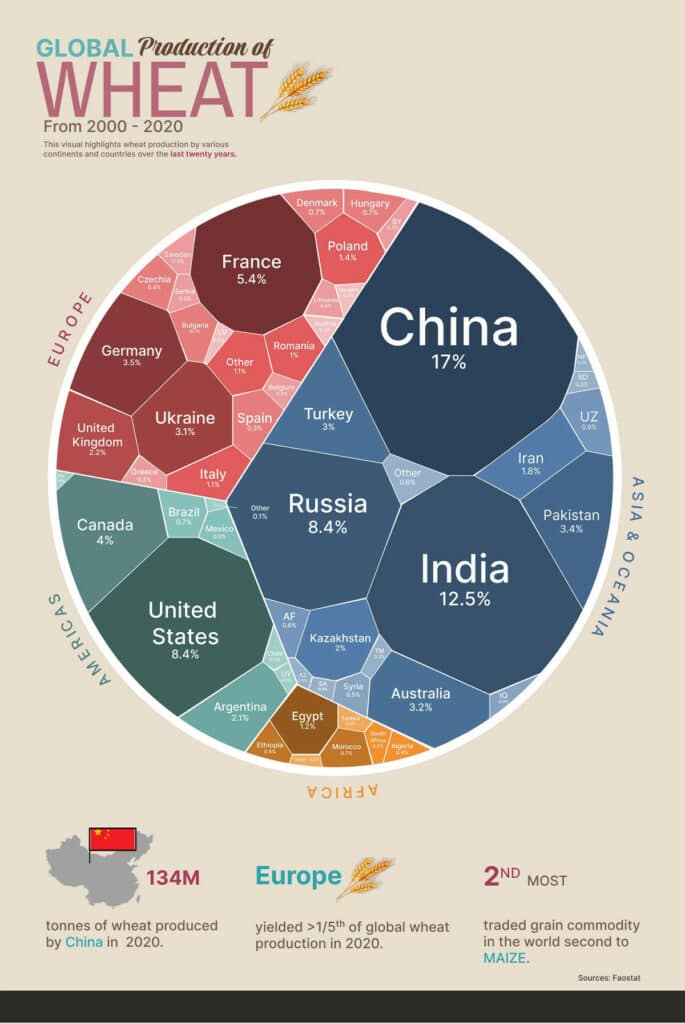
- China is the world’s largest wheat producer and Russia is the world’s largest exporter of wheat, accounting for more than 18% of international exports.
- India is the second largest producer of wheat with a share of around 13.5% of world total production.
- India produces around 107.59 MT of wheat annually while a major chunk of it goes towards domestic consumption.
- India accounts for even less than 1% in world wheat export. However, its share has increased from 0.14% in 2016 to 0.54% in 2020.