The Ganges River Dolphin or also called ‘Susu,’ is the National Aquatic Animal of India.
The Ganges River Dolphins (Platanista Gangetica) was officially discovered in 1801. Ganges River Dolphin is one of the National Symbols of India.
It was recognised as the National Aquatic Animal in 2009, by the Government of India.
The Ministry of Environment and Forests notified the Ganges River Dolphin as the National Aquatic Animal in May 2010.
India’s national aquatic animal, the Gangetic dolphin (susu), isblind and finds its way in the Ganges using sound waves.
National Aquatic Animal: Gangetic River Dolphin
The Ganges river dolphin (Platanista gangetica) is a species of freshwater dolphin classified in the family Platanistidae.
Ganga River Dolphin is endemic to the Indian sub-continent, and is also known as the Tiger of the Ganga.
It lives in the Ganges and related rivers of South Asia, namely in the countries of India, Nepal, and Bangladesh.
It is also known by the name susu (popular name) also shihu in Assam and shushuk in West Bengal and Bangladesh.
The Ganges river dolphin has been recognized by the Government of Indiaas its National Aquatic Animal in 2009 and is the official animal of the Indian city of Guwahati.
Its first occurrence, within the Hooghly River, was documented by William Roxburgh.
The Ganges Dolphin is among the four “obligate” freshwater dolphins found in the world – the other three are the ‘baiji’ found in the Yangtze River (China), the ‘bhulan’ of the Indus (Pakistan) and the ‘boto’ of the Amazon River (Latin America).
Although there are several species of marine dolphins whose ranges include some freshwater habitats, these four species live only in rivers and lakes.
The Chinese River Dolphin was declared functionally extinct by a team of international scientists in 2006.
Distribution of National Aquatic Animal:
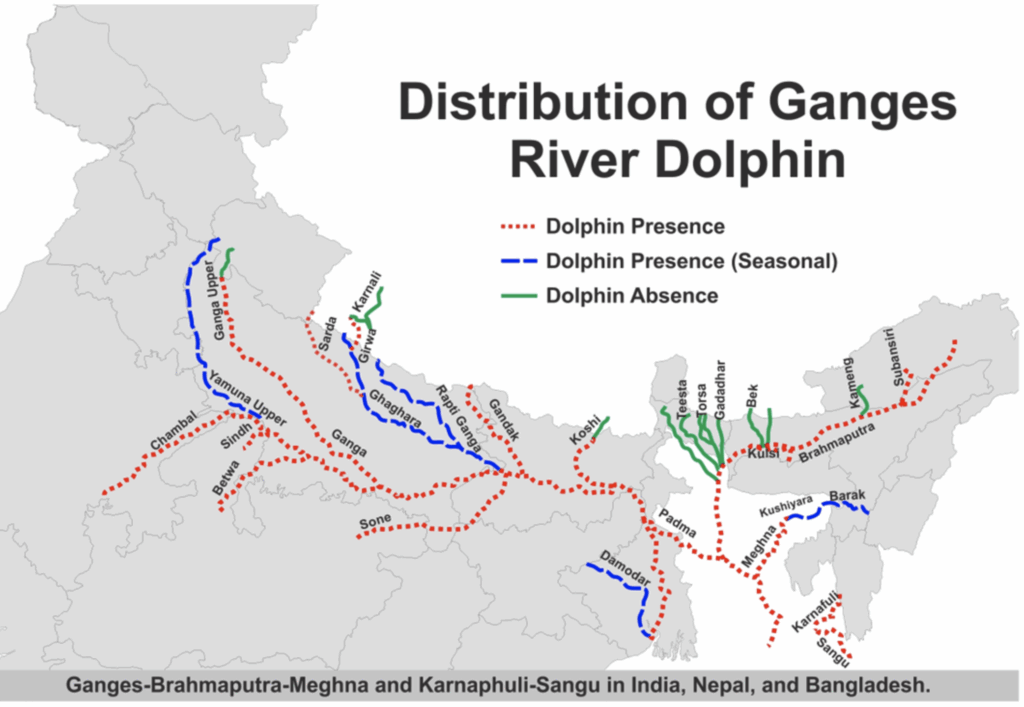
It lives along the Ganges-Brahmaputra-Meghna and Karnaphuli-Sangu river systems of Bangladesh and India, and the Sapta Koshi and Karnali Rivers in Nepal.
The Ganges river dolphin favours deep pools, eddy countercurrents located downstream of the convergence of rivers and of sharp meanders, and upstream and downstream of midchannel islands.
Ranges of the Ganges river dolphin
Threats to National Aquatic Animal:
Bycatch: These dolphins and people both favor areas of the river where fish are plentiful and the water current is slower. This has led to fewer fish for people and more dolphins dying as a result of accidentally being caught in fishing nets, also known as bycatch.
Pollution: Industrial, agricultural, and human pollution is another serious cause of habitat degradation.
Dams: Construction of dams and other irrigation-related projects make them susceptible to inbreeding and more vulnerable to other threats because they cannot move to new areas.
Dolphins below a dam are threatened by heavy pollution, increased fishing activities and vessel traffic. They also have less food because dams disturb the migration, breeding cycles and habitat of fish and other prey.
Conservation Status of National Aquatic Animal:
Indian Wildlife (Protection), Act 1972: Schedule I.
International Union for the Conservation of Nature (IUCN): Endangered.
Convention on International Trade in Endangered Species (CITES): Appendix I (most endangered).
Convention on Migratory Species (CMS): Appendix II (migratory species that need conservation and management or would significantly benefit from international co-operation).
Initiatives for Dolphin Protection:
Project Dolphin: The Prime Minister announced the government’s plan to launch a Project Dolphin in his Independence Day Speech 2020. It will be on the lines of Project Tiger, which has helped increase the tiger population.
Dolphin Sanctuary: Bihar’s Vikramshila Gangetic Dolphin Sanctuary, established in 1991, plays a key role in protecting these endangered dolphins, supported by local communities and conservation projects like Project Dolphin.
Conservation Plan: The Conservation Action Plan for the Ganges River Dolphin 2010-2020, which “identified threats to Gangetic Dolphins and impact of river traffic, irrigation canals and depletion of prey-base on Dolphins populations”.
National Ganga River Dolphin Day: The National Mission for Clean Ganga celebrates 5th October as National Ganga River Dolphin Day.