

Q. With reference to India’s projects on connectivity, consider the following statements :
- East-West Corridor under Golden Quadrilateral Project connects Dibrugarh and Surat.
- Trilateral Highway connects Moreh in Manipur and Chiang Mai in Thailand via Myanmar.
- Bangladesh-China-India-Myanmar Economic Corridor connects Varanasi in Uttar Pradesh with
Kunming in China.
How many of the above statements are correct?
- Only one
- Only two
- All three
- None
Answer: (d) None
East-West Corridor:
- The East-West Corridor is a part of the National Highways Development Project (NHDP) in India, which aims to connect Silchar in Assam to Porbandar in Gujarat.
- East-West Corridor is a 3,300 kilometres corridor via NH 27 (Porbandar–Rajkot-Samakhiali–Radhanpur–Kota–Jhansi–Kanpur-Lucknow–Ayodhya-Gorakhpur-Muzaffarpur–Darbhanga-Supaul-Purnia– Dalkhola-Kishanganj, Islampur–Sonapur- Ghoshpukur-Jalpaiguri Alipurduar- Bongaigaon – Nalbari Bijni–Guwahati–Nagaon–Dabaka–Silchar).
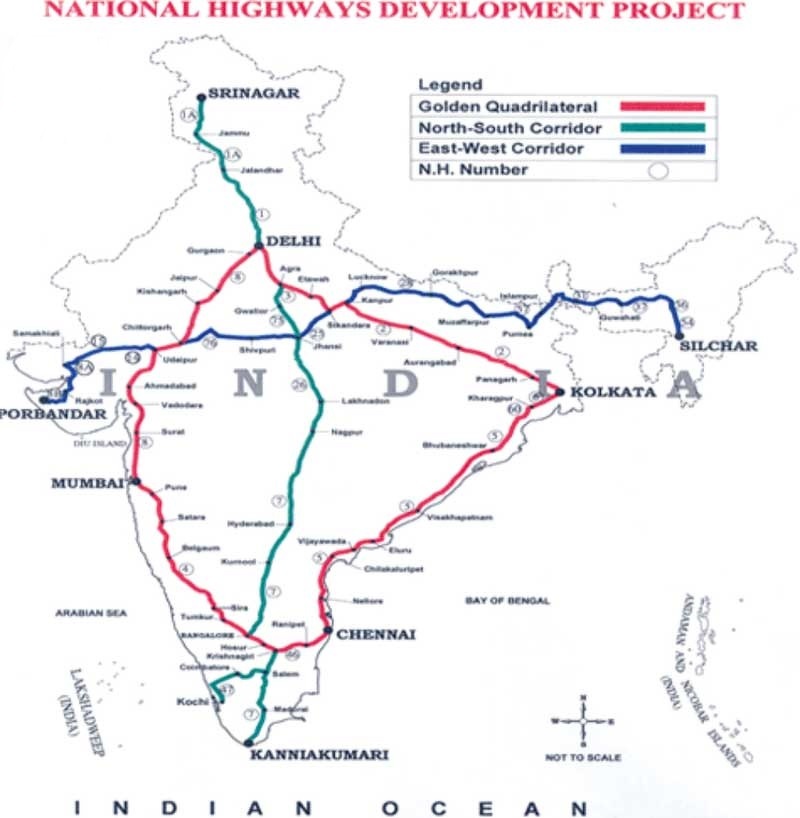
Golden Quadrilateral Project
- The Golden Quadrilateral is a national highway network that connects the majority of India’s main economic, agricultural, and cultural centers.
- It comprises a quadrilateral linking India’s four largest metropolises: Delhi (north), Kolkata (East), Mumbai (west), and Chennai (south).
- The National Highways Authority of India (NHAI), which is part of the Ministry of Road, Transport, and Highways, is in charge of the Golden Quadrilateral project.
- The fundamental goal of these superhighways is to shorten the distance and time connecting India’s four megacities.
- This project includes the North-South corridor connecting Srinagar (Jammu and Kashmir) and Kanyakumari (Tamil Nadu), as well as the East-West corridor connecting Silchar (Assam) and Porbandar (Gujarat).
- The network also connects other key metropolises such as Pune, Ahmedabad, Jaipur, Kanpur, Surat in the north and Bengaluru, Visakhapatnam, and Bhubaneswar in the south.

India-Myanmar-Thailand Trilateral Highway
- It is a significant regional connectivity project that aims to establish a road link between India, Myanmar, and Thailand.
- The highway will span a distance of approximately 1,360 kilometers (845 miles), starting from Moreh in Manipur, India, and passing through Myanmar before reaching Mae Sot in Thailand.
- It is an important infrastructure project to enhance trade, connectivity, and people-to-people ties among the three countries.
- It was first proposed by former Prime Minister Atal Behari Vajpayee and was approved at a ministerial-level meeting between India, Myanmar and Thailand in April 2002.
- The construction of the India-Myanmar-Thailand Trilateral Highway began in 2012 and is being implemented in several phases.
- The India-Myanmar Friendship Road forms the first segment of the IMT Highway. It runs from the border at Tamu/Moreh to Kalemyo and Kalewa.
- Implementing agencies: On the Indian side, the project is being implemented by the Ministry of External Affairs (MEA) with the cooperation of its counterparts in Myanmar and Thailand and budgetary allocation from the Ministry of Finance.

Bangladesh-China-India-Myanmar Economic Corridor
- The Bangladesh-China-India-Myanmar Economic Corridor (BCIM) is a proposed connectivity project that aims to enhance economic cooperation and trade between Bangladesh, China, India, and Myanmar.
- The corridor is expected to run from Kunming in China, through Myanmar, and Bangladesh, and eventually reach Kolkata in India.
