

Q. Which of the following statements is/are correct regarding vegetative propagation of plants?
- Vegetative propagation produces clonal population.
- Vegetative propagation helps in eliminating the virus.
- Vegetative propagation can be practiced most of the year.
Select the correct answer using the code given below.
- 1 only
- 2 and 3 only
- 1 and 3 only
- 1, 2 and 3
Answer: (c) 1 and 3 only
Vegetative Propagation
- It is an asexual method of plant reproduction that occurs in its leaves, roots and stem.
- It is often used when the crop plants either do not produce seeds or when the seeds produced are not viable or are of long dormancy.
- Some of the commonly seen examples of Vegetative Propagation are
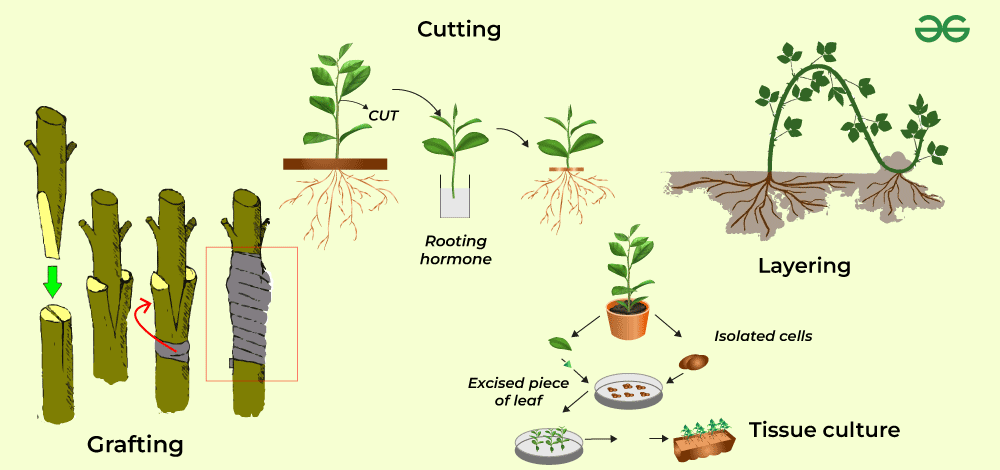
- Roses are often multiplied by planting their cuttings which include stem cuttings.
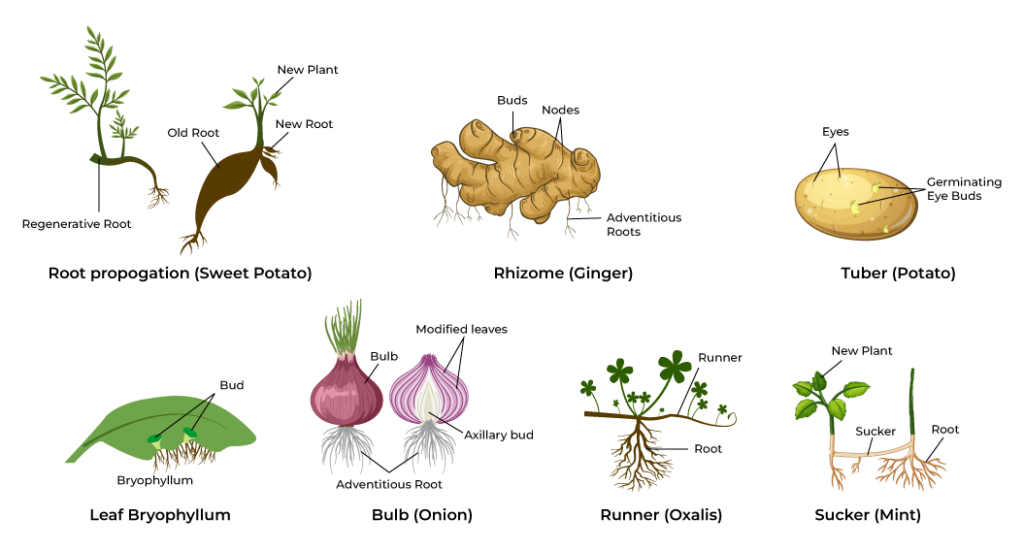
- Mint plant, which is seen in the kitchen garden grows and spreads quickly with the help of its underground stems called stolons, which grow roots and leaves.
- Tulips are grown on a large scale for ornamental purpose by colelcting their Bulbs and then planting them.
- Cherry and Apple trees can be propagated using shoots called suckers, which are found at the base of the tree.
- Vegetative propagation can be practised most of the year. Vegetative propagation can occur naturally or be induced artificially by a technique called Artificial Vegetative Propagation.
- Natural Vegetative Propagation
- This occurs when plants grow and develop naturally without any human interference. Natural vegetative propagation can be enabled by the development of adventitious roots. Thus, new plants may emerge from the roots, stem and leaves of the parent plant.
- The vegetative plant structures arising from the stem are known as rhizomes, bulbs, runners, tubers, etc.
- Artificial Vegetative Propagation
- This is a type of vegetative reproduction carried out by humans in the fields and laboratories.
- The part of a plant that is used for artificial vegetative propagation is called vegetative propagule. These methods are beneficial to retain desirable traits like flavor, color, disease resistance, etc.
- Natural Vegetative Propagation
- The widespread use of vegetative propagation results in the spread of viruses through propagules such as cuttings, tubers, runners and bulbs. A plant once systemically infected with a virus usually remains infected for its lifetime.
Clonal Propagation
- It is the process of asexual reproduction by multiplication of genetically identical copies of individual plants.
- It occurs by apomixis (seed development without meiosis and fertilization) and/or vegetative reproduction (regeneration of new plants from vegetative parts).