
Q. What is the application of Somatic Cell Nuclear Transfer Technology?
- Production of biolarvicides
- Manufacture of biodegradable plastics
- Reproductive cloning of animals
- Production of organisms free of diseases
Answer: (c) Reproductive cloning of animals
Somatic cell nuclear transfer
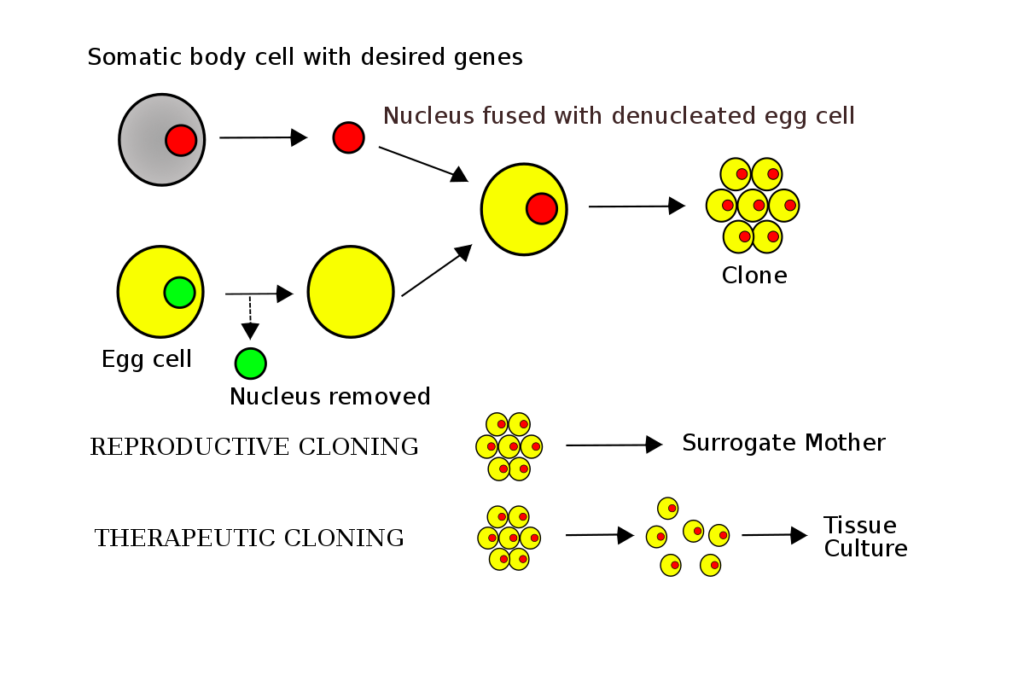
- Somatic cell nuclear transfer (SCNT) is a laboratory technique for cloning for creating an ovum with a donor nucleus.
- Cloning is the production of an exact copy of a complete organism, any other living part, or a cell.
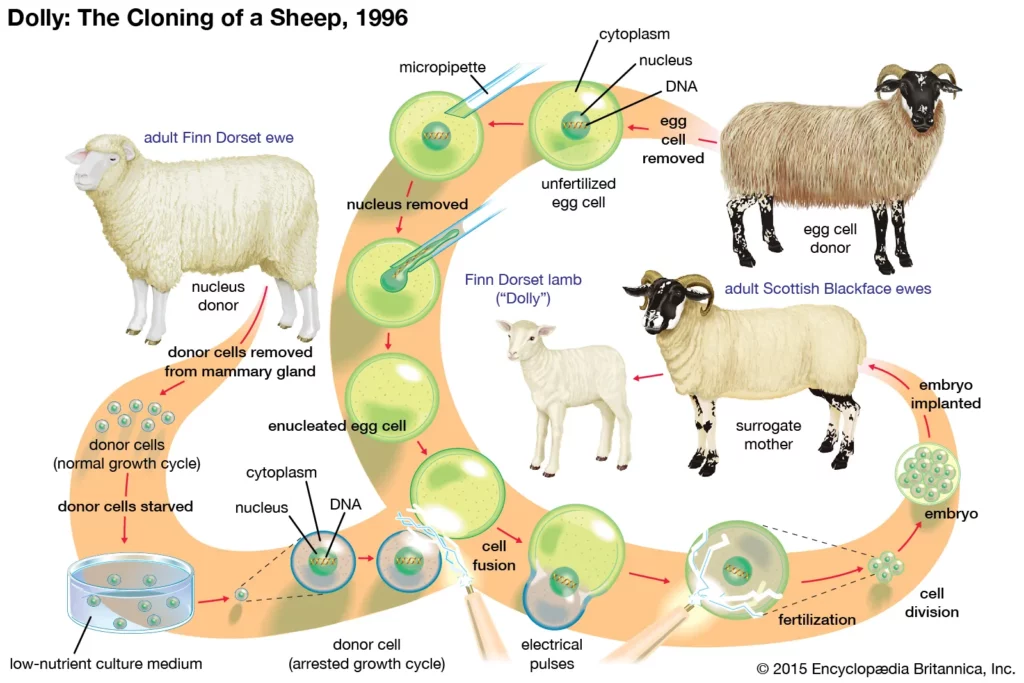
- Somatic Cell Nuclear Transfer Technology was used for the first time by Ian Wilmut and his colleagues at the Roslin Institute in Edinburgh for cloning the sheep “Dolly” on 5th July 1996 and was the first mammal to be cloned.
- Technology of Somatic Cell Nuclear Transfer:
- A somatic cell is isolated and extracted from an adult female.
- Then the nucleus and all of its DNA from an egg cell is removed.
- After that the nucleus from the somatic cell is transferred to the egg cell.
- After being inserted into the egg, the somatic cell nucleus is reprogrammed by the host cell and is stimulated with a shock.
- The egg cell, with its new nucleus, will behave just like a freshly fertilised egg.
- It developed into an embryo, which is implanted into a surrogate mother.
- Potential Applications of Somatic Cell Nuclear Transfer:
- Stem cell research- Somatic cell nuclear transplantation is being used in stem cell research. These cells are deemed to have a pluripotent potential because they have the ability to give rise to all of the tissues found in an adult organism. This could be used in therapies or disease research. This allows stem cells to create any cell type, which could then be transplanted to replace damaged or destroyed cells.
- Organ transplants- Another application of SCNT stem cell research to generate tissues or even organs for transplant into the specific patient. The resulting cells would be genetically identical to the somatic cell donor, thus avoiding any complications from immune system rejection.
- Therapeutic applications- SCNT have ample scope of success in therapy and curing diseases. It can be used to treat diseases like diabetes, Parkinson’s disease etc. In 2014, the New York Stem Cell Foundation was successful in creating SCNT stem cells derived from adult somatic cells. One of these lines of stem cells was derived from the donor cells of a type 1 diabetic. These insulin producing cells could be used for replacement therapy in diabetics, demonstrating real SCNT stem cell therapeutic potential.
- Reproductive cloning- Somatic Cell Nuclear Transfer technique is currently the basis for cloning animals (such as the famous Dolly the sheep), and has been theoretically proposed as a possible way to clone humans. But there are moral and ethical objections against reproductive cloning. In 2018, the first successful cloning of primates using somatic cell nuclear transfer, (the same method as Dolly the sheep), was successfully done with the birth of two live female clones .
- Preservation of endangered species- Interspecies nuclear transfer (iSCNT) is a means of somatic cell nuclear transfer used to facilitate the rescue of endangered species, or even to restore species after their extinction.
- Somatic cell nuclear transfer can be both boon and bane. It might help in many ways but it also has its share of effects which might include reduction of gene diversity, Nature’s rule like survival of fittest, ethical and moral issues. If got into wrong hands (Terrorists, crime syndicate) it might prove to be a disaster in waiting. Thus caution is needed with proper regulation for its usage.