Q. With reference to “Blockchain Technology”, consider the following statements:
- It is a public ledger that everyone can inspect, but which no single user controls.
- The structure and design of blockchain is such that all the data in it are about cryptocurrency only.
- Applications that depend on basic features of blockchain can be developed without anybody’s permission.
Which of the statements given above is/are correct?
- 1 only
- 1 and 2 only
- 2 only
- 1 and 3 only
Answer: (d) 1 and 3 only
Blockchain Technology
- Blockchain is a method of recording information that makes it impossible or difficult for the system to be changed, hacked, or manipulated. A blockchain is a distributed ledger that duplicates and distributes transactions across the network of computers participating in the blockchain.
- Blockchain technology is a structure that stores transactional records, also known as the block, of the public in several databases, known as the “chain,” in a network connected through peer-to-peer nodes. Typically, this storage is referred to as a ‘digital ledger.’
- Every transaction in this ledger is authorized by the digital signature of the owner, which authenticates the transaction and safeguards it from tampering. Hence, the information the digital ledger contains is highly secure.
- An asset can be tangible (a house, car, cash, land) or intangible (intellectual property, patents, copyrights, branding). Virtually anything of value can be tracked and traded on a blockchain network, reducing risk and cutting costs for all involved.
- The blocks form a chain of data as the ownership changes hands. Hence, it has no single user control. The blocks confirm the exact time and sequence of transactions, and the blocks link securely together to prevent any block from being altered.
- Each additional block strengthens the verification of the previous block and hence the entire blockchain is formed. The verification of each block make the blockchain tamper-evident and builds a ledger of transactions that network members can trust.
- The applications that depend on the basic features of the blockchain can be developed without asking anybody for permission or paying anyone. Since blockchain operates through a decentralized platform requiring no central supervision, it is used in voting, banking, messaging app, internet advertising, etc. Hence, it is not restricted to cryptocurrency.
Public Digital Infrastructure
- Digital public infrastructure (DPI) refers to blocks or platforms such as digital identification, payment infrastructure and data exchange solutions that help countries deliver essential services to their people, empowering citizens and improving lives by enabling digital inclusion.
- DPIs mediate the flow of people, money and information. First, the flow of people through a digital ID System. Second, the flow of money through a real-time fast payment system. And third, the flow of personal information through a consent-based data sharing system to actualize the benefits of DPIs and to empower the citizen with a real ability to control data.
- These three sets become the foundation for developing an effective DPI ecosystem.
- Each DPI layer fills a clear need and generates considerable value across sectors.
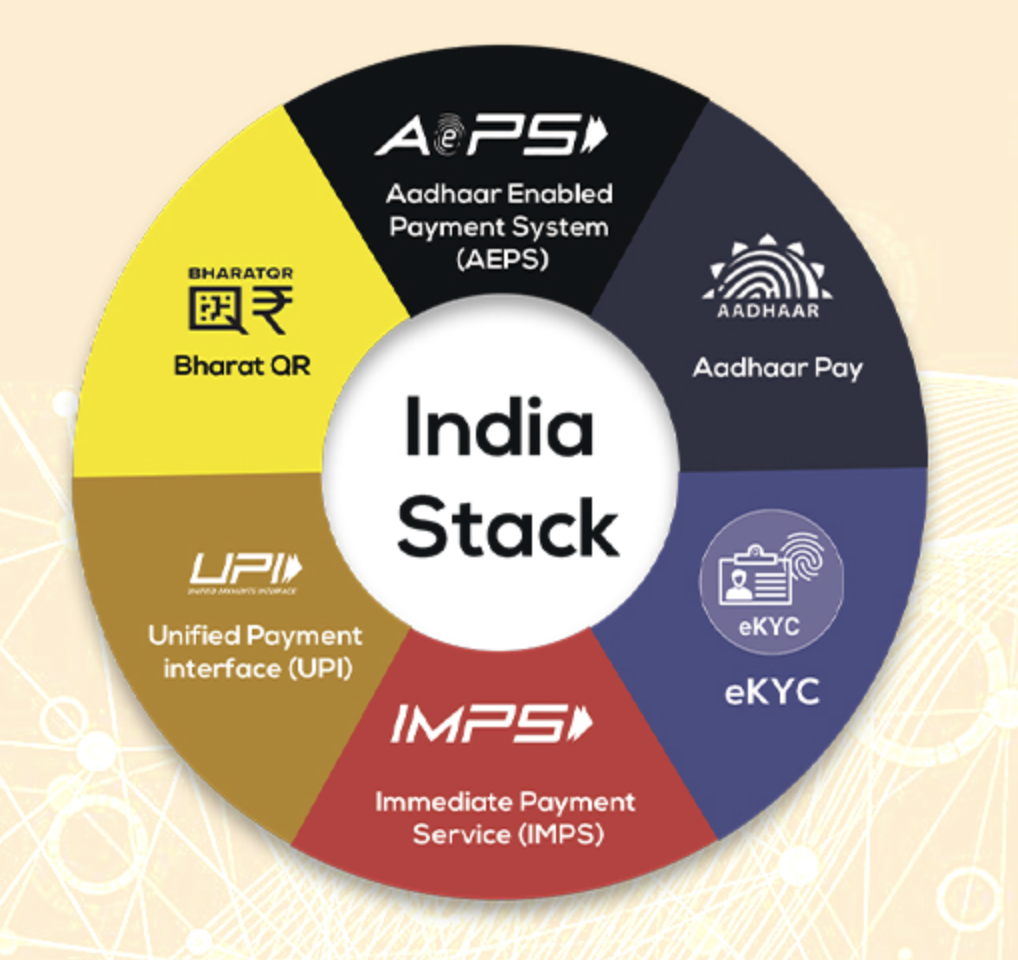
- India, through India Stack, became the first country to develop all three foundational DPIs,Digital identity (Aadhar),Real-time fast payment (UPI) and Account Aggregator built on the Data Empowerment Protection Architecture (DEPA).
- DEPA creates a digital framework that allows users to share their data on their own terms through a third-party entity, who are known as Consent Mangers.
India Stack
- IndiaStack is a set of APIs (Application programming interface) that allows governments, businesses, startups and developers to utilize a unique digital Infrastructure to solve India’s hard problems towards presence-less, paperless, and cashless service delivery.
- It aims to unlock the economic primitives of identity, data, and payments at population scale.
- The vision of India Stack is not limited to one country; it can be applied to any nation, be it a developed one or an emerging one.
- This project was conceptualized and first implemented in India, where its rapid adoption by billions of individuals and businesses has helped promote financial and social inclusion and positioned the country for the Internet Age.