

Q. With reference to Visible Light Communication (VLC) technology, which of the following statements are correct?
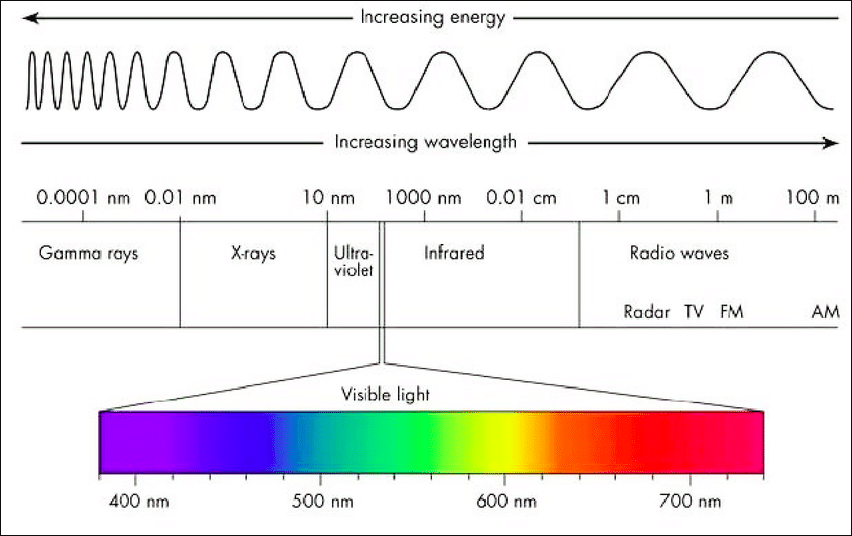
- VLC uses electromagnetic spectrum wavelengths 375 to 780 nm.
- VLC is known as long-range optical wireless communication.
- VLC can transmit large amounts of data faster than Bluetooth.
- VLC has no electromagnetic interference.
Select the correct answer using the code given below:
- 1, 2 and 3 only
- 1, 2 and 4 only
- 1, 3 and 4 only
- 2, 3 and 4 only
Answer: (c) 1, 3 and 4 only
Visible Light Communication Technology
- Visible light communication (VLC) is a wireless method that enables high-speed transmission of data with visible light.
- This data is transmitted by modulating the intensity of light given off by a light source. The signal is received by a photodiode device that transforms the data into forms that are readable and readily-consumed by end users.
- It makes use of Visible Light spectrum. It occupies the spectrum from 375 nm to 780 nm.
- Its biggest advantage is the size of the entire visible light spectrum, which is 10,000 times larger than the entire radio spectrum, which is also too congested due to its overuse.
- Aside from the size of the visible light spectrum, light travels 186,000 miles per second, which is way faster than the 344 meters per second traveled by radio waves in air. This means that communication using light is virtually instantaneous, which also makes VLC the fastest means of communication among those commercially available in the market.
- VLC systems operate at optical frequencies and emit no electromagnetic interference. Therefore, it can be used in Healthcare services.
- The nature of light is that it is unable to pass through opaque walls. Hence, VLCT is used in indoor environment/short range.
LiFi (Light Fidelity)
- LiFi (Light Fidelity) is a wireless communication technology that uses visible light, particularly LED bulbs, to transmit data.
- It was first demonstrated in 2011 by Professor Harald Haas from the University of Edinburgh, Scotland, who also coined the term LiFi.
- It provides high-speed, bidirectional, networked mobile communication in a similar manner as WiFi but with higher speeds, lower latency, and a larger bandwidth (thousands of terahertz).
- LiFi has the advantage of being useful in electromagnetic-sensitive areas like aircraft cabins, hospitals, and nuclear power plants without causing electromagnetic interference. Its utilisation of unused visible lights in human life has opened up new opportunities in wireless communications technology.
- LiFi works by modulating LED light to encode binary data, which is then received and decoded by photodiodes to transmit data wirelessly using visible light communication.
- Significance of LiFi:
- Light (electromagnetic waves) has been used in various applications by humans since time immemorial, but it remains unutilized in our daily lives, other than being used for lighting purposes. Tapping the potential of this unused light for wireless data transfer and the internet is the major hallmark of LiFi.
- The other significance of the LiFi is as follows:
- High speeds: LiFi can provide internet speeds over 100 Gbps, which is much faster than WiFi. This can enable high-speed applications.
- Security: Light cannot penetrate through walls that contain data within a closed area making it more secure.
- Decentralised means of communication: LiFi is a decentralised means of providing communication due to its working and components.
- Combined with blockchain technology, it can revolutionise the data transfer and communication technology with a quick and secure distributed system of transactions.
- No electromagnetic interference: LiFi uses visible light which does not cause electromagnetic interference. This allows its use in sensitive areas like aircraft and hospitals.
- High density: The visible light spectrum has 10,000 times more bandwidth than radio waves, thus it does not have the problem of ‘spectrum crunch’, as with the radio waves.
- This allows more devices to be connected.
- AR/VR: LiFi helps overcome technology challenges due to non-interference from other EM Waves and being faster, which allows Virtual Reality and Augmented Reality products to become wireless and reliable.
- Industry 4.0: LiFi can also enhance the capabilities industry and fulfill the dream of Industry 4.0 by:
- Increased Automation
- Better Decision-making
- Enhanced Security
- Greater Data Density
- Providing Connectivity in Radio Waves Hostile Industries, etc.
- Environmentally friendly: LiFi uses energy-efficient LED bulbs to transmit data. Being highly energy efficient, it results in lower carbon emissions.
- Cheaper deployment: LiFi can be implemented simply by installing LED bulbs. No new wiring or infrastructure is required making it easy to deploy.
- Prevention of “dead zones”: LED bulbs ensure that there are no dead zones as is the case with WiFi routers. Light can easily reach areas inside buildings where radio waves cannot penetrate.
LiFi vs WiFi
| Parameter | LiFi | WiFi |
|---|---|---|
| Technology | Visible Light Communication | Radio waves |
| Frequency Band | 430 – 770 THz | 2.4 GHz, 5 GHz |
| Max Speed | Up to 224 Gbps | Up to 54 Mbps (802.11ax) |
| Latency | Low, <1 ms | Medium, >10 ms |
| Security | High, confined to the area illuminated | Medium, can penetrate walls |
| Energy Efficiency | High, uses LEDs | Medium |
| Reliability | High, less interference | Prone to interference |
| Mobility Support | Limited, needs line of sight | Good |
| Outdoor use | Challenging due to sunlight | Excellent |
| Health hazard | None | Concerns about radiofrequency radiation |
| Deployment costs | Low, leverages lighting infrastructure | High for WiFi routers |