Q. In the context of hereditary diseases, consider the following statements:
- Passing on mitochondrial diseases from parent to child can be prevented by mitochondrial replacement therapy either before or after in vitro fertilization of the egg.
- A child inherits mitochondrial diseases entirely from the mother and not from the father.
Which of the statements given above is’/are correct?
- 1 only
- 2 only
- Both 1 and 2
- Neither 1 nor 2
Answer: (c) Both 1 and 2
Mitochondrial diseases
- Mitochondrial disease is a group of disorders caused by mitochondrial dysfunction.
- Mitochondria are the organelles that generate energy for the cell and are found in every cell of the human body except red blood cells. They convert the energy of food molecules into the ATP that powers most cell functions.
- When the number or function of mitochondria in the cell are disrupted, less energy is produced and organ dysfunction results.
- Mitochondrial diseases take on unique characteristics both because of the way the diseases are often inherited and because mitochondria are so critical to cell function.
- A subclass of these diseases that have neuromuscular symptoms are known as mitochondrial myopathies.
- Mitochondria are the organelle which contain DNA in circular form, and in animals it is the only organelle in addition to nucleus which contain DNA and gene. The sperm contains very low number of mitochondria and mitochondrial gene. So, in the offspring the mitochondrial genes are inherited from the mother. Thus, a father with mitochondrial gene defect cannot transmit the disease to his offspring.
- Mitochondrial replacement therapy (MRT) is a form of reproductive invitro fertilization (IVF) which works on the principle of replacing a women’s mitochondrial DNA (mt-DNA) with the donor’s healthy one. The carrier mother’s pronucleus is inserted into the donor mother’s enucleated oocyte containing normal mtDNA, and the embryo is implanted into the carrier mother by IVF.
- Mitochondrial replacement therapy can be done either before or after in vitro fertilization.
- MRT include different techniques like spindles transfer (ST), pronuclear transfer (PNT) or polar body transfer (PBT).
- Pronuclear transfer technique is a significant approach of MRT administered after fertilization, in which two zygotes are raised in vitro.
- Maternal spindle transfer (MST) technique is executed before fertilization is a form of selective reproduction similar to prenatal diagnosis and pre-implantation genetic diagnosis (PGD).
- The mitochondrial replacement approach is generic; instead of targeting a specific mutation, MRTs replace nearly all mitochondria and their resident mtDNA and so could be applied to any inherited
mtDNA disease.
Genetic disorder (Hereditary diseases)
- Hereditary diseases, also known as inherited diseases or genetic disorders is a health problem caused by one or more abnormalities in the genome. It can be caused by a mutation in a single gene (monogenic) or multiple genes (polygenic) or by a chromosomal abnormality.
- Although polygenic disorders are the most common, the term is mostly used when discussing disorders with a single genetic cause, either in a gene or chromosome.
- These diseases are then transmitted from generation to generation, or in other words, they are inherited from parents to their children.
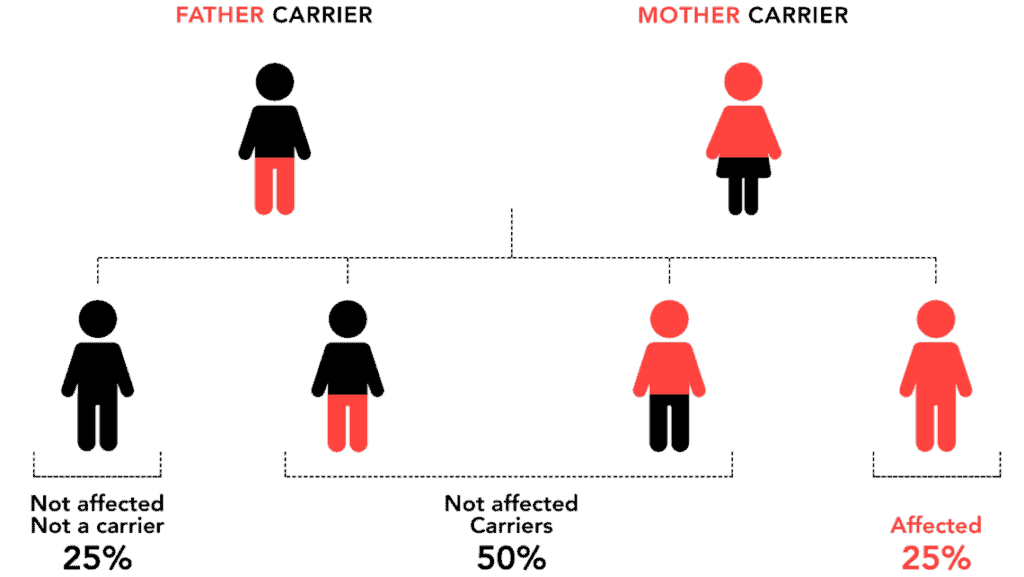
- The mutation responsible can occur spontaneously before embryonic development, or it can be inherited from two parents who are carriers of a faulty gene (autosomal recessive inheritance) or from a parent with the disorder (autosomal dominant inheritance).
- When the genetic disorder is inherited from one or both parents, it is also classified as a hereditary disease. Some disorders are caused by a mutation on the X chromosome and have X-linked inheritance. Very few disorders are inherited on the Y chromosome or mitochondrial DNA (due to their size).
- Genetic disorders are present before birth, and some genetic disorders produce birth defects, but birth defects can also be developmental rather than hereditary.
- The opposite of a hereditary disease is an acquired disease. Most cancers, although they involve genetic mutations to a small proportion of cells in the body, are acquired diseases. Some cancer syndromes, however, such as BRCA mutations, are hereditary genetic disorders.
- Most common hereditary diseases:
- Skin cancer
- Cardiomyopathies (hypertrophic cardiomyopathy, dilated cardiomyopathy, arrhythmogenic cardiomyopathy and restrictive cardiomyopathy)
- arthritis
- Inherited arrhythmia syndromes (sudden arrhythmic death syndrome, or SADS), long QT syndrome, Brugada, Catecholamainergic polymorphic ventricular tachycardia (CPTV).
- Inherited aortopathies, for example Marfan syndrome
- Breast cancer
- Prostate cancer
- Lung cancer
- Neuromuscular disorders (eg muscular dystrophy, myotonic dystrophy)
- Familial hypercholesterolaemia