

Q. Bisphenol A (BPA), a cause of concern, is a structural/key component in the manufacture of which of the following kinds of plastics?
- Low-density polyethylene
- Polycarbonate
- Polyethylene terephthalate
- Polyvinyl Chloride
Answer: (b) Polycarbonate
Bisphenol A (BPA)
- Bisphenol A is a synthetically obtained colourless, crystalline organic compound that occurs in the solid phase belonging to the diphenylmethane group. It is soluble in organic solvents but poorly dissolves in water
- Uses of Bisphenol A:
- Bisphenol A (BPA) is commonly used to coat the insides of food cans, bottle tops, and water supply lines, and was once a component of baby bottles.
- Bisphenol A (BPA) is a chemical produced in large quantities for use primarily in the production of polycarbonate plastics and epoxy resins. Specifically, it is used for packaging foods and beverages, baby bottles, thermal papers (i.e., receipts), and dental sealants.
- BPA polycarbonate plastics are very sturdy in nature and are used to make large variants of microwave-proof utensils.
- It is used as a material for safety glasses, bulletproof windows and helmets.
- It is used in many medical devices such as heart-lung machines, incubators, artificial kidneys, dental fillers, and sealants.
- It is also used as eyewear glasses , due to their optical clarity.
- Environmental impacts of Bisphenol A:
- BPA can enter the environment directly through the leaching of chemicals or degradation of materials containing bisphenol A and may render the land unfertile and barren making it unsuitable for agriculture.
- It affects the growth and reproduction of marine life.
- It causes endocrine effects in fish, amphibians, and reptiles.
- Adverse effects of Bisphenol A on human health:
- When ingested, the chemical disrupts the endocrine system by interfering with the hormones and affecting the brain and prostate gland of foetuses, infants, and children.
- It can cause high blood pressure, diabetes and cardiovascular disease in adults.
- BPA is a xenoestrogen and mimics estrogen present in the body, thus exhibiting hormone-like properties.
- It can indirectly aid in the spread of vector-borne diseases in humans and animals.
Low-density polyethylene
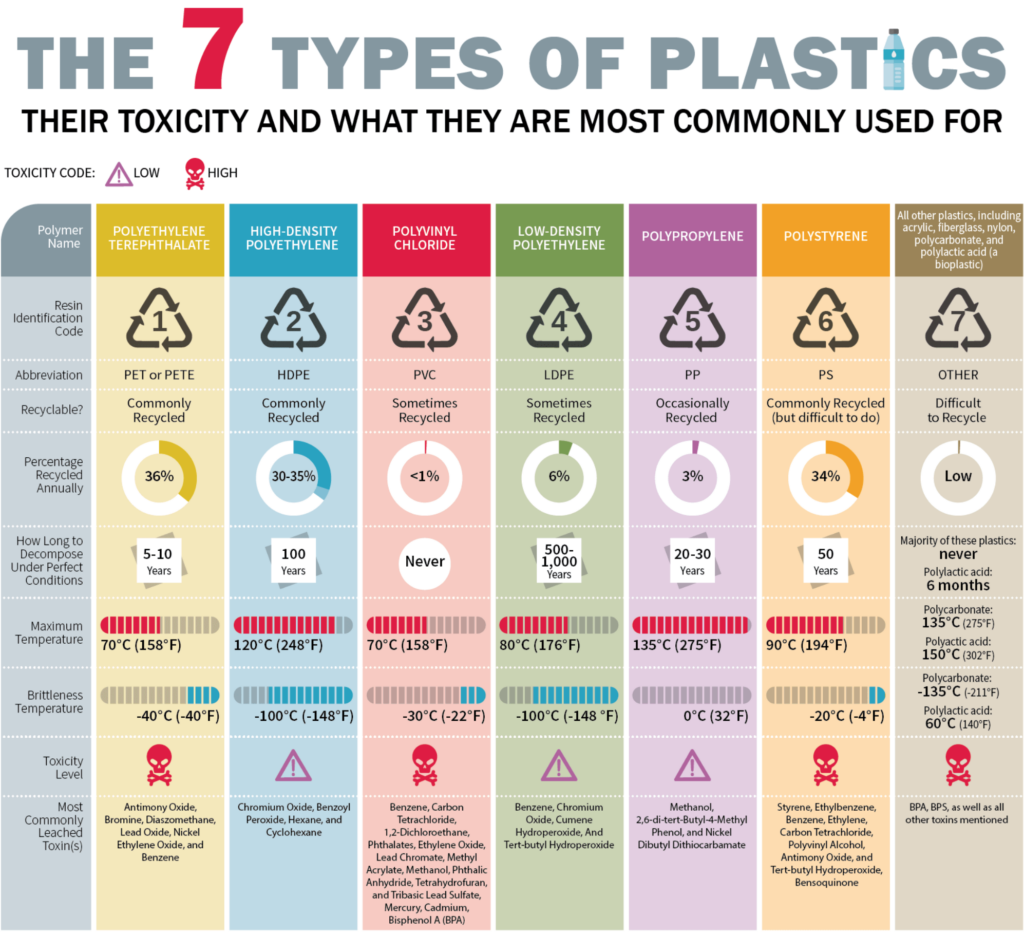
- Low Density Polyethylene (LDPE) is a flexible, odorless, transparent, 100% recyclable thermoplastic polymer popular in products like grocery/garbage bags, juice containers, and cling wrap.
- Its flexibility, toughness, and corrosion resistance combined with its low-cost, high-efficiency production process make it an appealing choice for engineering applications, fueling demand for the production of millions of tons of LDPE each year.
- Polyethylene is a thermoplastic polymer derived from petroleum composed of long chains of ethylene molecules known as monomers, which can be represented by the form (C2H4)n.
- The most notable properties of LDPE are its toughness, its high flexibility at low temperatures, and its corrosion resistance. It has good strength relative to its density, which explains why it has widespread use in the production of small, lightweight carrying containers like plastic bags.
- Some of the key properties of low density polyethylene include:
- More branching in molecular structure
- Low temperature flexibility
- Toughness
- Corrosion/Chemical Resistance
- Low density polyethylene has properties that are attractive for applications in food-safe bagging, waterproof packaging, and other packaging materials.
Polycarbonate
- Polycarbonates (PC) are a group of thermoplastic polymers containing carbonate groups in their chemical structures.
- Polycarbonate is a tough, transparent plastic material with outstanding strength, stiffness, and impact resistance.
- Its high strength makes it resistant to impact and fracture. It is lightweight so an excellent alternative to glass. PC is melted and forced into a mold with high pressure to give it the desired shape. It is widely used owing to its eco-friendly processing and recyclability.
- Polycarbonate’s optical clarity makes it ideal for applications such as machine guards, signs, architectural glazing, face shields, skylights, and POP displays.
- Polycarbonates do not have a unique resin identification code (RIC) and are identified as “Other”, 7 on the RIC list. Products made from polycarbonate can contain the precursor monomer bisphenol A (BPA).
- Used for:
- Indoor and outdoor signs
- Architectural glazing—medical facilities, retail and government buildings, and transportation centers at risk from breakage and vandalism
- POP displays and graphic holders
- Skylights
- Face shields
- Machine guards, sight glasses
- Semiconductor machinery components
- Transparent manifolds
Polyethylene terephthalate
- Polyethylene terephthalate (PET or PETE) is a condensation polymer of ethylene glycol and terephthalic acid.
- It is a thermoplastic synthetic substance, malleable under heat, and can be placed into nearly any shape known mostly for its short PET form.
- PET is a strong, stiff synthetic fibre and resin and a member of the polyester family of polymers. PET is spun into fibres for permanent-press fabrics and blow-molded into disposable beverage bottles.
- Polyethylene terephthalate (PET) is very moisture tolerant. Polyethylene terephthalate has outstanding chemical resistance to organic matter and water, it is not biodegradable.
- A list of uses of polyethylene terephthalate is given below.
- For the manufacturing of shopping bags, water bottles, videotapes, containers and bags, clothes and housing material, water bottles, microwave containers, packaging films, etc.
- Polyester for fabrics is strong and flexible, and when combined with materials like cotton can reduce wrinkling, and shrinking, and makes the fabric more resistant to tears.
- Advantages of Polyethylene terephthalate
- It is readily available and relatively inexpensive.
- It has a high strength-to-weight ratio.
- It is very resistant to moisture.
- It has excellent chemical resistance to organic material and water (it is not biodegradable which is good and bad depending on your perspective and its intended use).
- It is virtually shatterproof (it won’t break like glass packaging).
- It is easily recycled.
- It can be reused by conducting a series of washing processes or broken down into its constituent raw materials which can then be turned into the original resin.
- It is highly transparent.
- PET consists only of carbon, hydrogen, and oxygen, so if it is burned in the air (or in pure oxygen), the combustion products will be carbon dioxide and water.
Polyvinyl Chloride
- Polyvinyl chloride is the world’s third-most widely produced synthetic polymer of plastic (after polyethylene and polypropylene).
- Polyvinyl chloride or vinyl (PVC) is a polymer in which more than half of the content by weight consists of chlorine.
- PVC is produced by polymerization of the vinyl chloride monomer. PVC comes in two basic forms: Rigid (sometimes abbreviated as RPVC) and flexible.
- Resin is the main component in the production of PVC. It is white, brittle solid material available in powder form or granules. PVC is now replacing traditional constructional materials like ceramics, metal, concrete, wood, rubber and many more. PVC is produced by the process of polymerization of the vinyl chloride monomer.
- PVC is amorphous in nature, and hence it is easily combined with other chemicals/substances. Depending on additives used in manufacturing with PVC, many qualities can be imbued in products including anti-mist, different colours, elasticity, fire retarding, flexibility, impact resistance and microbe prevention.
- Properties of PVC:
- By nature, PVC is a lightweight, sturdy and abrasion-resistant material.
- This versatile thermoplastic polymer is resistant to the action of all inorganic chemicals.
- PVC is an excellent material for insulation due to its high dielectric strength and vapour barrier capacity.
- It can withstand extreme climatic conditions, shock and is free from corrosion. Hence, it is the preferred method for several outdoor applications.
- Since the durability is more, long-life is assured.
- PVC products are self-extinguishing due to high chlorine content.
- PVC can be made more flexible and softer by adding plasticizers such as phthalate and can be bent as per requirement.
- PVC is an intrinsic flame retardant.
- It offers good tensile strength and is rigid by nature.
- It is economical and is an affordable solution.
- It demands less maintenance and offers resistance to grease and oil.
- Applications:
- Plasticized PVC is used in flooring or (PVC-U) unplasticized PVC is used in making window frames.
- It is used in making sewage pipes and other pipe applications where cost or vulnerability to corrosion limit the use of metal.
- Used in construction fields for insulation on electrical wires or in flooring for hospitals, schools, homes, and other areas where a sterile environment is a priority.
- It is used in various industries like building, electronics, electrical, automotive, medical and packaging.
- PVC fabric is used in the manufacture of aprons shower curtains, raincoats, jackets and sports bags.
- It is used in the garden hose and imitation leather upholstery.