

Q. Consider the following pairs :
Objects in space : Description
- Cepheids Giant clouds of dust and gas in space
- Nebulae Stars which brighten and dim periodically
- Pulsars Neutron stars that are formed when massive stars run out of fuel and collapse
How many of the above pairs are correctly matched?
- Only one
- Only two
- All three
- None
Answer: (a) Only one
Notes:
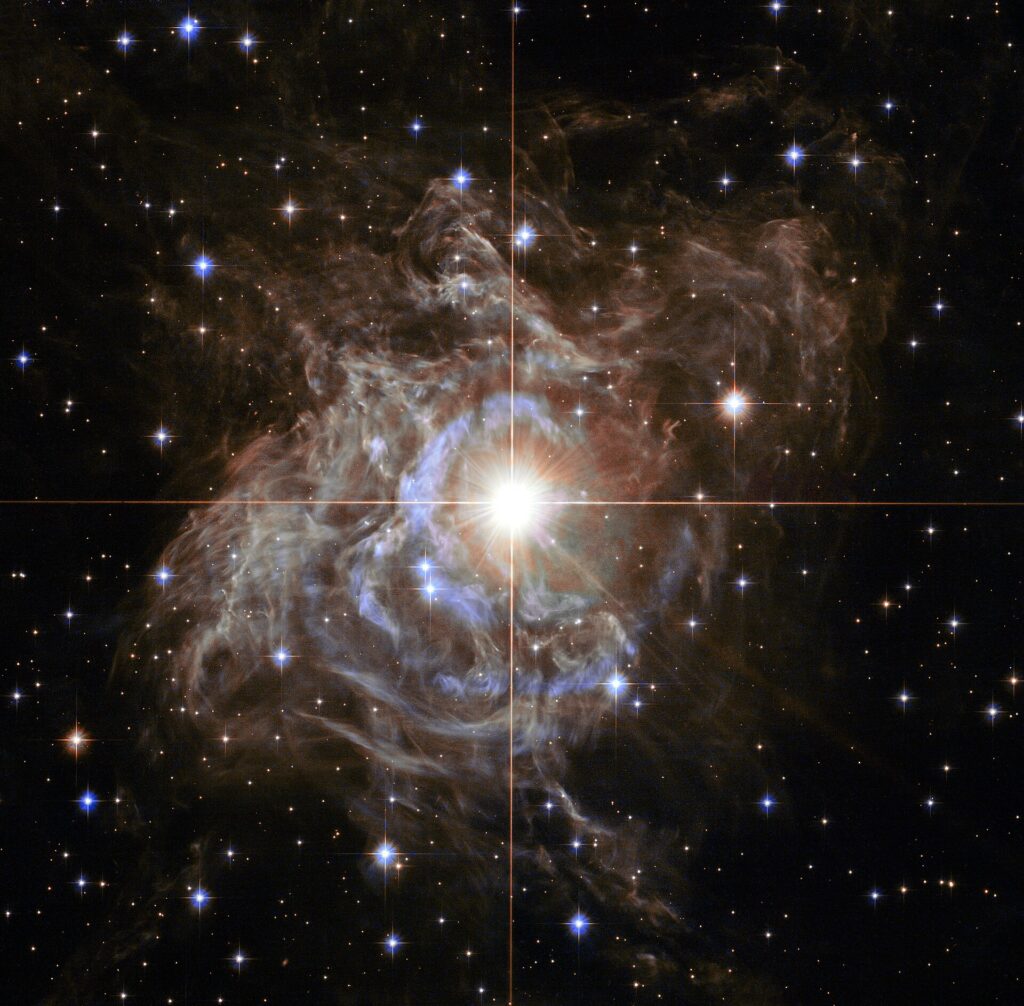
Cepheids
- Cepheids, also called Cepheid Variables, are stars which brigthen and dim periodically. This behavior allows them to be used as cosmic yardsticks out to distances of a few tens of millions of light-years. The brighter the Cepheid, the longer its period.
- In fact, Cepheids are very special variable stars because their period (the time they take to brighten, dim and brighten again) is regular (that is, does not change with time), and a uniform function of their brightness. That is, there is relation between the period and brightness such that once the period is known, the brightness can be inferred.
Nebula
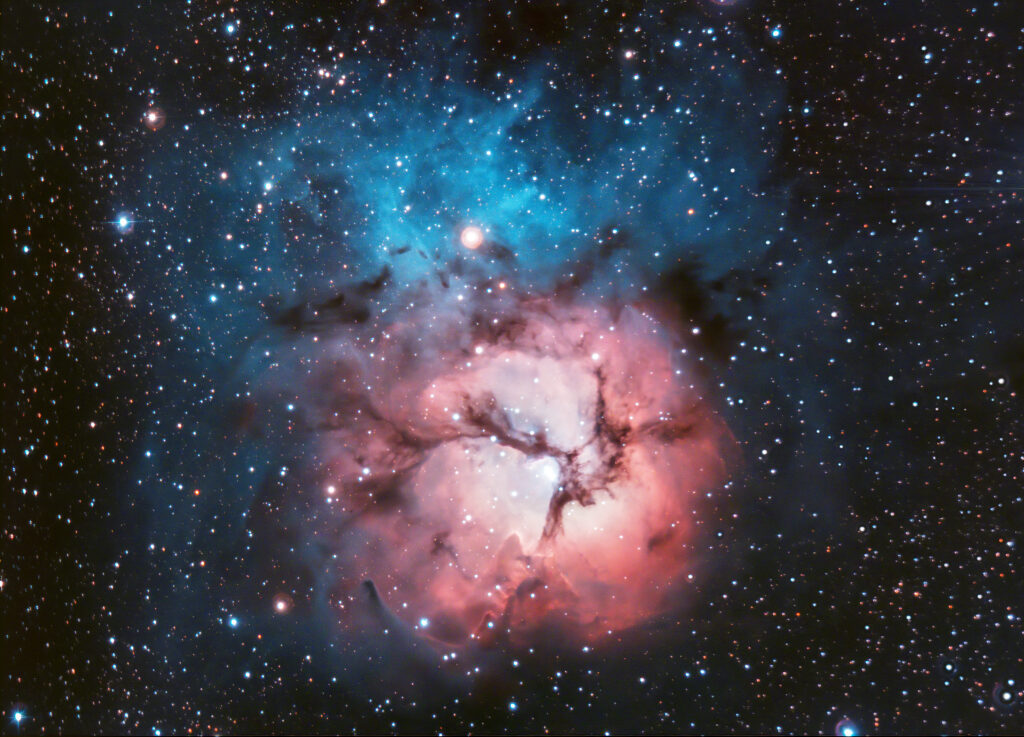
- A nebula is a giant cloud of dust and gas in space. Nebula is a distinct luminescent part of interstellar medium, which can consist of ionized, neutral, or molecular hydrogen and also cosmic dust.
- Some nebulae (more than one nebula) come from the gas and dust thrown out by the explosion of a dying star, such as a supernova. Other nebulae are regions where new stars are beginning to form. For this reason, some nebulae are called “star nurseries.”
- There are different kinds of nebulae based on their appearance {such as dark nebulae, reflection nebulae and planetary nebulae} or the physical processes that create them {such as protostellar nebulae, protoplanetary nebulae, or supernova remnants}.

Pulsars
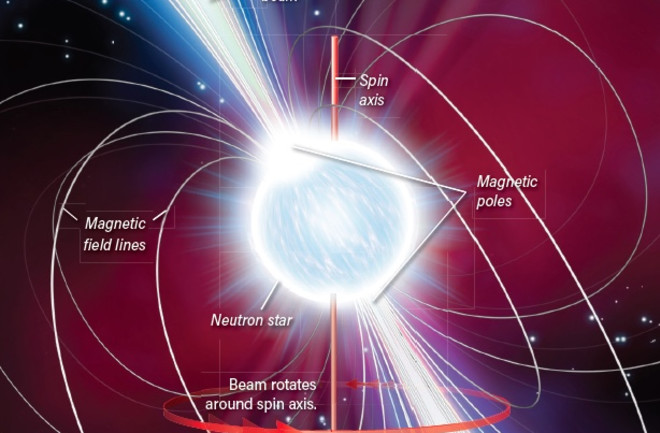
- Pulsars are neutron stars. Pulsars are rotating neutron stars observed to have pulses of radiation at very regular intervals that typically range from milliseconds to seconds. A pulsar is the crushed core of a massive star that ran out of fuel, collapsed under its own weight and exploded as a supernova.
Quasar
- Quasar refers to quasi-stellar radio source. They were thought to be stars earlier but they are not stars at all, but rather active galactic nuclei.
- Nowadays, the word “quasar” is often used to mean any Quasi-Stellar Object (QSO), whether or not it emits radio waves.
James Webb Space Telescope
- The telescope is the result of an international collaboration between NASA, the European Space Agency (ESA) and the Canadian Space Agency which was launched in December 2021.
- It is currently at a point in space known as the Sun-Earth L2 Lagrange point, approximately 1.5 million km beyond Earth’s orbit around the Sun.
- Lagrange Point 2 is one of the five points in the orbital plane of the Earth-Sun system.
- Named after Italian-French mathematician Josephy-Louis Lagrange, the points are in any revolving two-body system like Earth and Sun, marking where the gravitational forces of the two large bodies cancel each other out.
- Objects placed at these positions are relatively stable and require minimal external energy or fuel to keep themselves there, and so many instruments are positioned here.
- It’s the largest, most powerful infrared space telescope ever built.
- It’s the successor to Hubble Telescope.
- It can see backwards in time to just after the Big Bang by looking for galaxies that are so far away that the light has taken many billions of years to get from those galaxies to our telescopes.
- Objectives:
- It will examine every phase of cosmic history: from the Big Bang to the formation of galaxies, stars, and planets to the evolution of our own Solar System.
- The goals for the Webb can be grouped into four themes.
- The first is to look back around 13.5 billion years to see the first stars and galaxies forming out of the darkness of the early universe.
- Second, to compare the faintest, earliest galaxies to today’s grand spirals and understand how galaxies assemble over billions of years.
- Third, to see where stars and planetary systems are being born.
- Fourth, to observe the atmospheres of extrasolar planets (beyond our solar system), and perhaps find the building blocks of life elsewhere in the universe.