

Q. Which of the following have coral reefs?
- Andaman and Nicobar Islands
- Gulf of Kachchh
- Gulf of Mannar
- Sunderbans
Select the correct answer using the code given below.
- 1, 2 and 3 only
- 2 and 4 only
- 1 and 3 only
- 1, 2, 3 and 4
Answer: (a) 1, 2 and 3 only
Coral Reefs
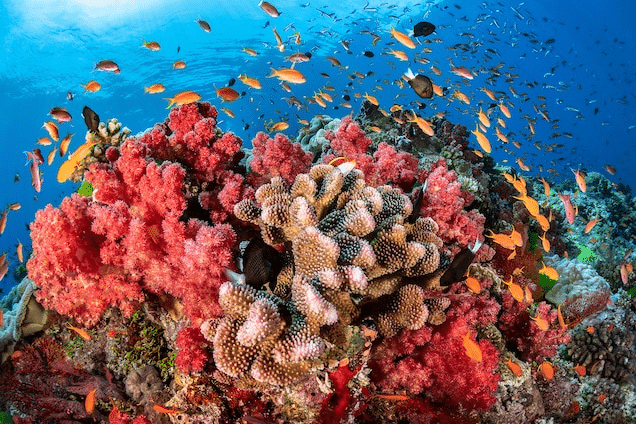
- Corals are nothing but calcareous rocks, formed from the skeletons of minute sea animals, called polyps.
- The polyps extract calcium salts from seawater to form hard skeletons which protect their soft bodies. These skeletons give rise to corals.
- The corals live in colonies fastened to the rocky seafloor. New generations develop on skeletons of dead polyps. The tubular skeletons grow upwards and outwards as a cemented calcareous rocky mass collectively called corals.
- The shallow rock created by these depositions is called a reef. These reefs, later on, evolve into islands.
- The corals Occur in different forms and colours, depending upon the nature of salts or constituents they are made of.
- The progressive development of corals appears over the sea surface in different forms over a period of time. Small marine plants (algae) also deposit calcium carbonate, thus contributing to coral growth.
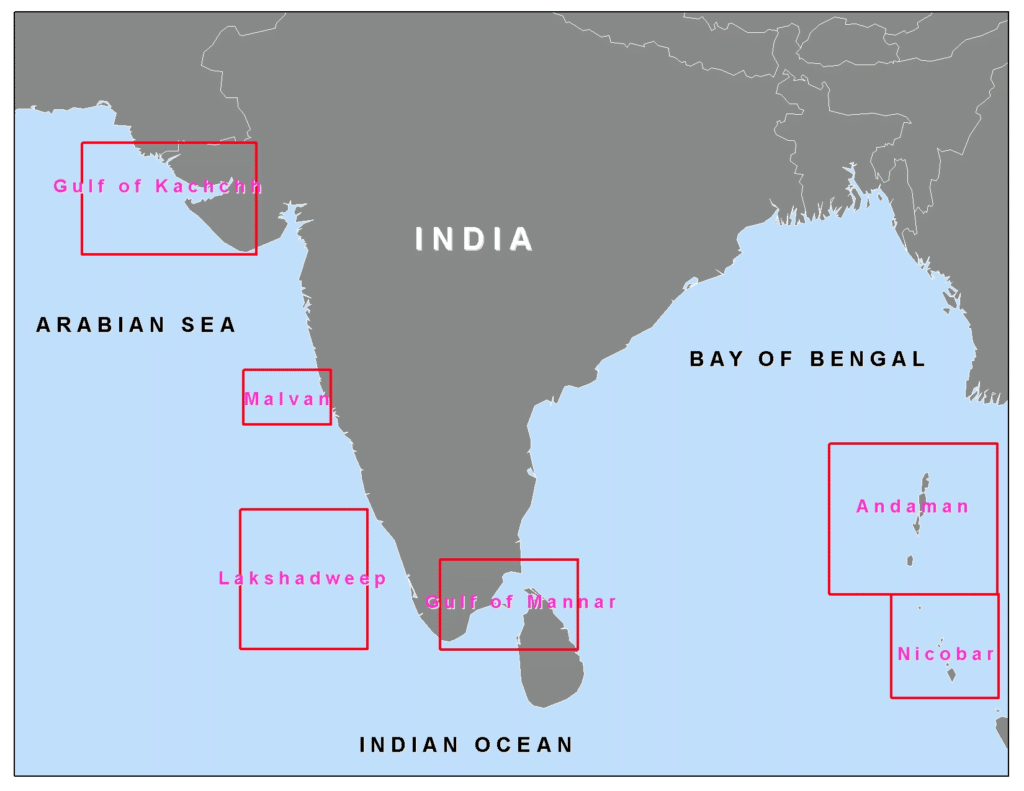
- Coral reefs in India are found in a lot of areas including the Gulf of Kutch, Gulf of Mannar, Palk Bay, Andaman & Nicobar and Lakshadweep Islands. The Gulf of Kutch in the northwest has some of the most northerly reefs in the world.
- Patches of coral reefs are also found in Ratnagiri, Malvan and Redi, south Bombay and at the Gaveshani Bank located in the west of Mangalore.
Ideal conditions for coral growth
- Corals thrive in tropical waters-between 30°N and 30°S latitudes.
- The ideal depths for coral growth are 45 m to 55 m below sea surface, where there is abundant sunlight available.
- The temperature of water should be around 20°C.
- Clear salt water is suitable for coral growth, while both fresh water and highly saline water are harmful for polyp growth.
- Adequate supply of oxygen and microscopic marine food, called plankton, is essential for growth and existence. As the food supply is more abundant on the seaward side, corals grow more rapidly on the seaward side.
Also Read: Coral Reefs & Coral Reefs Bleaching