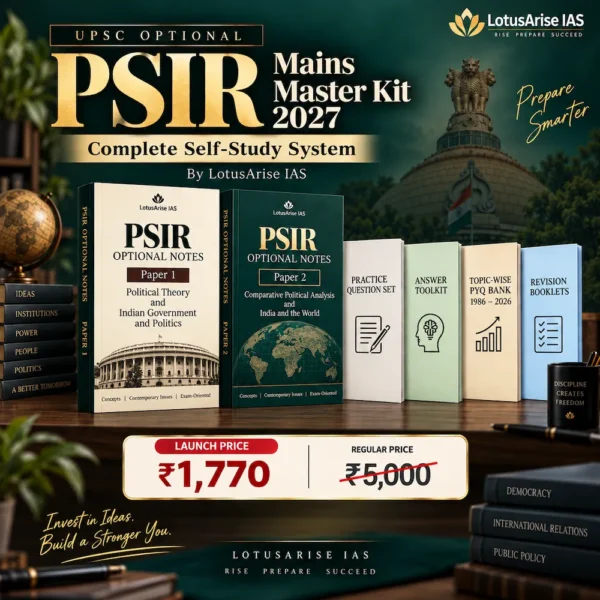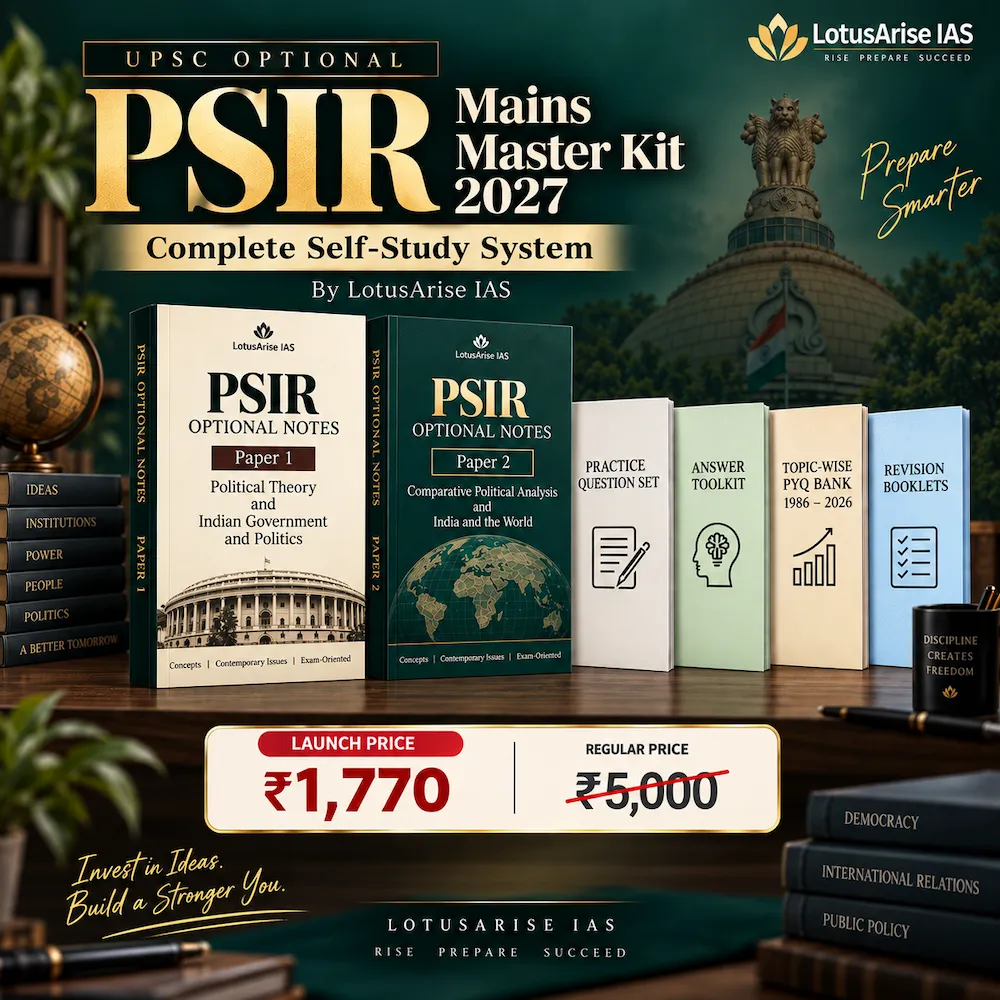
PSIR Optional Mains Master Kit 2027 — Complete Self-Study System by LotusArise IAS
Original price was: ₹5,000.00.₹1,770.00Current price is: ₹1,770.00.
₹1,770 — launch price for the PSIR kit. Regular price: ₹5,000
Most PSIR aspirants prepare the wrong way. Rawls from one book, his critics from another, India–China from last month’s newspaper. Then a 20-marker lands and there is no thinker to quote, no example to anchor it, no structure to hang it on.
PSIR Optional Mains Master Kit 2027 puts all of it in one system.
📚 Complete notes, Paper 1 & Paper 2 (available now) — 234 topics, 22 lakh+ words, online + PDF, verbatim PYQs after every topic
✍️ Practice question set (by Dec 2026) — syllabus-wise questions for timed answer writing
🧠 Answer toolkit + thinker and example banks (by Dec 2026) — intros, conclusions, frameworks, quotable lines, Indian examples
📊 Topic-wise PYQ bank 1986–2026 (available now) — four decades of questions; trend analysis and probables follow by Dec 2026
📝 Revision booklets (by Dec 2026) — every topic condensed for the final 60 days
🗓️ The notes and the PYQ bank are yours the day you enrol. Everything else releases in phases and is complete by 31 December 2026. Access valid until UPSC CSE Mains 2027.
One-time payment. No subscription. Instant access after purchase.
⭐⭐⭐⭐⭐ Trusted by 300,000+ UPSC aspirants monthly on LotusArise IAS
The PSIR problem most aspirants don’t talk about
Ask any PSIR aspirant six months into preparation what is going wrong. They won’t say the subject is dull. They won’t say there is too little material. They will say one of three things:
“I’ve read Rawls three times. When the question asks me to compare him with Sen and Nozick in 150 words, I freeze.”
“My Paper 2 notes stopped in 2022. Half of India’s foreign policy has changed since, and I don’t know which half.”
“I have four coaching sets, two IGNOU blocks and a folder of Telegram PDFs — and no idea which one to trust for which topic.”
These are not personal failings. PSIR rewards answers that combine a thinker, a concept, an Indian example and a current development, all within the word limit. Most aspirants have the content somewhere. What they lack is the system that puts it together.
PSIR Optional Mains Master Kit 2027 is that system.
Why PSIR is a strategically smart optional
PSIR carries 500 marks across Paper 1 and Paper 2, and very little of that preparation is wasted. Indian Government and Politics maps directly onto GS Paper 2 polity and governance. India and the World maps onto GS Paper 2 international relations. Political theory and Indian thought feed your Essay and your Interview.
Every hour you put into PSIR pays back across three or four papers. The subject is not the bottleneck. The integrated system is.
What’s available now and what’s coming
| Component | Status |
|---|---|
| 📚 Complete notes, Paper 1 & Paper 2 — 234 topics | Available now |
| ✍️ Practice question set | Releasing in phases, complete by 31 December 2026 |
| 📝 Revision booklets | Releasing in phases, complete by 31 December 2026 |
| 🧠 Answer toolkit + thinker and example banks | Releasing in phases, complete by 31 December 2026 |
| 📊 Topic-wise PYQ question bank, 1986–2026 | Available now |
| 📈 PYQ trend analysis + probables for 2027 | Releasing in phases, complete by 31 December 2026 |
Everything releases well before the final revision window, and all of it stays accessible until UPSC CSE Mains 2027.
What’s inside
📚 Complete PSIR Notes — 234 Topics, 22 Lakh+ Words (available now)
The full LotusArise IAS PSIR notes, as online premium articles and downloadable PDFs, covering every clause of the official syllabus.
Paper 1 — Political Theory, Indian Political Thought, Indian Government and Politics:
- Political theory and its approaches, theories of the state — liberal, neo-liberal, Marxist, pluralist, post-colonial, feminist
- Justice (Rawls and his critics), equality, rights, liberty, democracy — classical and contemporary
- Power, hegemony, ideology and legitimacy; liberalism, socialism, Marxism, fascism, Gandhism, feminism
- Indian thought — Dharmashastra, Kautilya, Buddhist tradition, Sir Syed, Aurobindo, Gandhi, Ambedkar, M N Roy
- Western thought — Plato, Aristotle, Machiavelli, Hobbes, Locke, J S Mill, Marx, Gramsci, Hannah Arendt
- The national movement, making of the Constitution, fundamental rights, DPSPs, amendment and basic structure
- Parliament, Prime Minister, President, Supreme Court, federalism, Panchayati Raj, constitutional and statutory bodies
- Party system, electoral behaviour, caste, religion, ethnicity, social movements
Paper 2 — Comparative Politics, International Relations, India and the World:
- Comparative politics — approaches, the state across economies, parties, pressure groups, social movements
- IR theory — realism, liberalism, Marxism, systems theory, constructivism, feminism, postcolonialism
- Key concepts — national interest, security, power, balance of power, deterrence, transnational actors
- The Cold War, Soviet collapse, unipolarity, the rise of China, Bretton Woods to the WTO, globalisation
- The UN — structure, Security Council, peacekeeping, specialised agencies, the reform debate
- Regionalism — EU, ASEAN, APEC, SAARC, BIMSTEC, the Americas, Africa, Eurasia
- Contemporary concerns — democracy, human rights, environment, gender justice, terrorism, nuclear proliferation
- Indian foreign policy — determinants, NAM, every South Asian neighbour, China, US, Russia, Japan, EU, West Asia, Africa, Latin America, Quad and the Indo-Pacific, the nuclear question, the UN seat, strategic autonomy
What makes these notes different from downloaded Telegram PDFs:
Every topic is written for answer writing, not academic reading. Thinkers, critiques and Indian examples sit side by side, so the comparison a question asks for is already on the page. Paper 2 is updated for developments through 2026. Every topic closes with the verbatim PYQs UPSC has asked on it, and the notes carry original diagrams for the concepts that are easier to see than to read.
✍️ Practice Question Set (by December 2026)
Syllabus-wise practice questions for timed answer writing, set on the themes UPSC returns to, not repeats of past papers. Built for the stage where you have read enough and need to write.
📝 Revision Booklets (by December 2026)
Each of the 234 topics condensed to its core arguments, thinkers and examples, for the last 60 days when full notes are too long to reread.
🧠 Answer Toolkit + Thinker and Example Banks (by December 2026)
- Ready introductions and conclusions for recurring question types
- Frameworks for “critically examine”, “comment” and India–X relations questions
- A thinker bank with key concepts, books and quotable lines for Paper 1
- An example bank of Indian cases and current data points for both papers
📊 Topic-wise PYQ Question Bank 1986–2026 (available now) + Trend Analysis and Probables (by December 2026)
Every PSIR question from 1986 to 2026, sorted topic-wise and ready the day you enrol, so you can see how UPSC has asked each topic across four decades. By December 2026, an analysis of which themes UPSC keeps returning to and a list of probable areas for 2027 are added.
The PSIR aspirant who buys this
First-time PSIR aspirants — You want one trusted resource from Day 1, not six books and three coaching sets. Start with the notes today, and move to practice questions and revision booklets as they arrive.
Repeaters who scored 230–270 — The reading is done. The gap is thinker integration, current Paper 2 content and answer structure. The notes fix the first two, the toolkit and practice set the third.
Aspirants with a different optional — The Indian Government and Politics and India and the World notes are directly useful for GS Paper 2. Many aspirants use PSIR material purely for that overlap.
Self-study aspirants outside Delhi — You don’t need to be in Mukherjee Nagar, Prayagraj or Jaipur, or pay ₹15,000–₹54,000 for classroom coaching. The kit gives you the structured content for self-study.
Working professionals — No batch schedule, offline PDFs, access until Mains 2027. Study in the hours you actually have.
Why not just use free notes from Telegram or Reddit?
Free PSIR notes exist. They are widely shared. Most aspirants have gigabytes of PDFs they have never systematically read.
The difference is not the content — it is the system. Random downloads stop at whatever year they were typed, carry no thinker comparisons, no Indian examples, no link to the questions UPSC has actually asked, and nothing to practise or revise from.
If you have the discipline to build your own integrated system from scattered sources, you may not need this. If you want a system that is already built — open it and start — this is what the Mains Master Kit is for.
Similar PSIR courses cost ₹6,999–₹54,000 elsewhere.
Total if bought separately: ₹3,680 ==> PSIR Mains Master Kit 2027: ₹1,770
One-time payment. No subscription. No recurring charge. Instant access to the notes and the PYQ bank after payment; remaining components added to your account as they release, all by 31 December 2026. Check your spam folder if the access email doesn’t arrive. For support: support@lotusarise.com | WhatsApp: 9005064862