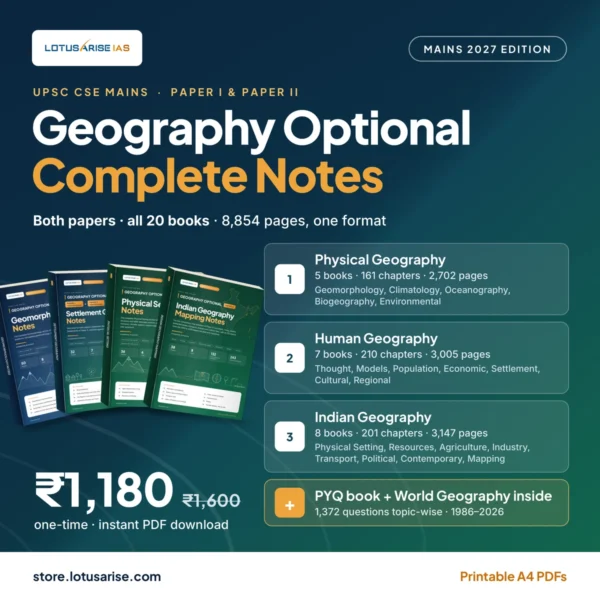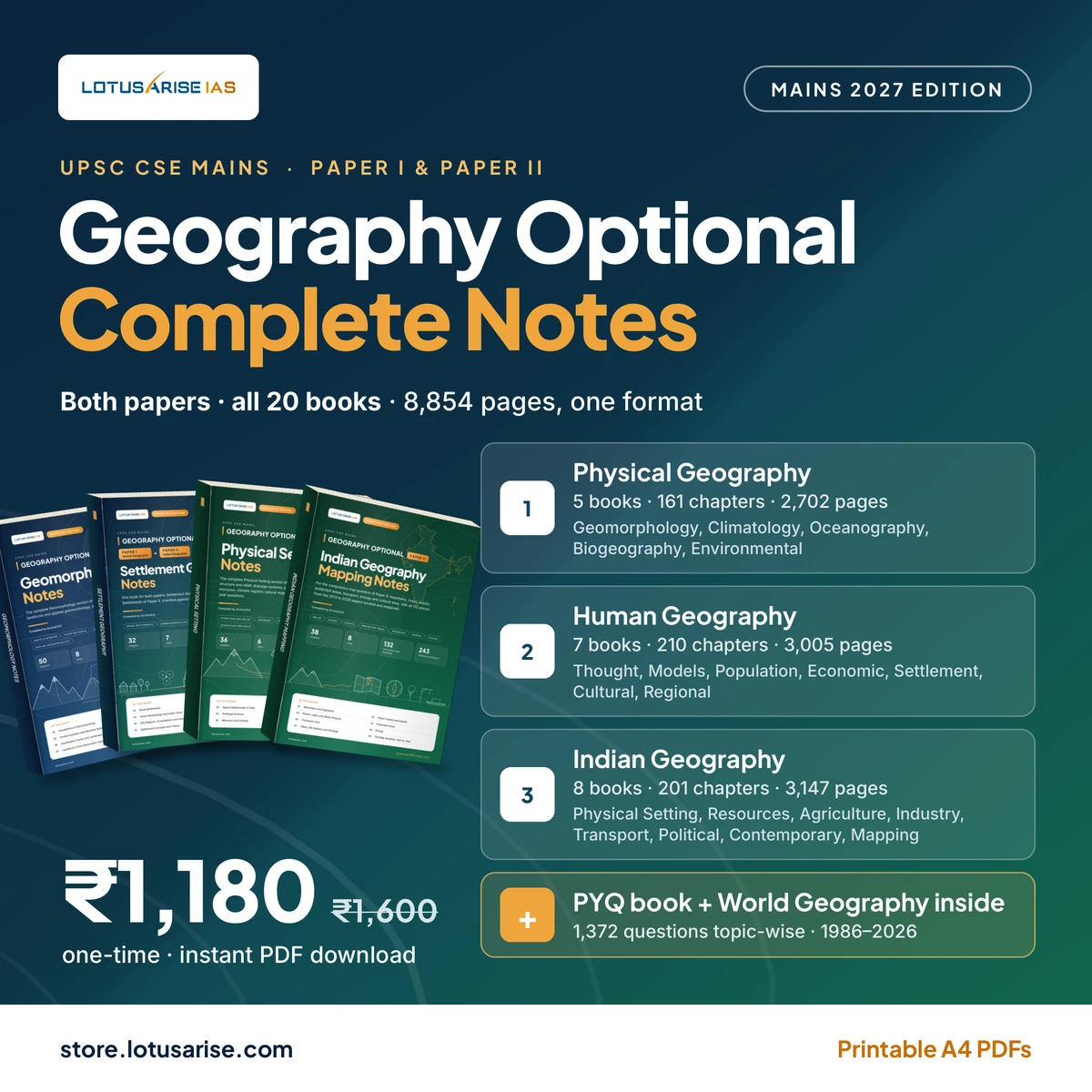
OFFER: Geography Optional Complete Notes (PDF) – UPSC Mains (Paper I & II)
Original price was: ₹1,600.00.₹1,180.00Current price is: ₹1,180.00.
₹1,180 (offer price). MRP ₹1,600 for 20 books and 7,511 pages — about 16 paise a page. Mains 2027 Edition.
Most Geography Optional aspirants do not run short of notes. They run short of one set. Paper I from one place, Paper II from another, PYQs in a third file, the map question kept for the last month.
Geography Optional Complete Notes puts both papers into one format, each book marked against what UPSC has asked.
📝 PYQs updated to Mains 2026 — 219 in Physical Setting, 177 in Settlement Geography, 160 in Geomorphology, and a topic-wise PYQ book of 1,372 questions
🧭 572 chapters across 20 books — all 20 syllabus units of both papers
📍 All 132 places from the 2013 to 2026 map questions — located and explained in the Mapping book
🗺️ 2,750 diagrams and figures — clear enough to redraw
📱 22 PDF downloads — the 20 books, World Geography & Mapping Notes and topic-wise PYQs; any device, offline, printable
One-time payment. No subscription. Unlimited downloads, no expiry. No mentorship, evaluation or live classes.
⭐ Read by 300,000+ UPSC aspirants every month on LotusArise IAS
The problem most aspirants don’t talk about
Ask a Geography Optional aspirant what is slowing them down a few months into preparation. They won’t say the subject is too hard. They will say one of three things:
“I have Paper I from one source, Paper II from another and PYQs in a third file. None of them follow the same order.”
“I keep telling myself the map question is for the last month. It is 20 marks every year.”
“I cannot tell what I am still missing, so I keep downloading more.”
None of this is a lack of effort. What is missing is one set that covers the syllabus end to end, in one format, marked against what UPSC has asked. Geography Optional Complete Notes is that set.
Why this is a smart place to spend your hours
Our own ten-year count, 2017 to 2026, found 540 questions carrying 7,790 marks, with the marks split almost evenly between the two papers. That count leaves out the map. 18 of the 20 syllabus units were asked in every one of those years, and the other two missed one year each. The 20-mark map question appears in every Paper II. There is no safe unit to drop.
The papers also feed each other. The 2026 question on El Niño and the Indian monsoon sits in both Climatology and Physical Setting.
The challenge is not the subject. It is having the whole of it in one place that you can actually revise.
What’s inside — 7,511 pages in 20 books, plus two extra PDFs
🌍 Paper I, Physical Geography — 5 books, 2,273 pages, 161 chapters
- Geomorphology — 698 pages, 50 chapters, 160 PYQs: plate tectonics, Davis and Penck, channel morphology, slopes, landforms
- Climatology — 314 pages, 30 chapters, 119 PYQs: heat budget, monsoon theories, cyclones, Köppen, global warming
- Oceanography — 304 pages, 24 chapters, 95 PYQs: ocean floors, currents, marine resources, coral bleaching, UNCLOS
- Biogeography — 353 pages, 23 chapters, 88 PYQs: soils, biomes, deforestation, agroforestry, Vavilov’s gene centres
- Environmental Geography — 604 pages, 34 chapters, 118 PYQs: ecosystems, pollution, biodiversity, net zero, legislation
🧠 Paper I, Human Geography — 4 books, 1,335 pages, 124 chapters
- Geographical Thought — 436 pages, 43 chapters, 79 PYQs: schools of thought, Quantitative Revolution, radical to welfare approaches, HDI
- Models, Theories and Laws — 244 pages, 18 chapters, 94 PYQs: Von Thünen, Weber, Christaller, Rostow, Heartland and Rimland
- Population Geography — 359 pages, 34 chapters, 112 PYQs: fertility, age-sex pyramids, migration, ageing, policy
- Economic Geography — 296 pages, 29 chapters, 98 PYQs: world resources, energy crisis, agricultural typology, food security, world trade
🤝 Combined books for both papers — 3 books, 1,120 pages, 86 chapters
- Settlement Geography — 407 pages, 32 chapters, 177 PYQs: Settlement Geography of Paper I and Settlements of Paper II; urban morphology, sprawl, slums, town planning
- Cultural Setting — 321 pages, 27 chapters, 119 PYQs: Cultural Setting of Paper II with the demographic topics of Paper I; tribes, languages, cultural regions, migration
- Regional Development and Planning — 392 pages, 27 chapters, 150 PYQs: Regional Planning of Paper I and Regional Development of Paper II; imbalance, multi-level planning, watersheds
🧭 Paper II, Indian Geography — 8 books, 2,783 pages, 201 chapters
- Physical Setting — 559 pages, 36 chapters, 219 PYQs: frontiers, Himalaya, river systems, monsoon, floods, soils
- Resources — 322 pages, 25 chapters, 124 PYQs: water, minerals, coal and petroleum, solar and wind, forests, wildlife
- Agriculture — 361 pages, 29 chapters, 99 PYQs: land reforms, cropping pattern, Green Revolution, dryland farming, agro-climatic zones
- Industry — 331 pages, 26 chapters, 63 PYQs: textiles, iron and steel, corridors, multinationals, SEZs, tourism
- Transport, Communication and Trade — 191 pages, 13 chapters, 74 PYQs: roads, railways, ports, trade balance, space programme
- Political Aspects — 159 pages, 14 chapters, 80 PYQs: federalism, new states, boundaries, water disputes, Indian Ocean
- Contemporary Issues — 229 pages, 20 chapters, 106 PYQs: hazards, pollution, soil erosion, food security, globalisation
- Indian Geography Mapping — 631 pages, 38 chapters, 132 places: built for the compulsory map question, with all 132 places from the 2013 to 2026 papers
🎁 Two extra PDFs
- World Geography & Mapping Notes, 2027 Edition — 318 pages, 14 chapters: continents, straits, rivers, mountains, boundaries, places in the news. Written for Prelims and GS Paper I.
- Geography Optional PYQs Topic-wise 1986–2026 — 171 pages: 1,372 questions in 20 units with marks, year-wise papers 2013–2026, ten-year pattern charts
Free samples: Geomorphology · Climatology · Oceanography · Biogeography · Environmental Geography · Geographical Thought · Models, Theories and Laws · Population Geography · Economic Geography · Settlement Geography · Cultural Setting · Regional Development and Planning · Physical Setting · Resources · Agriculture · Industry · Transport, Communication and Trade · Political Aspects · Contemporary Issues · Indian Geography Mapping
What makes this different from a downloaded PDF? Each chapter is marked against the questions UPSC has actually asked on it. A PYQ radar at the start shows how many times the topic has come and when it last did. Year tags sit on the headings UPSC has asked about. Faint highlights pick out key points, definitions and PYQ terms, and a PYQ list closes the chapter.
Some chapters appear in two books because the subject belongs in both: Central Place Theory in Models and in Settlement, Floods in Physical Setting and in Contemporary Issues. The page and chapter totals count each book as it stands. PYQ counts are given book by book and should not be added, because one question can sit in two books.
One thing to be clear about: the books give the previous year questions, not model answers. Solved answers are in the Geography Optional 300+ Score Pack.
The aspirant who buys this
First-timers — You want the whole optional in one place from day one, so you never have to ask what is still missing.
Repeaters — You have read the subject. Go through the PYQ list at the end of each chapter, then use the topic-wise PYQ book to sit full papers against the clock.
Aspirants short of time before Mains — The contents pages show the PYQ count for every chapter, and the radar, year tags and highlights show you what to read first.
Self-study aspirants outside Delhi, Prayagraj and Jaipur — No classroom and no batch. You get organised books that you can read anywhere, and print for handwritten practice.
Working professionals — One chapter at a time on your phone, offline, with no schedule and no expiry.
Why not just use free notes from Telegram?
Free notes exist, and most aspirants already have several. Many of these topics are also on our own website, free to read.
The difference is not that free material is wrong. It is that nothing ties it together. A forwarded PDF rarely tells you which of its pages UPSC has asked about, and nobody tells you what it leaves out. Here you get one format across both papers, every PYQ placed under its chapter, and files you can keep and print.
If you have the time to build and maintain your own file from scattered sources, you may not need this. If you would rather open one set and start revising, this is what it is for.
The price
₹1,180 (offer price). MRP ₹1,600. 20 books, 7,511 pages, 572 chapters and 2,750 diagrams and figures, at about 16 paise a page, plus the two extra PDFs.
Bought singly, the same files cost ₹2,568: 20 books at ₹118 each, plus the two extra PDFs at ₹149 and ₹59.
This is a PDF notes pack. It does not include mentorship, evaluation or live classes.
One-time payment. No subscription. No recurring charge.
Each book is a separate PDF download, listed on your order. The download links reach your email right after payment — please check your spam folder if you do not see them. Unlimited downloads, no expiry. English medium.
Read the free sample first (PDF)
For support: support@lotusarise.com