The Mongol Threat to India during the Sultanate Period

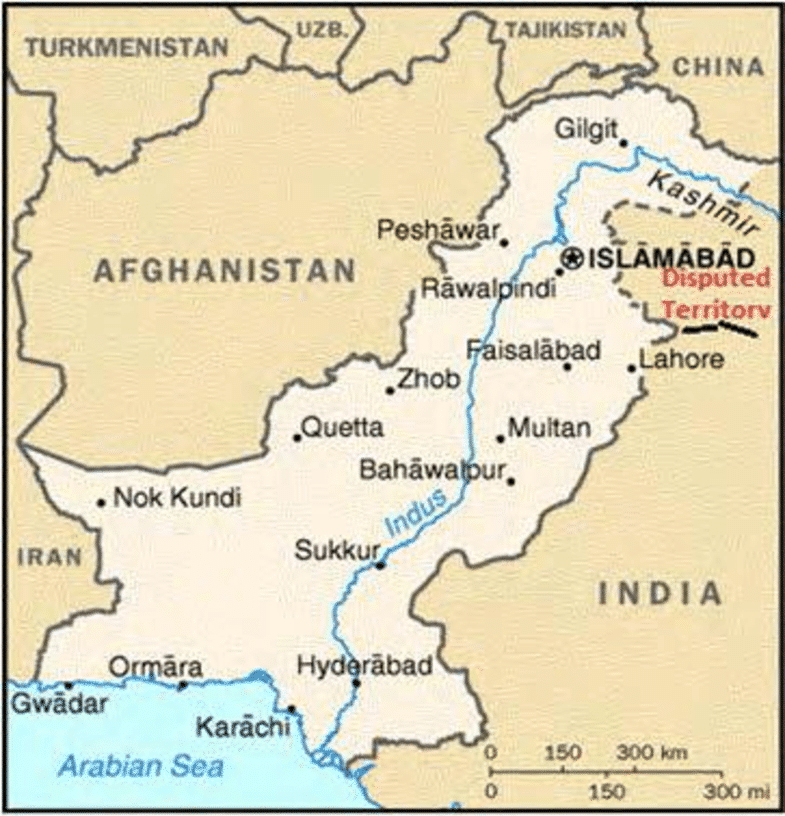
- Although India was defended in the North and North-West by an extensive range of mountains — the Himalayas and their extensions — the low mountains of the North-West were pierced by traditional entry points such as the Khyber and Bolan passes.
- Afghanistan and its neighbouring areas held enormous strategic importance for India, since they functioned as a staging ground for any invasion of the subcontinent — indeed, an attack on Afghanistan formed the first stage of both the Ghaznavid and Ghurian conquests of North India.
- This article traces the Mongol threat to India during the Sultanate period — beginning with the strategic significance of the Khyber–Bolan frontier, then following Professor K.A. Nizami’s influential framework of three distinct phases in the Sultanate’s response (Aloofness, Appeasement, and Resistance), before assessing the threat’s ultimate legacy for Indian defence policy.
The Khyber and Bolan Pass: Strategic Significance
- For the Delhi Sultans, control over the Kabul–Ghazni–Qandahar line, flanked by the Hindukush, mattered for two key reasons:
- It helped stabilise the “scientific frontier.”
- It connected India to the major silk route running from China through Central Asia and Persia.
- The Mongol onslaught, however, compelled the Delhi Sultans to retreat for safety along the Chenab, while the cis-Sutlej region became the principal cockpit of confrontation.
- As a result, the “Indus remained only the cultural boundary of India,” and for all practical purposes, the actual line of control was confined to territory west of the Indus.
- A viable defensive line in the north-west could, at this stage, still be provided either by the Indus itself, or by the Koh-i-Jud (Salt Ranges), which lay on the Indian side of the Indus.
- Over time, and in stages, the Mongols breached these successive lines of defence, eventually reaching the river Beas — posing a genuinely serious threat to the Sultanate of Delhi.
- Following the Ghurian conquest, it might reasonably have been expected that Ghur and Ghazni would provide an effective shield against future invasions of India. However, the separation of India from Ghur and Ghazni, and the subsequent conquest of that area — first by Khwarizm Shah, and then by the Mongols — completely transformed India’s strategic position.
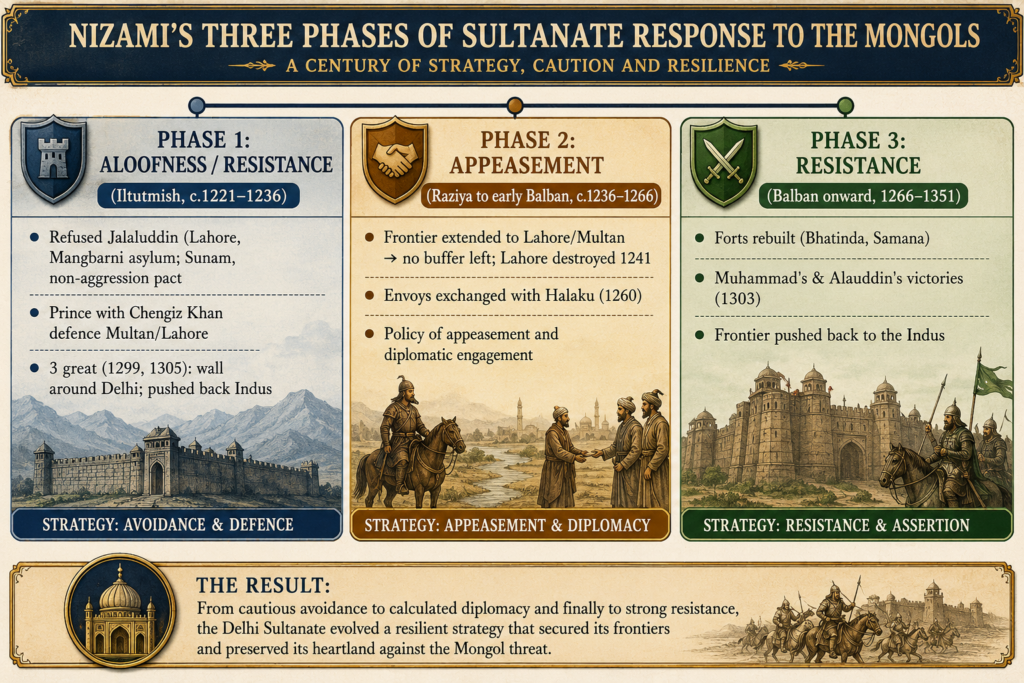
- Professor K.A. Nizami has categorised the Sultanate’s evolving response to the Mongol challenge into three distinct phases: Aloofness, Appeasement, and Resistance.
Phase I: Aloofness
- Iltutmish followed this policy of deliberate aloofness from Mongol affairs.
- The Mongol threat first appeared as early as AD 1221, when Chengiz Khan, having destroyed the Khwarizmi empire, reached the borders of India.
- In 1221, Chengiz lingered around the Indus for three months, having defeated the Khwarizmi prince Jalaluddin Mangbarni at the Battle of the Indus, after pursuing him from Samarkand.
- Jalaluddin subsequently crossed the Indus and entered India’s cis-Indus region, forming an alliance with the Khokhars, who dominated the tract up to the Salt Ranges.
- The Mongol commander Bala pursued Jalaluddin across the Punjab, attacking outlying towns such as Bhera and Multan, and even sacking the outskirts of Lahore.
- Jalaluddin regrouped and sought an alliance — or even asylum — with Iltutmish, but was turned down, on the stated grounds that the climate “was not suitable for him.”
- Minhaj Siraj records that Iltutmish subsequently led an expedition against Mangbarni, though the latter avoided any direct confrontation, finally leaving Indian soil in AD 1224.
- Ata-Malik Juvayni (1226–1283), in his Tarikh-i Jahan Gusha, offers two explanations for the factors that compelled Iltutmish to adopt this policy of “aloofness”:
- Iltutmish sensed genuine danger from Mangbarni, who might “gain an ascendancy over him and involve him in ruin.”
- Iltutmish was equally conscious of the underlying weaknesses of the Sultanate itself.
- Chengiz Khan is reported to have sent his own envoy to Iltutmish’s court.
- Before departing the region, Chengiz sent word to Iltutmish that he had abandoned his plan of sending an army into Hindustan, choosing instead to return to China via Gilgit or Assam.
- This suggests Chengiz had indeed contemplated a full invasion of North India, but abandoned the idea — either because of Iltutmish’s refusal to assist Jalaluddin, or because of a rebellion in Turkistan that demanded his immediate attention.
- So long as Chengiz Khan remained alive (d. AD 1227), Iltutmish avoided any expansionist policy in the north-west — suggesting an implicit understanding of mutual non-aggression may have been reached between the two sides.
- Following Chengiz’s death, the Mongols themselves remained preoccupied for some time with internal affairs and the ongoing conquest of Khurasan and Iran, leaving little attention for India.
- In 1234, however, Oktai, Chengiz’s successor in Turkistan, resolved to invade Hind and Kashmir.
- Iltutmish advanced as far as Banyan in the Salt Ranges to counter this threat — but fell ill along the way, returned to the capital, and died shortly afterward.
Note: The Struggle for Koh-i-Jud
- Soon after Iltutmish’s death, Wafa Malik, the former governor of Ghazni (previously ousted by the Mongols), entered India and captured the entire Koh-i-Jud (Salt Ranges) tract.
- This provocation invited renewed Mongol attacks — the Mongols duly ousted Wafa Malik and brought the whole of Koh-i-Jud under their own control.
- A prolonged struggle followed between Wafa Malik’s Qarlugh dynasty and the Mongols for control of Koh-i-Jud and Multan, with the Sultans of Delhi intervening whenever the opportunity arose.
- By 1246, the Qarlughs were forced to quit India entirely — but by this point, Koh-i-Jud had itself become a Mongol bastion, serving as a base for further Mongol attacks on India.
Phase II: Appeasement
- The shift from Iltutmish’s “aloofness” to a policy of “appeasement” resulted directly from the extension of the Sultanate frontier up to Lahore and Multan, which exposed the Sultanate to direct Mongol incursions, with no buffer state remaining between them.
- Raziya’s discouraging response to a proposed anti-Mongol alliance — put forward by Hasan Qarlugh of Bamyan — is itself an indicator of this appeasement-oriented policy.
- This policy of non-aggression stemmed primarily from two factors:
- The partitioning of Chengiz’s empire among his sons, which weakened overall Mongol power.
- The Mongols’ own ongoing pre-occupation in West Asia.
- Between 1240 and 1266, the Mongols for the first time embarked on a genuine policy of annexation in India, bringing the earlier “golden phase” of mutual non-aggression to an end. This shift is attributable to:
- A significant change in the situation across Central Asia.
- The Mongol Khan of Transoxiana, finding it increasingly difficult to challenge the might of the Persian Khanate, was left with little alternative but to try his luck in India instead.
- In 1241, the Mongols under Tair Bahadur invaded Lahore and completely destroyed the city.
- The Turkish governor was ill-prepared to withstand a siege, further hampered by the fact that many local inhabitants — merchants who regularly traded with Mongol territories — were themselves unwilling to assist him, fearing Mongol reprisals.
- There was, moreover, little realistic hope of assistance from Delhi, which remained in a state of confusion following the death of Raziya.
- The governor consequently abandoned the city. After capturing it, the Mongols met with genuinely stiff resistance from Lahore’s citizens, and many Mongols — including Tair Bahadur himself — were killed.
- In vengeance, the Mongols killed or enslaved the city’s entire population and devastated Lahore, before suddenly retreating on hearing of the death of the Mongol Qa’an, Ogtai.
- Although Lahore was subsequently reoccupied by Delhi, the city remained in a ruined condition for the next twenty years, repeatedly sacked either by the Mongols or their Khokhar allies.
- This was followed by two further invasions in AD 1245–46.
- Although Balban favoured a bold policy of clearing the entire area up to Koh-i-Jud of both the Mongols and their Khokhar allies, persistent factionalism within the Turkish nobility limited what could actually be accomplished.
- As a result, the frontier commanders of Multan and Sindh were largely left to fend for themselves — some ultimately came to terms with the Mongols, even establishing themselves as independent rulers under Mongol overlordship.
- Despite Balban’s best efforts as naib during the reign of Sultan Nasiruddin Mahmud, the effective Sultanate frontier during AD 1244–66 stood no further than the river Beas.
- Fortunately for Delhi, the Mongols had by this time already committed to conquering China, concentrating their main efforts on Iraq, Syria, and Egypt — leaving local Mongol commanders to plunder India only with such resources as they could muster independently. The Sultans of Delhi were, in this sense, fortunate not to face the full brunt of Mongol power.
- Although Balban favoured a bold policy of clearing the entire area up to Koh-i-Jud of both the Mongols and their Khokhar allies, persistent factionalism within the Turkish nobility limited what could actually be accomplished.
- The policy of appeasement nonetheless continued for some time.
- In AD 1260, an envoy from Halaku to Delhi was well received, and this diplomatic gesture was reciprocated in kind.
- Balban, seeking to limit Mongol depredations through a combination of military and diplomatic measures, sent (as naib) his own envoy to Halaku, the Mongol Il-Khan of Iran — by this point the most important figure among Chengiz’s successors.
- Halaku sent a return embassy in 1260, which received a grand and impressive reception from Balban.
- Halaku is said to have strictly ordered his own officers not to invade India — though this assurance should not be given undue weight, since his energies remained firmly devoted to the conquest of Iraq, Syria, and Egypt, having in fact suffered a serious setback in 1260, defeated by an Egyptian army.
- Interestingly, at around the same time, an envoy was also received from Barka Khan, one of the most powerful Mongol figures, and a bitter rival of Halaku.
- In this complex diplomatic situation, Halaku simultaneously despatched his own intendants (shuhna) to Sindh and the Koh-i-Jud region, effectively claiming overlordship there — implying, in turn, that the Sultans of Delhi would not attempt to disturb Mongol control over Sindh and the areas west of Lahore.
- In AD 1260, an envoy from Halaku to Delhi was well received, and this diplomatic gesture was reciprocated in kind.
Phase III: Resistance
- This decisive shift in Delhi’s Mongol policy becomes clearly visible from Balban’s reign onward.
- By the time Balban ascended the throne in 1266, Halaku had already died, effectively ending the earlier goodwill between the Mongols and the ruler of Delhi — even though the underlying situation on the ground had not fundamentally changed.
- Balban’s cousin, Sher Khan — warden of the marches, holding the iqtas of Lahore, Sunam, and Dipalpur — continued to act as a shield against the Mongols.
- By and large, Balban remained based in Delhi, concentrating his energies primarily on keeping the Mongols at bay, at least beyond the river Beas.
- Barani records that when two nobles, Tamir Khan and Adil Khan, urged Balban to pursue an expansionist policy and conquer Malwa and Gujarat, Balban firmly replied: “When the Mongols have occupied all lands of Islam, devastated Lahore, and made it a point to invade our country once in every year… if I move out of the capital, the Mongols are sure to avail themselves of the opportunity by sacking Delhi and ravaging the Doab. Making peace and consolidating our power in our own kingdom is far better than invading foreign territories while our own kingdom is insecure.”
- The Mongols nonetheless remained able to cross the Beas with some frequency. Initially, Balban adopted a genuinely forward policy:
- After clearing the roads in the doab, he marched his army toward Koh-i-Jud, ravaging the mountainous tract and its neighbouring areas, and capturing a large number of horses — a haul substantial enough to trigger a sharp decline in horse prices in Delhi.
- Balban employed both “force and diplomacy” against the Mongols, taking several concrete measures to strengthen his defensive line:
- Forts at Bhatinda, Sunam, and Samana were reinforced to check any Mongol advance beyond the Beas.
- In 1270, he ordered the fort of Lahore rebuilt, appointing architects to reconstruct the city.
- Soon afterward, however, Balban had Sher Khan — whom he suspected of harbouring ambitions of independence — poisoned, and entrusted defence of the frontier tracts instead to his eldest son, Prince Muhammad.
- Prince Muhammad proved an able and energetic commander: throughout the remaining years of Balban’s reign, his defensive arrangements at Multan and Lahore — with the river Beas as the operative line of military defence — successfully held firm.
- Barani notes that the Mongols no longer dared attack across the Beas, since their forces could not match those of Prince Muhammad (from Multan), Bughra Khan (from Samana), and Malik Barbak Bakatarse (from Delhi).
- Balban succeeded in occupying Multan and Uchh, though his forces remained under sustained Mongol pressure across Punjab.
- Every year, Prince Muhammad led fresh expeditions against the Mongols. He was ultimately killed in 1285 outside Multan, fighting bravely against a surprise Mongol attack.
- The prince’s death was a heavy personal blow to Balban, who had designated him as his intended successor — though it did not fundamentally alter the ground realities regarding the Mongol threat.
- Every year, Prince Muhammad led fresh expeditions against the Mongols. He was ultimately killed in 1285 outside Multan, fighting bravely against a surprise Mongol attack.
- The last Mongol attack under Balban’s successors came in 1288, when Tamar Khan ravaged the country from Lahore to Multan, though the Mongols retreated as soon as they learned of the approach of imperial forces.
- Thus, up to 1290, the Mongols continued to dominate western Punjab, with the river Beas functioning as the effective frontier.
- They also continually threatened Multan and Sindh, though they never mounted a serious offensive directly toward Delhi — allowing the Sultanate to survive, but only through constant vigilance and military preparedness.
Jalaluddin Khalji
- A final invasion by the Iranian branch of the Mongols occurred in 1292, when a Mongol army led by Abdullah, a grandson of Halaku, invaded India.
- Jalaluddin Khalji, who had just ascended the throne, advanced with a large force. After some skirmishing, the Mongols agreed to withdraw without a fight, suggesting some form of tacit agreement between the two sides.
- Jalaluddin held a cordial meeting with Abdullah, and a party of Mongols headed by Ulaghu (another grandson of Halaku) embraced Islam, along with 4,000 of his followers — who were permitted to settle near Delhi with their families, and to whom the Sultan even married one of his own daughters.
- These converts, together with a further band of 5,000 Mongols who had entered India in 1279, became known as “Nau (Neo) Muslims.”
- These cordial relations suggest a tacit understanding not to disturb the status quo, effectively leaving the Mongols in possession of West Punjab.
- Jalaluddin Khalji, who had just ascended the throne, advanced with a large force. After some skirmishing, the Mongols agreed to withdraw without a fight, suggesting some form of tacit agreement between the two sides.
- Changes within Mongol domestic politics, however, soon created a new situation in which the Mongols posed, for the first time, a genuinely serious danger to Delhi.
- The rise of the Ogtai-Chaghtai branch of the Mongols brought important changes: the Mongol chief Dawa Khan set out on a course of conflict with the Mongol Qa’an of Iran, overran Afghanistan, and extended his authority as far as the river Ravi.
Alauddin Khalji
- The first signs of a new Mongol policy emerged in 1297–98, when a Mongol army sent by Dawa Khan crossed not only the Beas but the Sutlej, leaving the road to Delhi seemingly open.
- Alauddin sent a large army under his trusted commander Ulugh Khan, who met and completely routed the Mongols near Jullundhar — the most convincing straight-fight victory any Delhi Sultanate army had yet achieved over the Mongols.
- A similar victory followed the next year, when Zafar Khan, another favoured commander of Alauddin, defeated the Mongols who had captured Siwistan in lower Sindh.
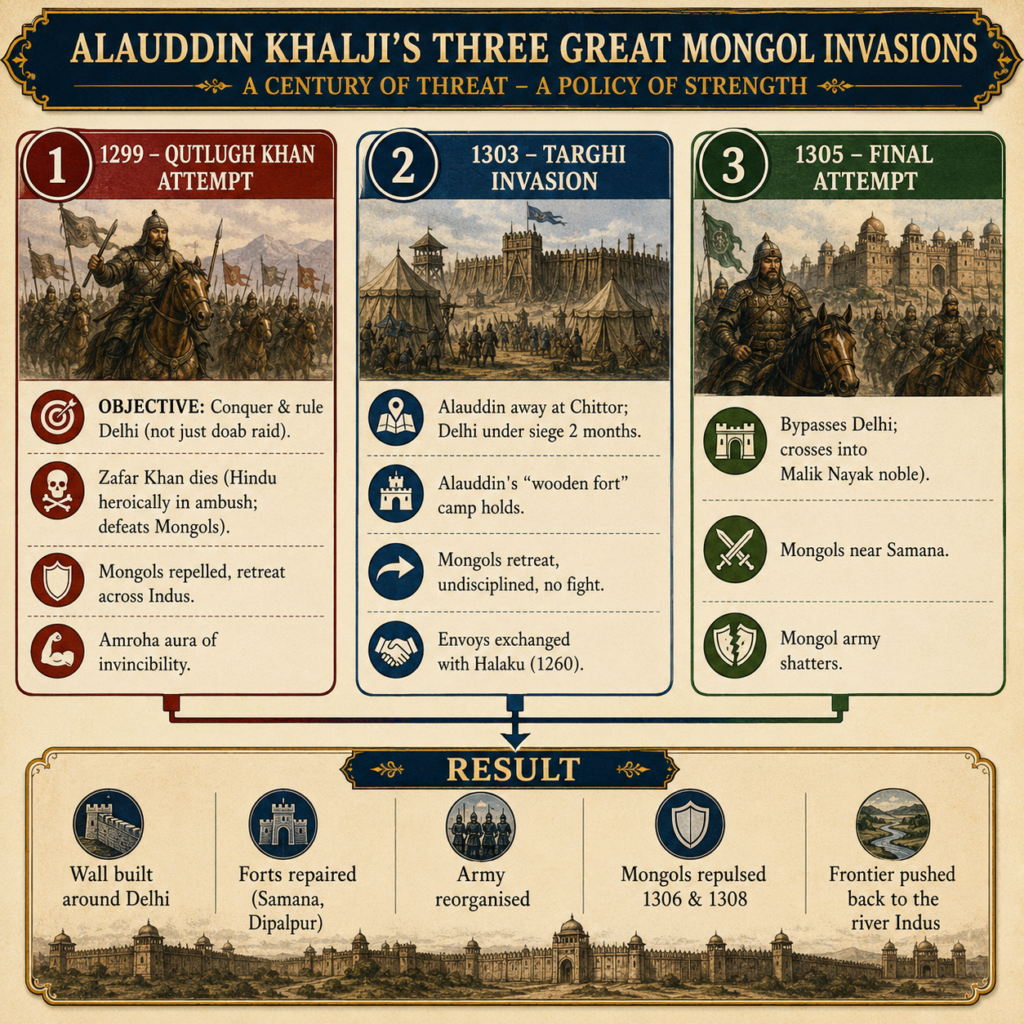
- These successive victories seem to have lulled Alauddin into a false sense of security regarding the Mongol threat — which is why he was caught genuinely unprepared when, in 1299, the Mongols invaded India under Qutlugh Khan (Qutlugh Khwaja), son of the Mongol ruler Dawa Khan — a determined attempt to ravage Delhi itself for the first time.
- Unlike earlier campaigns, the Mongols this time deliberately spared the countryside and towns along the way, their explicit objective being the conquest and rule of Delhi itself.
- On hearing of their approach, Alauddin quickly assembled an army and took up a position outside Siri, while the Mongols entrenched themselves at Killi, six miles north of Delhi.
- Many people from the surrounding countryside took shelter within Delhi itself, which grew extremely crowded, with provisions becoming scarce as food caravans from the doab stopped arriving.
- Alaul Mulk, the kotwal of Delhi, advised Alauddin to play a patient waiting game, inducing the Mongols to retire peacefully — since his army consisted largely of Hindustani soldiers unaccustomed to fighting the Mongols’ distinctive tactics of feigned retreat and ambush.
- Though Alauddin rejected this advice as unbecoming of a ruler’s prestige, he nonetheless issued strict instructions for his officers to hold their positions and not engage the Mongols without direct orders.
- Zafar Khan, however, eager for battle, attacked the Mongol contingent facing him — the Mongols duly feigned retreat, and once Zafar Khan had pursued them several miles, an ambush party cut off his retreat and surrounded him; Zafar Khan and all his followers died fighting.
- Although the Mongols won this initial engagement, Zafar Khan’s firmness convinced Qutlugh Khan that he could neither break Alauddin’s main lines nor capture Delhi itself. After two days of further skirmishing, he retreated from Delhi and swiftly recrossed the Indus — Alauddin did not attempt pursuit.
- From this first attack onward, Delhi became a regular Mongol target.
- In 1303, the Mongols advanced on Delhi a second time, under Targhi.
- Marching rapidly and encountering little resistance, the Mongols hoped to surprise Delhi, since Alauddin was away on his Chittor campaign at the time.
- The attack proved severe, inflicting large-scale destruction; the capital itself had been further weakened, since another army had been sent toward Warangal via Bengal and returned badly battered.
- With the Mongols having seized all the fords across the Jamuna, no reinforcements from the doab could reach Delhi despite royal summons.
- Alauddin emerged from Siri with all available forces, taking up a strongly defended position resting on the river Jamuna on one side and the old city of Delhi on the other — further reinforced by a surrounding ditch, lined with wooden planks, giving his camp, in Barani’s words, the appearance of a “fort made of wood.”
- The Mongols, unwilling to attack this fortified position, instead hovered around Delhi, generating great fear among the citizens amid an acute shortage of fuel and grain.
- These later Mongols, however, proved considerably less disciplined than their predecessors — coming to drink at tanks outside Delhi and selling cheap corn to residents, thereby inadvertently easing the food shortage. After two months of this ultimately futile siege, the Mongols withdrew once more without a fight.
- In 1305, the Mongols mounted a third and final desperate attempt at conquering Hindustan.
- Crossing the Indus, the Mongol army marched rapidly across Punjab, burning towns at the foothills of the Siwaliks, before crossing into the doab, bypassing Delhi entirely.
- Alauddin, whose army was now considerably stronger, sent a force of 30,000 under the Hindu noble Malik Nayak, who — according to the poet Amir Khusrau — had earlier served as governor of Samana and Sunam.
- A number of Muslim officers were placed directly under his command — a telling indicator of how far the social base of the Turkish Sultanate had broadened since the days of Balban.
- Malik Nayak met the Mongols near Amroha (north-west modern UP) and inflicted a crushing defeat, finally shattering the aura of Mongol invincibility in India.
- These constant Mongol attacks ultimately jolted Alauddin into decisive, permanent action:
- A protective wall around Delhi was built for the first time.
- All old forts along the Mongol invasion route were repaired, with strong military contingents stationed at Samana and Dipalpur.
- He undertook a broader reorganisation of internal administration and worked to recruit a large standing army.
- As a result, the Mongols were decisively repulsed in both 1306 and 1308 — Barani notes that whenever the Mongols subsequently attacked Delhi or its neighbouring regions, they were defeated.
- A further factor behind the Mongol reversal was the death of Dawa Khan in 1306, followed by civil war within the Mongol Khanate itself — which significantly weakened Mongol power going forward.
- Areas previously devastated by the Mongols were gradually brought back under the plough.
- Lahore and Dipalpur became effectively impassable barriers for the Mongols.
- The regional commander Tughlaq Shah (Ghazi Malik) launched a series of successful attacks on Mongol-held areas in West Punjab, pushing as far as the Indus — according to Barani, the Mongols no longer dared cross the river.
- Alauddin, in sum, not only successfully defended Delhi and the doab from the Mongol threat, but created the conditions under which India’s north-western frontier could be pushed back from the river Beas and Lahore all the way to the river Indus — a genuinely significant achievement.
- Even so, the underlying threat to India could not be considered fully eliminated, so long as the Mongols continued to dominate Afghanistan and its neighbouring territories — and indeed, after Alauddin’s death, the Mongol threat to India revived.
- In 1303, the Mongols advanced on Delhi a second time, under Targhi.
Later Invasions: From Ghiyasuddin Tughluq to Muhammad bin Tughluq
- In 1320, Dalucha Khan entered the Kashmir valley and devastated it — killing all the men, selling the women and children, and burning every house. Fortunately, the invading Mongol force itself perished in a snow blizzard while retreating from Kashmir eight months later.
- Ghiyasuddin Tughluq: shortly after his accession to the throne (1320), two Mongol armies reached Sunam and Samana, marching as far as Meerut — both were defeated with great slaughter.
- Muhammad bin Tughluq:
- The last significant Mongol invasion occurred under the leadership of Tarmashirin, during the reign of Sultan Muhammad Tughluq.
- In 1326–27, the new Mongol Khan Tarmashirin again invaded India — Ghiyasuddin Tughluq (still contemporary in this narrative) marched against him, pushing him back across the Indus, which remained thereafter the effective frontier with the Mongols.
- The boldest effort to counter the Mongol threat came from Muhammad bin Tughluq himself, who shortly after his accession recruited an army of 375,000 men for what became known as the Khurasan expedition.
- The intended effect of this campaign was the conquest of Kabul, Ghazni, and neighbouring areas — the very regions described earlier as staging theatres for the invasion of India.
- Like several of his other ambitious projects, however, Muhammad bin Tughluq’s enterprise failed, even at the planning stage.
- Even so, Muhammad bin Tughluq was among the few Turkish sultans of India to demonstrate genuine strategic insight regarding the north-west frontier. It was precisely the subsequent neglect of these strategic factors that ultimately led to Timur’s invasion of India in 1399.
- The last significant Mongol invasion occurred under the leadership of Tarmashirin, during the reign of Sultan Muhammad Tughluq.
Conclusion
- Taken as a whole, the Mongol threat to India during the Sultanate period lasted for almost a century, steadily gaining in intensity until it reached its climax during the reign of Alauddin Khalji.
- The Mongol incursions led to the virtual loss of western Punjab beyond Lahore for much of the second half of the 13th century — creating a serious threat to Delhi and the doab, much as the Ghaznavids had once posed.
- Unlike the Rajput rulers of the period, however, the Sultans of Delhi organised their resources and carried out a genuinely far-reaching restructuring of their economy specifically to meet the Mongol threat.
- They nonetheless failed in the broader task of building a truly viable defensive line based on Afghanistan to stem future incursions — a task later undertaken, more successfully, by the Mughals.
- Even so, the Delhi Sultans ultimately succeeded in managing the Mongol problem and keeping their kingdom fundamentally intact — a genuine testament to the underlying strength of the Sultanate.
- Finally, the Mongol destruction of Central and West Asia had one significant, if unintended, positive consequence for India: it triggered a large-scale migration of scholars, mystics, artisans, and others to Delhi, transforming the city into a great centre of Islamic culture.